
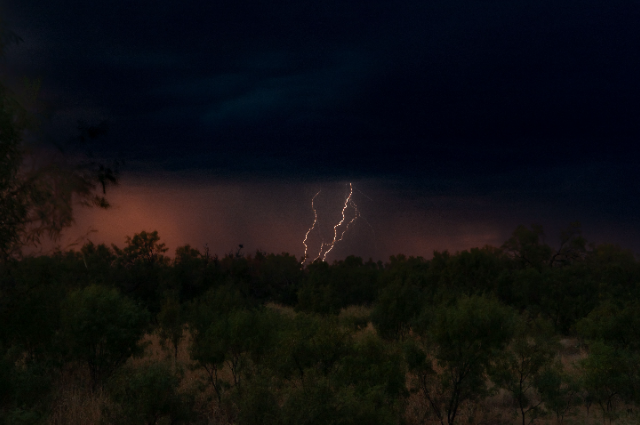
Most people experience a thunderstorm as noise and light: a flash across the sky, a rumble that follows a few seconds later, and the rush to get indoors before the rain arrives. Few stop to consider that the very same bolt rattling their windows is also quietly performing one of nature's oldest acts of agricultural generosity. Lightning, it turns out, is a fertiliser factory in the sky, and every storm that rolls across a field is leaving something behind in the soil long after the thunder fades.
Why Nitrogen Needs a Push
The atmosphere is full of nitrogen. Nearly four-fifths of the air people breathe is nitrogen gas, yet plants cannot use any of it in that form. The two nitrogen atoms in an atmospheric nitrogen molecule are bound together by one of the strongest chemical bonds in nature, a triple bond that resists almost everything short of extreme heat or industrial-scale pressure. As Wikipedia's overview of nitrogen fixation explains, this is precisely why nitrogen, despite its abundance overhead, behaves more like a locked vault than an available nutrient until something forces it open.
That something, in nature, is most often lightning. A single bolt can momentarily reach temperatures several times hotter than the surface of the sun, and according to an explainer published by Northern Woodlands, a strike carries roughly a billion joules of energy, enough electricity to power a household appliance for weeks. Even the powerful triple bond holding nitrogen together cannot withstand such a sudden, overwhelming surge of energy.
From Broken Bonds to Usable Nutrients
Once a lightning strike splits the nitrogen molecule apart, the freed atoms do not stay alone for long. They react almost immediately with surrounding oxygen, forming nitrogen oxide compounds that themselves are still unusable to plants. As these compounds cool and drift through the storm, they undergo a second transformation. Nitrogen oxide reacts with oxygen to form dioxide, which then combines with water vapour in the clouds to form nitrous or nitric acid.
It is this final chemical step that turns a violent electrical discharge into something a farmer would recognise as fertiliser. When the resulting acids reach the ground, they react with the soil to produce nitrates, a form of nitrogen that plant roots can actually absorb and use. The University of Wisconsin's Weather Guys put it simply: the raindrops falling during a thunderstorm are not just water; they are carrying dissolved nitrate compounds straight into the ground where root systems are waiting.
This entire sequence, from a torn-apart nitrogen molecule to a nitrate sitting in moist soil, happens within the span of a single storm. It is a remarkably fast nutrient cycle compared to the alternative routes nitrogen normally takes to reach a plant's roots.
How Much Nitrogen Are We Talking About?
The scale of this natural fertilisation is larger than most people assume. Researchers at the Walking Mountains Science Centre estimate that lightning fixes somewhere between three and ten teragrams of nitrogen globally every year, a quantity the centre compares to the combined weight of more than half a million elephants. Reporting on agricultural patterns in India found that monsoon thunderstorms can deposit between five and eight kilograms of nitrogen per hectare during a single rainy season, with the effect being strongest during the first major storms after a dry spell, a pattern researchers refer to as the first-flush effect.
This natural process predates industrial agriculture by millions of years and remains active alongside it today. Long before synthetic fertilisers existed, lightning and soil bacteria were the only two mechanisms capable of converting atmospheric nitrogen into a usable form, and lightning has a distinct advantage that bacteria lack: reach. Soil bacteria are limited to wherever they happen to live, but lightning distributes nitrogen far more broadly, reaching remote grasslands, forests, and fields where nitrogen-fixing microbes may be sparse or absent.
A Process Scientists Are Now Trying to Copy
Lightning's efficiency at breaking nitrogen's stubborn bond has not gone unnoticed by chemists and engineers. Industrial fertiliser production today relies almost entirely on the Haber-Bosch process, a method that combines nitrogen and hydrogen under extreme heat and pressure to manufacture ammonia. It is effective, but it is also energy-hungry, consuming a notable share of the world's total energy supply, largely because the hydrogen it requires typically comes from fossil fuels.
In response, some researchers have begun experimenting with lightning-inspired alternatives. A study published in the journal Chemosphere demonstrated that a controlled electrical discharge in a laboratory setting, essentially a miniature, manmade lightning bolt, could dramatically raise the nitrogen content of treated soil within minutes, suggesting a possible lower-energy path toward sustainable fertiliser production. Separately, engineering teams covered by Technology Networks have built reactors that mimic lightning's electrical discharge to produce ammonia using only air, water, and renewable electricity, with the explicit goal of avoiding the fossil-fuel dependence built into conventional fertiliser manufacturing.
These efforts are a reminder that some of the most promising solutions to modern problems are not new inventions at all, but careful attempts to copy a process the atmosphere has been running for as long as storms have existed.
Nature's Quiet Bargain
Some about the fact that a storm's most destructive-looking moment, a bolt of lightning tearing across the sky, is simultaneously its most generous. The same flash that can split a tree or knock out power lines is also splitting apart one of the most stubborn molecules in the atmosphere and setting it on a short journey toward becoming plant food. By the time the thunder has faded and the clouds have moved on, the soil below has already received its quiet, invisible gift: a fresh dose of nitrogen, delivered free of charge, exactly where it is needed most.
References
- Nitrogen fixation. Wikipedia. https://en.wikipedia.org
- Does lightning add nitrogen to the soil? The Weather Guys, University of Wisconsin-Madison. https://wxguys.ssec.wisc.edu
- How lightning fertilises soil with atmospheric nitrogen fixation. 13newsnow.com. https://www.13newsnow.com
- Splitting the Air: The Unexpected Chemistry of Lightning. Northern Woodlands. https://northernwoodlands.org
- From Flash to Fertiliser: How Lightning Feeds Plants. Walking Mountains Science Centre. https://www.walkingmountains.org
- Thunderstorms and Fertile Soil: How Lightning Fixes Nitrogen in India's Farms. Medium. https://medium.com
- Electrical discharge assisted nitrogen fixation: An alternative to chemical fertilisers. ScienceDirect (Chemosphere). https://www.sciencedirect.com
- Eco-Friendly Reactor Uses Lightning to Make Green Ammonia. Technology Networks. https://www.technologynetworks.com