
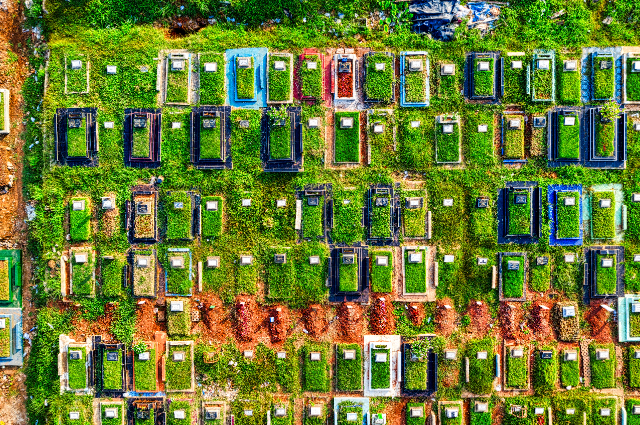
In the farming villages of Chau Ninh commune, in Vietnam's Hung Yen province near Hanoi, white crosses have begun appearing on gravestones. Each painted X carries the same quiet message: the family has come, dug up the remains of their parents, grandparents or children, and carried them away. The cemetery is being emptied grave by grave, not because of war, flood or disease, but to clear ground for a $1.5 billion Trump-branded luxury golf resort.
The project, Trump International Hung Yen, is the Trump family business's first venture in Vietnam, developed in partnership with the Vietnamese real estate firm Kinhbac City. Announced with a groundbreaking ceremony in May 2025, it promises championship golf courses, five-star hotels and luxury residential estates across roughly 2,446 acres of what is today agricultural land growing bananas, longan and other fruit. Eric Trump declared the resort would be "the envy of all of Asia," and provincial authorities have embraced it as a chance to put Hung Yen on the global investment map. For the roughly 4,000 households in its path, the view is very different.
The Cost Measured in Graves
Vietnamese authorities have moved with striking speed. Official progress reports indicate that surveys and inventories have been completed on more than 501 hectares, compensation paid on over 83 hectares, and more than 3,500 graves already relocated. In Vietnamese culture, ancestral graves are not simply plots of land. They are sacred sites bound up with filial piety, bloodlines and wartime memory, resting on the fundamental belief that the dead should not be disturbed. Forcing families to exhume their own relatives, however efficiently administered, inflicts a loss that no compensation schedule can price.
The compensation on offer has deepened the wound. Hoang Do, a 72-year-old villager, received 70 million dong, about $2,660, to move the remains of his son and his parents. "It's painful," he told the Financial Times. "I'm outraged by the compensation price." When the project was first announced, Reuters reported that some farmers were offered as little as $12 for roughly ten square feet of land, approximately $3 per square metre for ground that represents both their livelihood and their heritage. One woman said she was offered around $3,200 and rice in exchange for her entire farm.
For others, the objection is not financial at all. Hoang Anh Xa, 50, has five family members buried in the cemetery marked for clearance. "The grave of my great-grandparents has been there since 1967, before the establishment of this country, so why should I move them?" he asked. His grievance captures the community's careful position: villagers insist they do not oppose the government or the Party; they ask only for fair land prices and respect for their dead. "I won't be able to find another job," Xa added, pointing to the second loss that follows the first: when the farmland goes, so do the livelihoods built on it.
Where Diplomacy Meets the Fairway
What makes Hung Yen more than a local land dispute is its timing and its politics. The resort took shape as Hanoi negotiated with a Trump administration that had threatened tariffs of up to 46 per cent on Vietnamese exports, an existential threat to an export-driven economy. Analysts and local commentators have noted that welcoming a Trump-branded mega-project sends an unmistakable signal of goodwill toward a president known for transactional diplomacy. The White House maintains that the president has no role in his family's business operations, citing a trust managed by his children; financial disclosures nonetheless show that income from Trump business ventures ultimately accrues to him. The Trump Organisation, for its part, says it is not responsible for compensation payments, which are handled by local authorities, yet it is expected to operate the resort once built.
The arrangement distributes benefits and costs with uncomfortable clarity. The national government gains diplomatic leverage; the province gains prestige and investment; the developers gain the Trump brand's premium in a rising market. The villagers of Chau Ninh gain an average of a few thousand dollars, the obligation to dig up their ancestors, and an uncertain future without land or comparable work. They were never asked to vote on any of it.
What Gets Erased
Resistance has already delayed the original timeline, which envisioned a functioning resort by 2027, and commentators warn that pressing ahead without meaningful consultation risks converting quiet grief into lasting resentment. The deeper question Hung Yen poses extends well beyond Vietnam: what happens when the machinery of state diplomacy and global luxury development converges on a community with no power to negotiate? Development always has a price. The test of its legitimacy is who is made to pay it, and whether they had any say. In Chau Ninh, the answer so far is written in white paint on emptied graves: the dead have moved, the living have complied, and the fairways will be green by the time anyone asks whether it was worth it.
References:
- The Vietnamese Magazine — "Graves for a Golf Course: The Social Cost of Trump International Hung Yen" (June 2026): https://thevietnamese.org
- The Daily Beast — "Graves Dug Up in Vietnam to Make Way for Trump's Golf Course" (May 2026): https://www.thedailybeast.com
- The Mirror US — "'It's painful:' Local families scramble as graves dug up for Trump golf course in Vietnam" (May 2026): https://www.themirror.com
- Sunday Guardian — "'Disturbing Graves': Vietnam Moves the Dead to Make Way for Trump's $1.5B Golf Course" (May 2026): https://sundayguardianlive.com
- Atlanta Black Star — "Trump's Luxury $1.5B Golf Project Sparks Fury After Families Are Paid Pennies" (June 2026): https://atlantablackstar.com
- Irish Star — "Donald Trump's measly payout to families as he digs up graves for golf course laid bare" (May 2026): https://www.irishstar.com
- Original reporting referenced throughout: Financial Times and Reuters (via the sources above).