
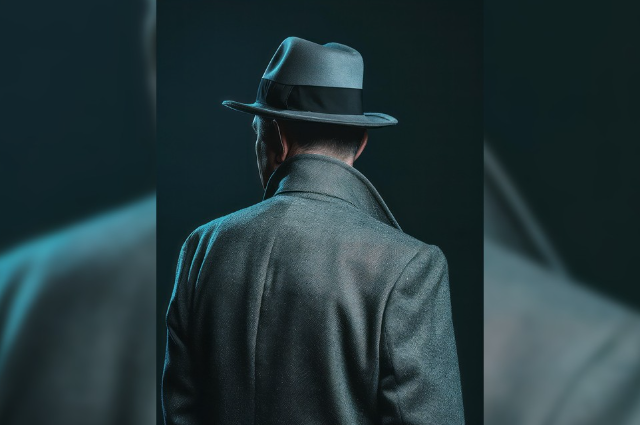
Image by TAI-Design from Pixabay
"The bravest soldiers are not always those who fight on the battlefield. Some fight in silence, without medals, recognition or even their own identity."
India's freedom and security have been protected not only by the soldiers we proudly salute but also by countless invisible heroes whose names never appear in history textbooks. These men and women lived in the shadows, accepted impossible missions, and sacrificed everything so that millions of Indians could live in peace. Among these unsung patriots stands one extraordinary man whose story is filled with courage, sacrifice, and heartbreaking tragedy—Ravindra Kaushik, remembered as India's Black Tiger.
Born on 11 April 1952 in Sri Ganganagar, Rajasthan, Ravindra Kaushik was an ordinary young man with extraordinary talent. He loved acting, mimicry, and theatre during his college days at SD Bihani College. His ability to imitate voices, master languages, and perform confidently on stage caught the attention of Indian intelligence officers during the early 1970s. At a time when India had just witnessed the wars with Pakistan and national security was of the highest importance, these qualities made him an ideal candidate for one of the most dangerous professions in the world—a covert intelligence officer for the Research and Analysis Wing (RAW).
Kaushik underwent years of rigorous training in Delhi. His mission demanded much more than physical courage. He had to erase his old identity and build a new life from scratch. He mastered Urdu, studied Pakistani culture, traditions, geography, and Islamic practices so thoroughly that no one would suspect he was an Indian. Under the new identity of Nabi Ahmed Shakir, he entered Pakistan, reportedly studied law at Karachi University, and eventually secured a position connected with the Pakistani military establishment. According to several published accounts, his exceptional performance enabled him to rise to an influential rank and secretly pass highly valuable military intelligence to India for several years. His contributions were considered so significant that he earned the codename "Black Tiger," a title said to have been bestowed in recognition of his exceptional service.
Every piece of information he sent home strengthened India's security. Yet every passing day also increased the danger to his own life. Unlike soldiers who fight with uniforms and weapons, spies fight with silence, deception, and constant fear. One mistake means imprisonment, torture, or death. Ravindra Kaushik accepted this risk without hesitation because he believed that the nation was greater than any individual. His patriotism was not expressed through speeches or slogans but through unimaginable personal sacrifice. He left behind his family, abandoned his identity, and lived every day knowing that discovery could cost him everything.
However, fate took a cruel turn in 1983. According to widely reported accounts, another Indian operative was captured by Pakistani authorities and, during interrogation, revealed information that exposed Kaushik's identity. Soon afterwards, Ravindra Kaushik was arrested on charges of espionage. The man who had spent years protecting his country suddenly found himself completely alone inside enemy prisons. He was initially sentenced to death, though the sentence was later commuted to life imprisonment. Over the following years, he was shifted between several Pakistani prisons, where he reportedly endured severe torture, harsh conditions, illness, and unimaginable suffering. Yet despite everything, he never returned to the country for which he had sacrificed his youth and his future.
Perhaps the most heartbreaking part of his story lies in the letters he wrote from prison. In one of them, he painfully asked, "Is this what those who sacrifice their lives for a great country receive?" Another reported letter expressed the sorrowful thought that had he been an American, he might have been rescued much sooner. Whether one agrees with these sentiments or not, they reveal the loneliness of a man who had devoted every moment of his life to serving India. His family repeatedly appealed for help, but because intelligence operations are highly secretive, governments rarely acknowledge or negotiate publicly for captured spies. Ravindra Kaushik remained imprisoned until his health deteriorated. Suffering from tuberculosis and heart disease, he passed away in Mianwali Central Jail in 2001, far away from his homeland, without ever embracing his family again.
The story of Ravindra Kaushik is not merely the story of a spy. It is the story of a patriot who willingly surrendered his identity, his family, his dreams, and ultimately his life for the safety of more than a billion people. While many of the operational details surrounding his mission remain classified or disputed, there is little doubt that he served India with exceptional courage. His life reminds us that patriotism is not measured only by waving the national flag or singing the national anthem. True patriotism means placing the nation above personal comfort, recognition, and even survival. As citizens of independent India, we enjoy freedoms secured by known heroes and unknown guardians alike. Ravindra Kaushik was one of those silent guardians. His name deserves to be remembered with honour, gratitude, and respect—not because he sought fame, but because he gave everything for the nation without expecting anything in return. India may never fully repay his sacrifice, but as Indians, we can ensure that the legacy of the Black Tiger is never forgotten.
References
- India Today. (2026). For Ravindra Kaushik, India's Real Dhurandhar in Pakistan, It Didn't End Well.
- The Indian Express. (2019). Raj Kumar Gupta to Helm Biopic on Indian Spy Ravinder Kaushik.
- NDTV. (2026). Who Was Ravindra Kaushik, RAW's "Black Tiger" and the Original Dhurandhar.
- The Economic Times. (2025). Ravinder Kaushik: The Indian Spy Who Became a Major in the Pakistan Army.
- V.K. Singh. India's External Intelligence: Secrets of Research and Analysis Wing (RAW). (Book)