
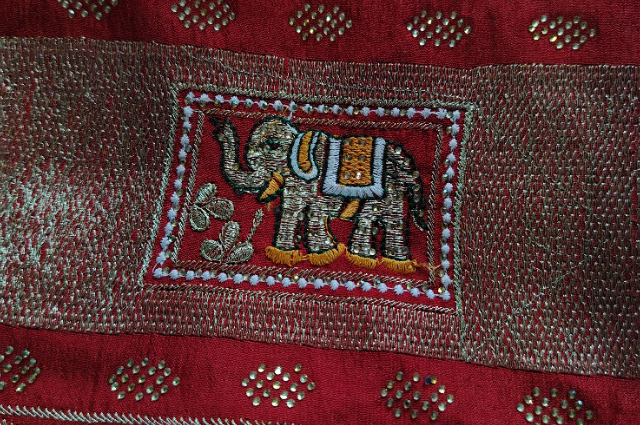
In a quiet room in Kutch, Gujarat, a woman bends over a piece of fabric with a needle between her fingers, concentrating on a design that may take days or even months to complete. There is no roaring machine beside her, no factory conveyor belt and no industrial mechanism capable of reproducing the precise rhythm of her hands. There is only fabric, thread, needle, colour and an inherited knowledge that has travelled through generations. Every small movement of the needle creates another fragment of a cultural vocabulary that existed long before contemporary fashion discovered the commercial value of Indian craftsmanship. Across India, thousands of artisans continue to practise embroidery traditions that have been preserved largely through families and communities. Kutch embroidery, Chikankari, Phulkari and Kantha are not merely decorative techniques; they are repositories of memory, identity and social history. India's official handicrafts portal notes that hand embroidery has ancient roots, while different regions developed distinctive traditions including Chikankari in Uttar Pradesh, Kantha in Bengal and Phulkari in Punjab. In Kutch, embroidery historically belonged to women's everyday lives, appearing on clothing, dowry textiles and household objects. The work could communicate community, marital status, social identity and aesthetic preference without requiring written language. A garment therefore became more than something to wear; it became a visual record of belonging. For many artisans, learning embroidery begins at home rather than in an institution. A young girl observes her mother, grandmother, aunt or elder sister handling thread and gradually learns how a particular stitch should look and feel. The knowledge is transmitted through observation, repetition and correction rather than through formal textbooks. In some communities, children grow up surrounded by embroidery before they fully understand its economic significance. The craft becomes part of domestic life before it becomes a profession. Yet behind the romance of handmade textiles lies an immense amount of labour. An artisan must maintain concentration, eyesight, hand control and patience for hours. She may work after completing household responsibilities, particularly when embroidery is home-based. The resulting garment can appear effortless to the customer precisely because the artisan has concealed the effort within thousands of small stitches. India's embroidered textiles therefore deserve to be viewed not simply as fashion products but as evidence of human skill. Each finished piece carries the time, memory and discipline of the person who made it.
The story becomes particularly powerful in Kutch, where embroidery has long functioned as a form of cultural expression among women. The region is home to numerous communities, each possessing distinctive embroidery vocabularies, motifs, stitches and colour combinations. Kala Raksha Producer Company describes artisans from communities including Rabari, Marvada, Sameja, Maru Meghwal, Garasia, Jat and Mutava, whose embroidery traditions have been practised for generations. What appears to an outsider as colourful decoration can therefore contain information about community and identity. Government documentation on Kachchh explains that traditional embroidery historically helped women create clothing for themselves and their families, mark festive occasions, honour deities and participate in the economic exchanges associated with marriage and other social obligations. The distinction between art and everyday life was consequently almost invisible. A woman could be creating something beautiful while simultaneously preserving a cultural code. In some communities, embroidery was not originally made for an anonymous customer. It was made for a daughter, a husband, a household or a ceremonial occasion. The garment carried the fingerprints of the family that produced it. The motifs could be geometric, floral or inspired by animals and the surrounding landscape. Mirror work, popularly associated with Kutch, adds another dimension, reflecting light through small pieces traditionally known as abhla. Yet the craft is far more diverse than the popular image of colourful mirror embroidery suggests. Different communities developed different technical approaches, and some stitches require remarkable precision and an understanding of proportion and geometry. The result is an artistic language that is simultaneously local and sophisticated. What makes the tradition especially remarkable is its capacity to survive without remaining completely static. Artisans have adapted embroidery to new garments, accessories and markets while preserving the technical vocabulary that identifies their communities. Designers have incorporated Kutch embroidery into contemporary jackets, denim, bags, shoes and other fashion products. The transformation demonstrates that tradition does not necessarily survive by remaining frozen in the past. Sometimes it survives precisely because artisans are capable of carrying its essential techniques into new forms. The thread remains traditional, but the garment can belong to a new generation. This ability to adapt has become one of the most important reasons Indian embroidery continues to occupy a place in contemporary fashion.
For women in Kutch, embroidery has also been connected with economic independence, particularly as organisations developed ways to transform a domestic skill into paid work. One of the most significant examples is Shrujan, founded by Chanda K. Shroff after she visited Kutch during the severe drought of 1969. Shroff initially travelled to Dhaneti village as part of a relief effort, but she noticed the extraordinary embroidery on the women's clothing. Rather than treating the women simply as recipients of charity, she recognised that their existing skills could become a source of dignified income. She purchased 30 saris, found 30 women to embroider them and took the completed pieces to Mumbai, where they sold rapidly at an exhibition. That experiment eventually developed into Shrujan, which today reports working with more than 3,500 craftswomen across approximately 120 villages in Kutch. The significance of the model lies in its understanding of the artisan as a skilled worker rather than an object of pity. Shrujan's craftswomen work from their homes, while materials are delivered to them and finished pieces are collected after completion. The organisation states that artisans are paid for their skill and time after completing the embroidery. This model matters particularly for women whose domestic responsibilities make conventional factory employment difficult. Home-based work allows an artisan to remain within her community while earning an income from a specialised skill. It can also transform the social perception of embroidery from unpaid domestic labour into recognised economic contribution. Indian Express has documented the experiences of several women who entered this system. Yashodaben, a widow and mother of three, had previously worked as a labourer and domestic worker and struggled to provide for her family. After becoming an embroiderer with Shrujan, she reported earning around ₹20,000 for a sari and was able to keep two of her children in school. Her story demonstrates how the commercialisation of traditional craft can change the economic possibilities available to rural women. But the transformation did not occur without resistance. In some communities, selling embroidery that had traditionally been made for family use was initially considered unacceptable. Women had to negotiate social expectations before they could turn their skills into livelihoods. Their decision to work commercially therefore represented both economic and cultural change.
The biography of Rajiben, another Kutch craftswoman documented by Indian Express, demonstrates how embroidery can become a profession that evolves over an entire lifetime. Rajiben began working with Shrujan when she was only nineteen and eventually became a supervisor. By the time she was forty, she was reported to be earning approximately ₹40,000 a month and had a daughter and an engineer son who were well settled. Her journey illustrates something that is often missing from discussions about traditional crafts: artisans can develop professional expertise rather than remaining permanently at the lowest level of the production chain. Rajiben eventually began teaching younger women the techniques she had learnt and encouraging them to experiment with colour. Her role therefore changed from learner to practitioner and then mentor. That progression is fundamental to the survival of heritage crafts because a tradition cannot remain alive if knowledge stops with one generation. Mastery must be transmitted. A younger artisan must learn not only how to hold the needle but also why a particular stitch is used, where a motif belongs, how colours interact and which elements should remain unchanged. This apprenticeship is rarely captured in the price of a finished garment. Customers see a completed sari, shawl or jacket, but the artisan sees years of accumulated knowledge. Parmaben, another early Ahir craftswoman associated with Shrujan, described how embroidery transformed her circumstances after a life in which agriculture was unreliable, and migration was sometimes necessary. With paid craft work available within her village, she could earn without repeatedly leaving her community. Such stories reveal the relationship between craft and rural stability. When agriculture fails because of drought or economic uncertainty, a household with a second livelihood can become more resilient. Embroidery may therefore function simultaneously as culture, employment and social security. It can give women a degree of financial autonomy while allowing them to remain connected to their homes. For some families, the income contributes directly to children's education. For others, it helps with household expenditure, healthcare or savings. The economic value of embroidery is consequently not confined to the final retail price. It can alter decisions within a household. A needle moving across fabric may appear to create only decoration, but the income generated from those stitches can pay school fees, purchase food or prevent a family from being forced to migrate. The craft becomes an instrument of economic resilience.
The same relationship between embroidery, family and livelihood can be seen in Lucknow, where Chikankari has developed into one of India's most recognisable hand-embroidery traditions. Its origins are debated, with one commonly repeated account connecting it to Persian influence and the Mughal court, while other interpretations propose older Indian textile connections. What is certain is that Chikankari became deeply associated with Lucknow and the Nawabi cultural world. Its delicate vocabulary includes techniques such as Bakhia, Murri, Phanda and Jaali work, each producing a different texture or visual effect. The process begins long before the final garment reaches a boutique. Fabric must be prepared, designs transferred and embroidery executed carefully before washing and finishing reveal the final pattern. Traditionally, the work depended heavily on patient manual labour. Today, thousands of women continue to earn through the craft, often working from home or in small workshops. Hindustan Times profiled Sabina Huda, a Chikankari artisan who begins her day with household responsibilities before travelling to a workshop around 9 a.m. and embroidering until approximately 5 p.m. Her young daughter sometimes accompanied her to the workshop when childcare arrangements were difficult. Her daily routine illustrates a reality experienced by many women artisans: paid craft labour does not necessarily replace domestic labour. Instead, the two can exist simultaneously. A woman may prepare breakfast, send children to school, travel to work, spend hours embroidering and return home to continue household duties. The physical act of embroidery also demands considerable visual concentration. Artisans repeatedly perform small movements with their fingers and needles, maintaining consistent tension and precision. The work can produce eye strain, back pain and fatigue, particularly when performed for long periods without ergonomic support. In Kutch, designers and students have even developed tools intended to reduce physical strain, including a support belt designed to help prevent back pain and a light-emitting accessory intended to help artisans work in low-light conditions. These interventions may appear modest, but they recognise something essential: traditional craftsmanship depends upon human bodies. If those bodies are exhausted, injured or unable to work, the craft itself becomes vulnerable. Preserving heritage therefore requires preserving the health and dignity of the people who practise it.
Behind the elegance of embroidered fashion lies a difficult economic question: how much should the person who creates the work actually earn? Chikankari provides a stark example of the disparity that can exist between artisan labour and retail value. A 2022 Mint report, citing research from a doctoral thesis, estimated that more than 200,000 women earned a living through Chikankari while receiving only around 5–7 per cent of the eventual retail price; the same report noted that some artisans earned as little as ₹3,000 a month. Such figures expose the distance between the luxury image of hand embroidery and the financial circumstances of the people producing it. A beautifully embroidered garment may appear expensive in a boutique, yet the artisan responsible for the most labour-intensive stage may receive only a small fraction of that amount. This disparity is one of the central challenges confronting India's craft economy. The consumer often pays for the brand, retail space, marketing, packaging and design, while the artisan's contribution remains comparatively invisible. The problem is not simply that artisans need higher wages. They also need stronger access to markets, reliable orders, transparent pricing and recognition of their intellectual and cultural contribution. Recent work on Chikankari social enterprises has focused precisely on these issues, seeking to combine skill development, market access and sustainable business models without compromising artisan welfare. For the artisan, the difference between a fair and unfair transaction can determine whether the craft remains a viable occupation for the next generation. If young people observe their parents working for long hours while receiving very little income, they may understandably seek other professions. This creates one of the most serious threats to traditional craftsmanship. A technique can survive culturally but disappear economically. The stitches may still be admired in museums while fewer people remain capable of producing them. The challenge, therefore, is to make traditional craftsmanship sufficiently respected and remunerative that young people can imagine a future within it. That does not mean every child of an artisan must become an artisan. It means the choice should exist because the occupation offers dignity and economic possibility. Fair compensation is consequently not merely a labour issue. It is a heritage-preservation issue. If society wants traditional embroidery to survive, it must be prepared to pay for the human expertise required to create it.
The relationship between embroidery and contemporary fashion has changed considerably in recent decades. Techniques that were once associated primarily with traditional clothing now appear on couture, denim, jackets, handbags, footwear, wedding garments and international fashion collections. Kutch embroidery has proved particularly adaptable because its distinctive stitches and motifs can be translated onto new silhouettes without losing their cultural identity. Designers have experimented with traditional Kutch, Mochi and Rabari work on modern garments, demonstrating that heritage craftsmanship can coexist with global fashion aesthetics. Chikankari has experienced a similar transformation. Once associated strongly with traditional white-on-white garments, it now appears on silk, cotton, chiffon, georgette and other fabrics, while coloured threads have introduced new visual possibilities. Younger consumers have also developed renewed interest in indigenous crafts as sustainable and ethical fashion becomes more prominent. The contemporary appeal of embroidery is therefore not merely nostalgic. Handmade clothing offers a different relationship with time. A machine can reproduce a pattern rapidly, but a hand-embroidered garment records the duration required to create it. In 2026, the distinction has become particularly relevant as the fashion industry debates what the word “handmade” actually means. Recent fashion commentary has highlighted concerns about “craft-washing”, in which industrial products are presented as though they were genuinely artisanal. Authentic craftsmanship depends upon identifiable human skill, specialised techniques and transparent production practices. This makes the artisan's identity increasingly important. The person behind the thread should not disappear beneath the name of a fashion label. When designers collaborate respectfully with craft communities, they can create new markets without severing the connection between product and maker. A garment can then become a meeting point between generations: an inherited technique interpreted through a contemporary design language. Recent examples demonstrate the power of this approach. In 2026, an ivory Chikankari ensemble created for Priyanka Chopra's Global Vanguard Award involved women artisans from different generations working entirely by hand for more than one and a half months. The global visibility of such garments can bring attention to Indian craftsmanship, but the real measure of success remains whether that visibility improves recognition and livelihoods for the artisans themselves.
The hours invested in embroidery are difficult to understand until one considers the physical process behind a finished piece. A single motif may require repeated insertion and withdrawal of a needle, careful control of thread tension and painstaking attention to the reverse side of the fabric. Chikankari's Jaali work, for example, requires manipulation of the fabric's threads to create a lace-like appearance without simply cutting the cloth. In Kutch, some traditional styles demand such precision that artisans require excellent eyesight and may shift towards patchwork as they grow older. Kala Raksha notes that patchwork has also provided a way for elder artisans to remain involved in craft production after detailed embroidery becomes physically more difficult. This is an important reminder that a craft community is not composed only of young workers producing fashionable garments. It contains different generations, each possessing different forms of knowledge. An older artisan may no longer be able to perform the finest stitches for several consecutive hours, but she may know motifs, techniques and cultural histories that a younger worker has never encountered. The transmission of craft is therefore not a simple teacher-student relationship. It is an intergenerational exchange. A grandmother can teach a granddaughter a stitch; the granddaughter can introduce her grandmother's technique to a new market. One generation provides memory while another provides adaptation. This is how a tradition remains alive rather than becoming a museum specimen. In many Indian craft communities, the home itself becomes an informal classroom. Children learn by watching adults work, handling materials and eventually attempting simple stitches. Education takes place through repetition, observation and storytelling. Yet this informal education should not be romanticised. Children from artisan families also deserve access to formal schooling, and craft should remain a choice rather than an economic compulsion. The ideal future is not one in which young people are forced to inherit their parents' occupation, but one in which they can inherit the knowledge and choose how to develop it. A daughter may become an artisan, a designer, an entrepreneur, a teacher or a researcher while still carrying the visual language of her ancestors into another field. Heritage becomes stronger when it gives the next generation possibilities rather than obligations.
There is another dimension to these artisans' lives that deserves attention: the emotional relationship between the maker and the object. For many Kutch communities, embroidery historically served as a language through which women communicated identity, belonging and social position. The Government of Gujarat's documentation explains that different embroidery styles helped distinguish communities, sub-communities and social status. Google Arts & Culture similarly describes embroidery among Kutch communities as work, leisure, creativity, language, skill and pride. Women embroidered not only garments but also quilts, household covers and decorative objects. Such work means that a textile can contain a biography even when no name is written on it. The colours may recall a landscape. A motif may belong to a particular community. A pattern may have been taught by a mother to her daughter. A garment may have been created for a wedding and preserved for years as a family memory. The artisan therefore becomes a historian of ordinary life. She records what official archives may overlook: domestic rituals, regional aesthetics, migration, family relationships and changing ideas of beauty. This is why the disappearance of a craft technique is more serious than the loss of a fashion trend. When a stitch disappears, a small vocabulary of cultural memory can disappear with it. Organisations such as Kala Raksha and Shrujan have attempted to prevent this by documenting techniques, creating markets and helping artisans earn from their knowledge. Shrujan reports that its craftswomen practise more than 50 styles of embroidery across different communities. Such diversity demonstrates how dangerous it would be to reduce Indian embroidery to a single visual category. “Indian embroidery” is not one craft. It is an enormous constellation of regional traditions, community practices and individual interpretations. The needle is similar, but the language changes from one place to another. Preserving this diversity requires careful documentation and respect for community ownership. It also requires consumers to understand what they are buying. When a person purchases authentic handmade embroidery, the value should not be measured solely by how fashionable the garment appears. The purchase also supports the continuation of a body of knowledge. In that sense, every ethical purchase becomes a small vote for cultural survival.
The future of Indian embroidery will ultimately depend on whether heritage can coexist with dignity, fair remuneration and contemporary relevance. There is already evidence that this is possible. Kutch organisations have connected thousands of women with markets while allowing them to work from their villages. Shrujan's model demonstrates how traditional skills can become a sustainable livelihood without removing artisans from their communities. Kala Raksha's artisan-owned structure similarly brings together hundreds of craft practitioners from multiple villages and supports the continuation of different embroidery traditions. Contemporary designers are increasingly incorporating regional embroidery into garments that appeal to younger and international audiences. Chikankari has moved from traditional Lucknow clothing into contemporary wardrobes, couture and global fashion. But visibility alone will not preserve the craft. Artisans need fair payment, safe working conditions, healthcare, opportunities for skill development and direct or more equitable access to markets. They also need recognition as creative professionals rather than anonymous labourers. The next generation needs the freedom to study while retaining access to its cultural inheritance. Schools, design institutions, fashion houses, museums and consumers can all contribute to that process. Designers can collaborate with artisans rather than merely extracting motifs from their traditions. Brands can disclose who made a garment and how much labour it required. Consumers can ask whether a supposedly handmade product is genuinely handmade. Governments and institutions can strengthen social protection for ageing artisans and improve working conditions for home-based workers. Most importantly, society can change the way it speaks about craft. An artisan should not be celebrated only as a symbol of poverty overcome or tradition preserved. She is a skilled professional whose knowledge has economic and cultural value. Her hands contain expertise that may have taken decades to acquire. The thread passing through her fingers connects her to a mother, grandmother and community that existed before the current fashion cycle. When she teaches that technique to another person, she does more than pass on a stitch. She passes on memory. She passes on identity. She passes on the possibility that an ancient Indian tradition can still have a future.
Perhaps that is why the most important story in Indian embroidery is not the story of the finished garment hanging inside a luxury showroom. It is the story of the woman sitting quietly behind it. She may have begun learning beside her mother, without a classroom or certificate. She may have spent her childhood watching colours become flowers, mirrors become patterns, and simple threads become elaborate landscapes. She may have completed her household responsibilities before beginning her paid work. She may work for hours while protecting the fabric from a single mistake. Her fingers may ache, her eyesight may tire, and her back may stiffen, yet she continues because the work represents both livelihood and identity. For some artisans, embroidery has helped pay children's school fees and reduce dependence on uncertain agricultural income. For others, it has created an opportunity to earn from home and gain greater recognition within their communities. For master craftswomen, it has become a responsibility to teach younger generations. Their journeys show that Indian heritage is not preserved only inside museums, government archives or historical monuments. It survives inside ordinary homes where women continue to thread needles, repeat inherited stitches and invent new designs. It survives when a young artisan takes an old motif and places it on a contemporary jacket. It survives when a daughter learns a stitch from her mother and later teaches it to another generation. It survives when a customer understands that a handmade sari is not simply an expensive piece of clothing but the physical record of someone's time. India's embroidery traditions have endured because generations of artisans have refused to allow their knowledge to disappear. Their work has travelled from village courtyards to fashion houses, from family wardrobes to international runways. Yet the greatest achievement belongs not to the brands that eventually display these textiles, but to the hands that kept the techniques alive long enough for the world to rediscover them. Every stitch is small. A single thread appears insignificant. But thousands of such stitches can create a garment, a livelihood, a community's identity and an inheritance for the future. The women behind India's embroidery therefore are not merely preserving the past. They are quietly stitching India's cultural future, one thread at a time.
References:
- Development Commissioner (Handicrafts), Ministry of Textiles, Government of India. “Embroidery.” Indian Handicrafts Portal. The official portal lists Kutch Embroidery, Phulkari, Lucknow Chikan, Kantha and several other Indian embroidery traditions.
- District Administration, Kachchh, Government of Gujarat. “Handicraft – The Main Styles of Embroidery in Kachchh.” The government source documents Suf, Khaarek, Paako, Rabari, Garasia Jat and Mutava embroidery traditions and their techniques.
- Shrujan. “The Shrujan Story.” The organisation records Chanda Shroff’s 1969 visit to drought-affected Kutch, the beginnings of Shrujan and its work with more than 3,500 craftswomen across approximately 120 villages.
Shrujan – The Shrujan Story - Kala Raksha: Preservation of Traditional Arts. “Embroidery: A Woman’s Art.” This source explains the cultural role of Kutch embroidery, its connection with women's identity and community, and traditions including Suf, Khaarek, Paako, Rabari, Jat and Mutava.
- Kala Raksha – Embroidery: A Woman’s Art
Assomull, Sujata. “Crafting a Future for the Women Behind ‘Chikankari’.” Mint, 6 March 2022. The report discusses the economic conditions of Chikankari artisans, including research indicating that more than 200,000 women earn through the craft and that artisans can receive only a small proportion of the final retail price. - Mint – Crafting a Future for the Women Behind Chikankari
- Hindustan Times. “Lucknow Chikankari’s Legacy: Story of Women Artisans Hidden Behind Threads.” The report documents the working life of Chikankari artisan Sabina Huda, including the combination of household responsibilities and embroidery work.
- Hindustan Times – Lucknow Chikankari’s Legacy
- Kala Raksha Producer Company Limited. “Artisans & Embroidery Traditions.” The producer company documents the communities and techniques involved in Kutch embroidery and explains how traditional embroidery has been transmitted through generations of women artisans.
Kala Raksha Producer Company – Artisans & Embroidery Traditions
Kala Raksha Producer Company Limited. “About – Kala Raksha Producer Company Limited.” The source describes the artisan-owned enterprise model, its formation with NABARD support, market access, contemporary product development and women's participation in leadership