
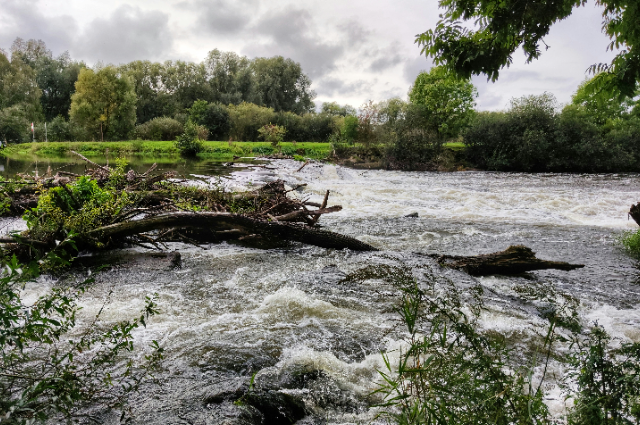
On 1 August 2026, the swollen Kariangode River in Kannur became the setting for an act of courage that would cost a volunteer rescuer his life. R Rajesh, a 36-year-old swimming and rappelling instructor from Kalliyoor in Thiruvananthapuram, had gone towards the flood-hit area as part of a rescue effort. Heavy rain had rapidly transformed the river and surrounding land into a dangerous stretch of rushing water. Among those trapped was 61-year-old farmer Benny, who had been stranded on an islet near Meenthulli in Cherupuzha. The water had risen around him, cutting him off from the mainland and leaving him in desperate need of help. Rajesh and two other rescuers, identified in reports as Shibin and Jithin, decided to reach him. They crossed the swollen river using ropes and their knowledge of water rescue. When they reached Benny, the immediate priority was to get him back alive. Rajesh knew the danger better than most people around him because he had spent years working with adventure sports and rescue training. Yet experience did not make the river any less threatening. The current was powerful, the water was unpredictable, and every movement had to be carefully calculated. Still, Rajesh moved towards the stranded farmer when help was urgently needed. It was not the first time he had placed himself between danger and another human being. For years, he had responded to emergencies without waiting for recognition or reward. On this occasion, however, his decision would become the final rescue mission of his life.
The rescue became more dangerous as Rajesh and his companions began bringing Benny towards safety. The farmer was struggling to remain secure in the turbulent water, while the rescuers were attempting to guide him across with the help of a rope. At some point during the return journey, Rajesh made a decision that has since become the most remembered part of his story. He removed the life jacket he was wearing and gave it to Benny. Rajesh was an experienced swimmer, but Benny was not equipped to face the same conditions without protection. The life jacket therefore became more valuable on the older man's body than on Rajesh's. It was a simple piece of safety equipment, but in that moment it represented the difference between survival and catastrophe. Rajesh secured it around Benny and continued helping him towards the bank. The other rescuers concentrated on getting Benny safely through the current. Rajesh stayed behind, helping to ensure that the rescued man made it out of danger. Then the river changed its course of events within seconds. A strong current caught Rajesh as he attempted to move towards safety. He lost his grip on the safety rope and was swept away by the floodwaters. Those around him could do little as the experienced rescuer disappeared into the raging river. The man Rajesh had gone into the water to save survived the ordeal. Rajesh did not return. His decision to give away his life jacket would later be remembered across Kerala as a profound act of selflessness.
For Rajesh's family and friends, the first hours after his disappearance were filled with disbelief rather than acceptance. They knew his ability in water and had seen him return safely from dangerous situations before. Rajesh was not someone who entered a river without understanding its risks. He was trained in swimming, rappelling, rope rescue and adventure activities. He had also spent years teaching others how to handle difficult terrain and water conditions. That experience made his disappearance especially difficult for those who knew him. People who had grown accustomed to hearing that Rajesh had gone somewhere to help others now waited for news of his own safety. Search teams began looking for him as the river continued to carry enormous volumes of water downstream. The operation continued as flood conditions gradually changed. His family waited through the uncertainty that follows every disaster when a missing person's fate is not immediately known. On 4 August, after an extensive search, Rajesh's body was recovered downstream. The search that had carried a small hope of finding him alive ended in grief. His remains were taken back to Thiruvananthapuram, where his family and neighbours prepared to receive him. The journey home was no longer the return of a rescuer after another successful mission. It was the final journey of a man who had spent years answering calls for help. In Kalliyoor, people gathered to pay their respects. Many came not because Rajesh had been famous, but because they had heard what he had done for others. His death transformed a largely unknown volunteer into a symbol of courage for a state accustomed to facing floods, landslides and other disasters.
Rajesh's courage on the Kariangode River cannot be understood fully without looking at the years that came before it. He had already been involved in rescue work during the devastating Kerala floods of 2018. Those floods tested communities across the state and brought ordinary citizens into extraordinary situations. Rajesh was among those who stepped forward when people were trapped and needed assistance. According to accounts from his family and associates, he repeatedly participated in rescue missions rather than treating disaster response as a one-time act. His involvement continued years later during the 2024 Wayanad landslides. Wayanad presented a different kind of danger, with landslides destroying homes and burying entire stretches of settlements. Rajesh again went towards the disaster zone to assist those affected. His work was not limited to one particular emergency or one particular group of people. He had developed a reputation for responding whenever his skills could be useful. Friends remembered him as someone who could not easily ignore a person in distress. He also trained people in adventure activities and safety techniques, passing on skills that could become vital during emergencies. His connection with the Adventure and Disaster Management Society in Kalliyoor reflected that commitment to preparedness and rescue. For Rajesh, helping people was not simply a dramatic act performed during a crisis. It had become part of his everyday identity. His family said he often spent his own money and even took loans while organising rescue-related activities. That detail reveals another side of his character: the rescuer was also a man who carried personal financial burdens while trying to ease the burdens of others.
Away from the floodwaters, Rajesh was a husband, father, son, brother, instructor and neighbour. His family home in Kalliyoor was not the home of a wealthy professional with unlimited resources. Reports from his neighbourhood describe a family facing financial difficulties and an unfinished house. Rajesh was working towards building a better home for his family while continuing his work in adventure sports and rescue training. He is survived by his wife, Shafiya, and their two school-going sons, Arshan and Abhishek. His parents, Rajasekharan and Geetha, also had to confront another devastating loss within the family. Rajesh's brother Ranjith had died in a train accident about two years earlier, leaving the family with another deep wound. The death of Rajesh therefore brought back memories of an earlier tragedy that had not completely disappeared. Neighbours described him as someone who remained involved in community activities despite his own struggles. He helped organise charitable activities, supported people in need and was known for his involvement with young people. He also trained students and young adventure enthusiasts, sharing skills that could make them more confident and responsible in difficult environments. His work was often carried out without the kind of public attention that follows government officials or professional emergency responders. He was a volunteer who repeatedly chose to show up. That choice had consequences for his family as well as for the people he rescued. Every time he left home for a rescue operation, those closest to him had to live with the possibility that he might not return. Yet Rajesh continued answering the call. In the end, the same commitment that brought him into countless rescue situations became the reason his family had to say goodbye.
The story of Rajesh also raises a difficult question about the people who stand between disaster victims and danger. Kerala has repeatedly witnessed ordinary citizens becoming rescuers during emergencies. During the 2018 floods, communities organised boats, ropes, food, shelter and transport when official resources were stretched. During the Wayanad landslides in 2024, volunteers entered areas filled with mud and debris to search for survivors. Rajesh belonged to this tradition of citizens who do not wait for a formal uniform before helping another person. His expertise made him particularly valuable during water-related emergencies. He understood ropes, currents and the physical demands of rescue work. But training can never eliminate every danger. Floodwater can change direction suddenly, hide debris and create currents strong enough to overpower even experienced swimmers. Rajesh's death is therefore not a lesson that courage makes a person invincible. It is a reminder that disaster rescue remains inherently dangerous, even for those who are highly skilled. His decision to give Benny the life jacket demonstrates how quickly rescuers sometimes have to make life-and-death choices. There was no time for a lengthy discussion about personal safety. Benny needed protection immediately. Rajesh believed his swimming ability gave him a better chance of continuing without the jacket. That calculation ultimately proved fatal. Yet his act cannot be separated from the larger system of rescue safety. Volunteers need training, equipment, communication, supervision and proper support when they enter hazardous conditions. The bravery of individuals should never become an excuse for society to overlook the risks they face. Rajesh's story honours his courage while also reminding us that rescuers themselves deserve protection.
As news of Rajesh's death spread, tributes came from across Kerala's political and social spectrum. Chief Minister V D Satheesan described the incident as heartbreaking and recognised Rajesh's history of responding to disasters. His tribute highlighted the selflessness involved in giving away his life jacket before being swept away. Other political leaders also remembered Rajesh's contribution to rescue operations. BJP state president Rajeev Chandrasekhar described him as a volunteer and rappelling instructor who had responded during the 2018 floods, the 2024 Wayanad disaster and the 2026 floods. Leader of the Opposition Pinarayi Vijayan also expressed condolences and later visited Rajesh's family. The tributes were significant because Rajesh had not held a conventional government position in disaster response. He was a volunteer whose value came from his skills, experience and willingness to act. His funeral brought together people from different sections of society. Political differences disappeared in the presence of a family mourning a man who had died while trying to save another person. Chief Minister Satheesan visited the family home and paid his respects. The government subsequently decided that Rajesh would be accorded state honours. His funeral became more than a farewell to one individual. It became a public acknowledgement of the contribution that volunteers make during disasters. Kerala was recognising not merely the dramatic final act, but the years of service behind it. For people who had known Rajesh personally, however, official honours could never compensate for his absence. The medals, tributes and ceremonies belonged to the public memory of Rajesh. His wife and children had to face the much quieter reality of returning home without him.
The decision to accord Rajesh state honours was followed by another important announcement. The Kerala government said it would complete construction of his unfinished house. The announcement carried particular meaning because Rajesh's family had been living with financial difficulties while he worked towards completing the home. For a man who had spent much of his life helping others, his own family's unfinished needs had remained unresolved. The government decision therefore became a practical gesture rather than merely a ceremonial tribute. It acknowledged that the responsibilities of society do not end when a volunteer dies. A rescuer may save someone else's family while his own family continues to depend upon him. Rajesh's death made that contradiction painfully visible. His relatives had spoken about his generosity, even when he himself was dealing with debts. He was known to spend money on charitable activities and rescue-related efforts. The unfinished house became a symbol of the ordinary life he had been trying to build alongside his extraordinary commitment to others. Now, that house would have to be completed without him. The government's promise offered at least one form of security to his wife and children. It could not replace a husband or a father. It could not answer the questions his children might carry for years about why he had gone into the floodwater. But it could prevent one burden from becoming heavier. The state also announced wider relief measures for families affected by the floods. Such assistance matters because disaster does not end when the rain stops, or the water recedes. Families often face months or years of financial and emotional recovery afterwards. Rajesh's family now belongs to that long aftermath.
The circumstances of Rajesh's death also exposed the difficult realities that can follow a disaster. After his body was recovered, concerns were raised about the transportation of his remains from Kannur to Thiruvananthapuram. The family reportedly had to shift the body to a private freezer ambulance after problems arose during transportation in a non-freezer ambulance. The Kannur district administration later ordered an inquiry into the alleged lapse. For a family already grieving a sudden death, the episode added another layer of distress. It showed that disaster management does not end with rescue or recovery. The dignity of the dead and the needs of grieving families are also part of the response. Rajesh had entered the floodwater to protect another person's life. After his death, his family expected the system to treat his remains with the same care and dignity. The controversy prompted questions about coordination between departments and the handling of disaster victims. It also demonstrated how quickly a tragedy can expose weaknesses that might otherwise remain unnoticed. The government inquiry was therefore important not only for Rajesh's family but for future disaster responses. Volunteers who risk their lives need to know that their families will be supported if the worst happens. Their contribution cannot be measured only in moments of heroism. It must also be reflected in the systems that care for them afterwards. A disaster-resilient society must protect rescuers as well as victims. Rajesh's story has already become an emotional symbol of sacrifice. It should also become an administrative lesson about preparedness, accountability and dignity.
For Benny, the farmer Rajesh went into the river to save, survival came with an unbearable memory. He lived because the rescuers reached him in time and because Rajesh gave him his own life jacket. The man who received that protection would later attend the funeral of the person who had saved him. Such encounters are difficult to describe because survival and grief exist side by side. Benny did not ask Rajesh to sacrifice his life. He had simply been trapped by rapidly rising floodwaters and needed help. Rajesh saw another human being in danger and responded. That is what makes the story so powerful. There was no family connection between the two men. There was no promise of reward or recognition. There was simply one person in danger and another person capable of helping. Rajesh's final decision was made in the middle of a dangerous rescue, not in a moment prepared for public admiration. He gave the life jacket because Benny needed it more. In that instant, the boundary between stranger and fellow human being disappeared. Benny's safe return to the bank therefore carries a painful truth. One man's survival became inseparable from another man's death. For Benny, gratitude may always be accompanied by grief. For Rajesh's family, knowing that he died saving another person may bring both pain and a measure of pride. His final act cannot undo their loss. But it can explain something about the kind of man he was. He had spent years responding to people who needed help, and on his final mission he did the same.
Rajesh's death came during another period of severe monsoon weather in Kerala, a state where rain is both a source of life and a recurring threat. Floods and landslides have become deeply etched into the collective memory of Kerala after the devastation of 2018 and the Wayanad landslides of 2024. Each disaster has demonstrated that communities are often the first line of support when lives are suddenly at risk. Rivers can rise within hours, roads can disappear beneath water, and familiar landscapes can become dangerous without warning. In Kannur, the conditions around Cherupuzha became particularly threatening as heavy rain caused water levels to rise rapidly. The danger was not confined to homes or roads. Farmers, workers and residents in low-lying areas could suddenly find themselves surrounded by water. Benny's situation was one example of how quickly a routine day can become a struggle for survival. Rajesh was already in the region because of his work in adventure activities and rescue training. His skills placed him in a position where he could respond when others could not. But his death also reminds us that the increasing complexity of extreme weather demands better preparedness. Communities need early warnings, safe evacuation routes, trained rescue teams and appropriate equipment. Volunteers can supplement emergency services, but they cannot be expected to replace them. Their courage should strengthen disaster response rather than become its foundation. The tragedy also shows why local knowledge and community networks remain important during floods. People like Rajesh often know the terrain, understand the behaviour of water and can reach places that formal teams may struggle to access quickly. Their contribution is invaluable. But every rescue should aim for the survival of both the person being rescued and the person doing the rescuing.
In Kalliyoor, the meaning of Rajesh's death is far more personal than the public language of heroism can express. His family has lost a husband, a father and a son. His children have lost the person whose return from every rescue mission they had once taken for granted. His parents have lost another child after already enduring the death of Rajesh's brother. His wife now has to think about the future of two children while carrying the emotional weight of a sudden bereavement. His unfinished house stands as a reminder of plans that will never be completed in the way he had imagined. Friends remember his energy, his willingness to teach and his instinct to help. Neighbours remember a man who could gather people for community activities and charitable work. Former students remember an instructor who taught them how to face adventure with discipline rather than recklessness. Rescue colleagues remember someone who was prepared to enter difficult situations when others hesitated. These memories create a portrait much larger than the final image of a man being swept away by floodwater. Rajesh's life was not defined only by the moment of his death. It was shaped by years of service that received little public attention. His family says he kept showing up whenever people needed help. That phrase may be the simplest way to understand his legacy. He did not appear only when cameras were present. He went when someone was stranded, frightened or vulnerable. He used the skills he possessed to help people who often had none. In doing so, he showed that humanity is sometimes expressed through action rather than words. His story asks what we owe to strangers when they are in danger. Rajesh's answer was immediate: if he could help, he would.
The state honours given to Rajesh are therefore not simply a ceremonial conclusion to a tragic news story. They are an acknowledgement of a volunteer culture that has quietly supported Kerala through some of its most difficult moments. His life illustrates how disaster response is often strengthened by people who possess skills but do not necessarily belong to formal emergency services. It also reveals the human cost behind the word “volunteer”. A volunteer is often someone with a family, a job, debts, responsibilities and personal fears. When that person enters a disaster zone, the risk is not abstract. Someone is waiting for them to come home. Rajesh knew the dangers of floodwater better than many people, yet he still went towards a stranded farmer. His final act was not a grand speech about courage. It was the practical decision to give a life jacket to someone who needed it more. He then continued the rescue until the river took him away. That decision has become the central image through which Kerala remembers him. But his true legacy lies deeper than the life jacket. It lies in the years he spent helping others, training people and responding to emergencies. It lies in the lives he helped protect during earlier disasters. It lies in the people who learned skills from him and may one day use those skills to save someone else. It lies in his children, who will grow up hearing stories about the father who went where others were afraid to go. It lies in a family home that the state has promised to complete in his memory. And it lies in a simple truth that disasters repeatedly reveal: courage does not always belong to those wearing uniforms. Sometimes it belongs to an ordinary person who sees another human being in danger and chooses not to turn away.
Rajesh was eventually laid to rest with full state honours, bringing a formal end to a life that had been spent responding to emergencies. His funeral was attended by people from his neighbourhood, political leaders, colleagues, friends and members of the wider community. The ceremony recognised a man who had never sought a public title for his work. His greatest reward had often been the knowledge that someone had survived. The river took his life, but it could not erase the years he had spent giving his time and skills to others. His story will remain painful because his final rescue succeeded only for one person. Benny survived, while Rajesh did not. That imbalance is at the heart of the tragedy. Yet there is also something profoundly human in the choice Rajesh made. He did not know that the life jacket he handed over would become a symbol of his own sacrifice. He simply saw a man struggling in dangerous water and tried to give him a better chance of survival. The people of Kerala now carry that image with them. A rescuer giving away the one object that could protect him is difficult to forget. But Rajesh deserves to be remembered for more than that single moment. He was the volunteer who kept showing up. He was the instructor who taught others. He was the neighbour who helped his community. He was the father whose children waited for him to return. He was the husband whose family now has to continue without him. He was the son whose parents have endured another devastating loss. And, finally, he was a man who believed that another person's life was worth risking his own for. Kerala's full state honours may have marked his final farewell, but his real memorial will be found wherever someone chooses to help another person in need.
References:
- WION News. “Kerala Hero Dies After Giving His Life Jacket to Save 61-Year-Old in Kannur.” WION News.
- Onmanorama. “Kerala Swimmer Died Saving a Man from Swollen River, Gave His Life Jacket Before Being Swept Away.” Onmanorama.
- WION News. “Kerala Hero Dies After Giving His Life Jacket to Save 61-Year-Old in Kannur.” WION News.
- The Indian Express. “He Gave Away His Life Jacket to Save a Stranded Farmer. Kerala Is Now Mourning Rajesh.” The Indian Express. The report also notes Chief Minister V. D. Satheesan’s statement that Rajesh would be accorded a state funeral.
- The News Minute. “He Took Loans to Organise Rescue Missions’: Family of Swimmer Rajesh Who Died in Kerala Flood.” The News Minute.
- India Today. “Hero of Kerala Floods Gives Away Life Jacket, Dies Trying to Save Drowning Farmer.” India Today.
- Mongabay-India. “Assam Floods Expose a Crisis Beyond Heavy Rain.” Mongabay-India.
- India Today. “Assam Floods 2026: The Rain Was Ordinary, So Why Did Upper Assam Drown?” India Today.
- Down To Earth. “On International Day of the World’s Indigenous Peoples, Meet Assam’s Second-Largest Plains Tribe That Lives in Harmony with Floods.” Down To Earth.