
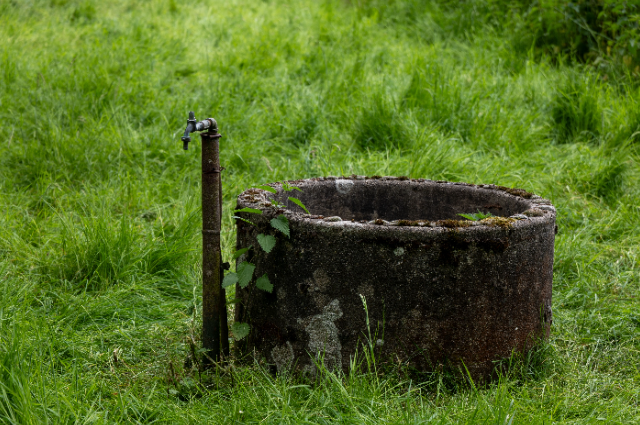
An ordinary farm well in Gujarat has become an extraordinary sight after its water began moving in steady, wave-like patterns, almost as though a small piece of the sea had appeared beneath the ground. In Virparda village in Morbi district, an approximately 18-foot-deep well has been rippling, oscillating, and at times spilling water over its edge without any visible person or object disturbing the surface. The unusual movement has continued intermittently for several days, leaving villagers, visitors, and motorists passing along the nearby highway puzzled. Instead of remaining relatively calm like water in a normal well, its surface appears to rise and fall in rhythmic movements. Videos showing the phenomenon quickly spread across social media, turning a quiet agricultural location into an unexpected attraction. The sight naturally raised a simple but fascinating question: how can water inside a village well behave as if invisible waves are pulling it?
The unusual behaviour was first noticed by farmer Pranjivanbhai Sadariya, whose farm contains the well. According to Sadariya, he noticed the strange activity around August 2, when he arrived at his farmland and found water spilling over the edge of the newly constructed well. What surprised him was not simply the increased water level but the continuous movement of the water itself. The well had reportedly been constructed only around three months earlier, making the sudden change even more striking. For a farmer familiar with his land and its water sources, such behaviour was difficult to ignore. The water did not appear to be disturbed by a person drawing water or by another obvious source. Instead, it seemed to be moving from within the well. Sadariya's account gave the mysterious phenomenon a clear beginning and soon became part of a story that travelled far beyond the village.
The well itself has several features that have made the incident particularly intriguing. It is approximately 18 feet deep and around 30 feet wide, according to reports, and is situated on farmland along the Jamnagar-Amritsar National Highway. Yet perhaps the most interesting detail is that the nearby wells did not show the same unusual movement. Residents who visited the location reportedly observed that two or three surrounding wells remained calm while the water in Sadariya's well continued to ripple. This difference immediately raised another scientific question. If recent rainfall had affected the region, why would only one well display such dramatic movement? Underground water systems are rarely as simple as they appear from the surface, and differences in depth, construction, rock formations and groundwater pathways can matter. The contrast between the wells therefore became an important part of the mystery rather than merely an unusual detail.
As more people witnessed the phenomenon, curiosity quickly turned into a local spectacle. Residents from Virparda and nearby villages began gathering around the well, while motorists and passersby reportedly stopped along the highway to see the moving water for themselves. People recorded videos on their mobile phones and shared them online, allowing the strange sight to reach audiences far beyond Morbi. Some viewers were fascinated by the apparently rhythmic movement, while others were concerned that it might be a warning of something more serious. Social media added another layer to the story because a visual mystery can spread much faster than a scientific explanation. Once the videos became widely circulated, the well was no longer simply a local curiosity. It had become a question being debated by people who had never even visited the village.
Where there is an unusual event without an immediate explanation, theories often appear before evidence does. The Morbi well was no exception. Some people wondered whether the movement could be connected to an earthquake or another form of underground disturbance. Others suggested that underground water channels might be responsible, while some interpretations moved into supernatural territory. Another local belief suggested a connection between underground water movement and tides in the Arabian Sea. Such explanations are understandable reactions to something that looks extraordinary, but they should not be confused with facts. A video can show what is happening on the surface without revealing what is happening several metres below it. That gap between what people can see and what they cannot see is often where speculation begins.
The idea of a connection with the sea was particularly interesting because Gujarat has an extensive coastline and complex groundwater systems. For people living in a state where the sea is a major geographical presence, it may seem intuitive to wonder whether unusual water movement could be influenced by tidal forces. The suggestion that underground channels might connect the well with the Arabian Sea therefore became one of the many explanations circulating among observers. However, there is no evidence presented by authorities that the Arabian Sea is responsible for the movement in this particular well. The theory remains a question raised by local curiosity rather than a scientific conclusion. Understanding that distinction is important because unusual natural phenomena can easily become exaggerated when speculation is repeated as fact.
The possibility of seismic activity was treated more seriously because earthquakes and underground vibrations can influence water in wells and other confined spaces. With the water apparently moving without an obvious surface cause, some residents feared that the phenomenon could be a sign of an earthquake. Authorities therefore examined whether recent seismic activity or a nearby geological fault could explain what was happening. District Geologist J.S. Vadher said the phenomenon was not considered seismic activity based on the preliminary assessment. Officials also consulted the Institute of Seismological Research in Gandhinagar, and reports said no relevant active fault connection or recent seismic event had been identified in the area. The clarification helped reduce fears among residents. At the same time, it reinforced the need for a proper scientific investigation into what was actually disturbing the water.
With rumours growing and public interest increasing, Morbi District Collector Swapnil Khare ordered further investigation into the unusual phenomenon. A scientific team from Gandhinagar was expected to examine the site, while the Gujarat Groundwater Research Institute was asked to conduct a detailed study and provide a report. The decision to bring specialists into the investigation marked an important shift in the story. Instead of allowing social media theories to determine the explanation, authorities sought observations from geologists and groundwater experts. Such an approach is particularly important when a natural phenomenon is unusual enough to attract large crowds. The investigation can examine the well's construction, surrounding geology, groundwater conditions, rainfall patterns and other possible factors. Until that detailed assessment is completed, the most responsible explanation is a preliminary one rather than a definitive answer.
One scientific term that has been associated with the phenomenon is “well seiche.” In simple terms, a seiche refers to an oscillating movement of water in an enclosed or partly enclosed body, similar to the back-and-forth movement that can occur when water inside a container is disturbed. In a well, such oscillations can potentially be connected to changes in groundwater pressure and underground conditions. Geologists have suggested that the unusual Morbi movement may be linked to changes taking place beneath the surface rather than to an earthquake or supernatural force. The term does not mean that scientists have already established every detail of what is happening at Virparda. Instead, it provides a scientific framework for understanding how water in a confined space can develop visible waves when underground conditions change.
Heavy monsoon rainfall may be an important part of that explanation. When large quantities of rain enter the ground, groundwater systems can become rapidly recharged, particularly after intense rainfall in upstream or elevated areas. As water moves through soil, fractures and pores within underground rock formations, pressure conditions can change. Officials have suggested that air trapped within pore spaces or cracks in the rocks may also be displaced as groundwater moves. If that air escapes through pathways connected to the well, it could disturb the water and create visible ripples or turbulence. This explanation is still preliminary, but it fits the broader idea that the well's unusual behaviour could be driven by a combination of rainfall, groundwater recharge and underground pressure changes. What appears mysterious at the surface may therefore be the visible result of processes taking place quietly beneath the ground.
The question of why only one well appears to be affected remains one of the most interesting parts of the story. If groundwater recharge and heavy rainfall are responsible, nearby wells might be expected to show at least some similar changes, yet residents reported that surrounding wells remained largely unchanged. One possible reason could be differences in the wells' depth, construction or connection with underground water-bearing formations. Variations in the local geology, including fractures, rock layers and groundwater pathways, could also influence how pressure is transmitted from one location to another. The shape and structure of an individual well may affect how easily water oscillates once it is disturbed. However, these possibilities should remain possibilities until investigators establish which conditions exist beneath the Virparda well. The fact that one well is behaving differently is not evidence of something supernatural; rather, it is precisely the kind of detail that makes a scientific investigation necessary.
For the people of Virparda, the strange well has transformed an ordinary part of the landscape into a symbol of curiosity. What began with one farmer noticing water spilling over the edge became a viral story, fuelled by videos, theories and the fascination of people wanting to see the phenomenon themselves. Yet the most valuable lesson from the incident may not be the final explanation alone. Natural events can appear mysterious when their causes are hidden beneath the surface, and uncertainty can quickly create rumours when information is limited. Authorities have urged people not to spread fear-inducing claims, while scientific teams work to understand the phenomenon properly. An ordinary farm well may have looked like a miniature sea for a few extraordinary days, but science reminds us that mystery does not have to end in superstition. Sometimes, the most fascinating answer is the one waiting quietly beneath the ground, where careful observation and evidence can turn an unexplained sight into an understood natural phenomenon.
References:
- Hindustan Times — “Viral video shows ‘waving’ well in Gujarat’s Morbi; experts have a theory.”
- Moneycontrol — “This ‘mysterious’ well in Gujarat has been moving on its own for 5 days. Experts explain why.”
- Times Entertainment — “This ‘shaking’ well in Gujarat has left an entire village searching for answers.”
- The Indian Express — “Gujarat’s ‘wave well’ goes viral as rippling water draws experts to investigate.”
- Hindustan Times — “Heavy rains lash south and central Gujarat; 27,000 shifted amid flood-like situations.”
- India Today — “‘Shaking’ well in Gujarat’s Morbi sparks curiosity among villagers.”
- ThePrint — “Gujarat: Waves in well puzzle Morbi; experts hint at air pressure, groundwater recharge.”
- The Indian Express — “Gujarat’s Morbi puzzled by well that won’t stop making waves despite no seismic activity.”
- The Times of India — “‘Waves without quake’: Mystery well in Gujarat baffles locals as water ripples for 5 days; watch.”
- Bhaskar English — “Well water starts churning on its own near Morbi: Orchard owner says well was overflowing just 2 days ago, while water in nearby wells remains calm.”