
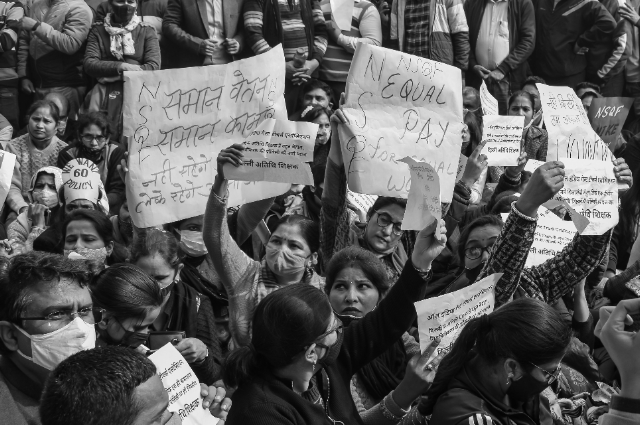
HYDERABAD, October 12, 2026: Women journalists and civil society members staged a protest at the Ambedkar Statue junction near Liberty Circle in Hyderabad on Monday evening, condemning alleged police assaults, sexual harassment and the detention of journalists covering demonstrations in New Delhi. Organised under the banner of Women Journalists – Hyderabad, the gathering expressed solidarity with journalists, students and women who alleged police misconduct during protests over the Special Intensive Revision (SIR) of electoral rolls and demands for the resignation of Chief Election Commissioner Gyanesh Kumar.
The demonstrators raised concerns over the treatment of media personnel covering public protests, particularly allegations that women journalists faced physical attacks, intimidation and sexual harassment despite identifying themselves as members of the press. They also objected to restrictions on journalists attempting to document police action and demanded accountability for alleged misconduct. The protest brought renewed attention to questions surrounding press freedom, the right to peaceful assembly and the responsibility of law enforcement agencies to protect citizens while maintaining public order.
Independent journalist Uma Sudhir, who participated in the Hyderabad demonstration, said the developments had raised concerns extending beyond the immediate political demands behind the protests. According to her, the issue had evolved into a broader question concerning constitutional freedoms, including the right to freedom of speech and expression and the right to protest peacefully. Referring to visuals emerging from Delhi, she described the reported treatment of demonstrators as deeply disturbing. She argued that the conduct of police personnel towards citizens exercising democratic rights should concern people throughout the country, regardless of their political affiliations or direct involvement in the demonstrations.
Sudhir emphasised that the police were responsible for protecting citizens rather than preventing them from exercising their democratic rights. She maintained that the freedom to question public authorities and demand accountability was fundamental to a democracy and called on citizens to speak out against alleged abuses. Her remarks reflected the central concern voiced at the Hyderabad gathering: that journalists must be able to report on public events without facing intimidation or obstruction. The protest was therefore not limited to the demands raised at Jantar Mantar but also highlighted the wider implications of alleged police misconduct for independent journalism and democratic participation.
Hyderabad-based stand-up comedian Vivek Muralidharan also joined the demonstration, saying his participation stemmed from concerns over the treatment of protesters rather than support for any particular political demand. He argued that the issue extended beyond calls for Gyanesh Kumar’s resignation and centred on the manner in which students, women and journalists had allegedly been treated by Delhi Police. Muralidharan said such conduct deserved condemnation irrespective of the location or the cause behind a demonstration. His participation reflected the solidarity expressed by civil society members who viewed the allegations as a matter of public accountability rather than a concern restricted to journalists or political groups.
The Hyderabad demonstration followed allegations by three independent women journalists who said they had faced sexual harassment by police personnel while covering a protest at Jantar Mantar in New Delhi on October 3. The demonstration concerned demands for the resignation of Chief Election Commissioner Gyanesh Kumar over objections to the SIR process. One journalist specifically accused Assistant Commissioner of Police Vivek Bhagat of sexually assaulting her, alleging that he touched her inappropriately and pushed her while she was recording police action against protesters. She also alleged that her complaint was not registered immediately when she and others approached a police station. The allegations remain subject to investigation and have not been established as proven facts.
The journalists’ complaints prompted the Delhi Police to transfer the matter to its Crime Branch for further inquiry. On October 4, the police said the complaints had been referred for a fair and impartial investigation. The Press Council of India subsequently expressed shock and dismay over the reported treatment of journalists, stressing that media personnel must be allowed to work without fear while documenting public demonstrations. It urged Delhi Police to act on the complaint and ensure that reporters could perform their professional duties without aggression or threats. Senior Congress leader Rahul Gandhi also questioned the delay in registering a case, directing criticism towards Union Home Minister Amit Shah, under whose ministry Delhi Police functions. Gandhi referred to allegations of misconduct against women protesters, the reported seizure of cameras and the detention of journalists, and demanded accountability from the authorities.
The National Human Rights Commission (NHRC) took suo motu cognisance of a media report concerning the alleged harassment of the three women journalists. In a statement issued on October 8, the commission said the allegations, if true, raised serious questions about possible human rights violations. It issued a notice to the Delhi Police Commissioner, seeking a detailed report within two weeks. The commission's intervention placed the complaints under additional scrutiny while the Crime Branch inquiry continued. The notice did not establish that the allegations were true; rather, it required the police leadership to respond to the reported incidents. The complaints had initially been received by the New Delhi district police before being transferred to the Crime Branch.
The investigation also drew criticism from the complainant’s legal representative over the manner in which the journalist was questioned. According to reports, the woman was summoned to the Crime Branch office in Prashant Vihar on October 8, nearly a week after filing her complaint. Her lawyer, Supreme Court advocate Saimon Farooqui, said she was given a 25-point questionnaire covering the incident and her background. The questions reportedly included whether she knew ACP Vivek Bhagat before the incident, whether she had encountered him previously, whether he was attempting to detain other people at the time and other details concerning his conduct during the protest. The lawyer alleged that investigators focused excessively on the complainant’s family and professional background, including the length of time she had worked with her media organisation. He argued that the questioning made her feel as though she were being treated as an accused person rather than a complainant.
The Crime Branch also sought a video recording held by the journalist and her legal team. According to her lawyer, the complainant indicated that the footage would be submitted after an FIR was registered in connection with her complaint. Her legal team also asked the police to secure CCTV footage covering a 500-metre radius around the alleged incident site, near a Mother Dairy booth on Janpath Lane, and preserve recordings from body-worn cameras used by police personnel deployed in the area. The lawyer questioned why the inquiry was being conducted at the Crime Branch office in Prashant Vihar when the original complaint had been submitted at Parliament Street police station. He also raised concerns over the absence of counselling for the complainant. These objections formed part of the legal team's criticism of the handling of the case; the police inquiry was continuing.
At the time of the reports concerning the Crime Branch inquiry, no FIR had been registered in connection with the three journalists’ complaints. The complainant was also reportedly detained twice after the incident: first on October 4 during protests concerning the SIR process and Gyanesh Kumar, and again on October 5 while participating in a demonstration outside Parliament Street police station demanding registration of a case against the officer. An FIR was registered against her and 16 other protesters under provisions relating to assault or criminal force against a public servant, vandalism and unlawful assembly, among other allegations. The separate case against the protesters added to concerns raised by the complainant’s legal team about the treatment of those demanding action on the alleged harassment. The allegations against the police officer and the charges against the protesters remain distinct matters and must be assessed on their respective evidence.
The concerns surrounding journalists’ safety did not end with the October 3 incident. On October 11, Delhi Police detained journalists covering further demonstrations against Gyanesh Kumar, according to media reports. At least 12 journalists were reportedly taken into custody while covering protests, including a reporter from Hindustan and journalists from other news organisations. One reporter said he was pushed around and injured despite wearing an identification card clearly identifying him as a member of the press. The reported detentions intensified scrutiny of the working conditions faced by journalists covering the demonstrations. They also reinforced demands from media professionals and civil society groups for clear safeguards that distinguish legitimate journalistic work from participation in a protest.
The demonstrations were linked to wider objections to the Special Intensive Revision of electoral rolls and calls for the resignation of the Chief Election Commissioner. Protesters and political groups have raised concerns about the revision process and its potential impact on eligible voters, while the Election Commission's electoral-roll exercise remains a matter of political and public debate. In Delhi, police action against demonstrators and the alleged harassment of journalists became additional points of contention. In Hyderabad, the Women Journalists – Hyderabad gathering brought those concerns into a public forum outside the national capital, demonstrating how reports of police conduct in one city can prompt solidarity and demands for accountability elsewhere.
The Hyderabad protesters called for the immediate and unconditional release of detained journalists, the withdrawal of cases registered against media personnel and an independent investigation into allegations of police misconduct. They also demanded action against personnel found responsible for assaults or harassment and measures to ensure that journalists could cover demonstrations without intimidation or obstruction. Their demands reflected the need for transparent investigations and effective safeguards for media workers, particularly when reporting on contentious public events. They also urged authorities to respect the constitutional rights of citizens and ensure that the exercise of police powers did not obstruct legitimate reporting or peaceful democratic participation.
The NHRC’s notice, the Crime Branch inquiry and the criticism voiced by journalists and civil society members have placed the handling of the complaints under public scrutiny. The outcome will depend on the evidence gathered, the preservation of relevant video and CCTV recordings, and the authorities’ response to the allegations. Until the investigation establishes the facts, the claims against individual police personnel must remain allegations rather than conclusions. At the same time, the complaints and the reported detention of journalists have raised serious questions about the conditions under which the media can document demonstrations in the national capital.
The protest at Liberty Circle was therefore both an expression of solidarity with the journalists who reported alleged misconduct and a call for institutional accountability. Its central demand was that journalists should be able to document public events without fear of assault, harassment or arbitrary obstruction. For a democratic society, the ability to report on protests and the responsibility of the police to maintain public order are not mutually exclusive. Ensuring that both are respected requires impartial investigations, transparent procedures and protection for the rights of journalists and citizens alike.
References:
- “Delhi Police Crime Branch Summons Journalist Over Jantar Mantar Sexual Assault Complaint; NHRC Seeks Report.” Moneycontrol, October 9, 2026.
- “Hyderabad Journalists Protest Against Police Action on Demonstrators in Delhi.” The Hindu, October 12, 2026.
- “3 Women Journalists Allege Cops Sexually Harassed Them During Delhi Protest.” NDTV, October 4, 2026.
- “Journalist Alleging Harassment by Delhi Police ACP Had to Endure 25-Point Questionnaire by Crime Branch.” The Hindu, October 8, 2026.