
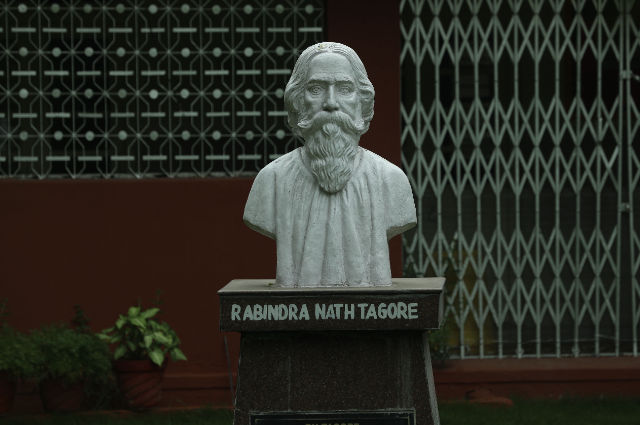
There are words in a national anthem that are sung so often that their history becomes almost invisible. In India’s Jana Gana Mana, one such word has survived a century of political transformation, Partition and changing borders: Sindh. Every time the anthem is sung, Punjab, Sindh, Gujarat, Maratha, Dravida, Utkala and Banga are named, while Rajasthan, Kashmir and the Northeast are not. At first glance, this may appear to be a simple question of geography. Why does an anthem of modern India contain the name of a region that is now a province of Pakistan? And why does it omit several regions that are firmly within India today? The answer begins not in 1947, but in 1911, when Rabindranath Tagore wrote the composition that would eventually become India’s national anthem. The map before Tagore was not the map before us. Modern states had not been created, princely territories still existed, administrative boundaries were different, and political India was still under British rule. The word “Sindh”, therefore, cannot be understood only through the borders of today. It has to be read through history, poetry, culture and the memory of a community whose relationship with its homeland was transformed by Partition.
Rabindranath Tagore wrote the original composition, Bharoto Bhagyo Bidhata, in Bengali on 11 December 1911. It was written in a Sanskritised register of Bengali and conceived as a spiritual hymn, rather than as a modern geographical catalogue. Its first stanza was publicly sung later that month, on 27 December 1911, at the Calcutta session of the Indian National Congress. The timing of its first performance, coinciding with the visit of King George V and the Delhi Durbar, eventually produced one of the longest-running controversies surrounding the song: the claim that Tagore had written it to welcome or praise the British monarch. Tagore repeatedly rejected that interpretation. In a later explanation, he made clear that the “Dispenser of India’s destiny” could not be a mortal king. The confusion was also strengthened because another song praising the emperor was reportedly sung at the same Congress session, while sections of the press mixed up the two events. Tagore’s wider public life provides important context: his involvement in the anti-Partition-of-Bengal movement, his educational work at Santiniketan and his renunciation of his knighthood after the Jallianwala Bagh massacre all form part of the historical record surrounding him. In 1950, the first stanza of Jana Gana Mana was adopted as India’s National Anthem, with Dr Rajendra Prasad announcing the decision before the Constituent Assembly on 24 January.
To understand the geographical names in the anthem, however, it is necessary to resist the temptation to read them as a list of India’s present-day states. In 1911, there was no Rajasthan as a unified state. Much of the territory that would later form Rajasthan consisted of princely states collectively associated with Rajputana. Kashmir had a different political status, and the Northeast was made up of several distinct territories and communities. Yet even the explanation that Tagore simply listed British provinces does not completely settle the matter. Sindh, for example, was part of the Bombay Presidency in 1911 and became a separate province only in 1936. Gujarat, Maratha and Dravida were also not straightforward equivalents of modern administrative states. Assam, despite being under British administration, was not named. The political map itself was changing around the time the poem was written: the 1911 Delhi Durbar saw major announcements concerning the annulment of Bengal’s partition and the reorganisation of provincial administration. The anthem therefore belongs to a particular historical moment, but its geographical imagination was broader than a bureaucratic map. Its references draw upon regions, cultural identities, historical landscapes and civilisational memory. Expecting a poem written in 1911 to anticipate Rajasthan, present-day state boundaries, the Northeast as a political expression or states created decades later would be to ask history to predict the future.
Then came 1947, and the single word “Sindh” acquired another layer of meaning. Partition divided Punjab and Bengal, but Sindh experienced a different kind of rupture. Its territory was not divided between India and Pakistan; Sindh became part of Pakistan, while a large non-Muslim population was displaced from the region. Research on Sindhi refugees describes this as a form of demographic or deterritorialised Partition: approximately a million non-Muslim refugees, not all of them Sindhi-speaking, were dispersed across India and abroad, without an Indian territorial counterpart to the homeland they had left. Many Sindhis eventually rebuilt their lives in cities and settlements across India, particularly in the former Bombay province, but they did so without a state that carried the name of their ancestral homeland. Their citizenship became Indian, but their historical geography remained across an international border. Language, food, literature, religious traditions, family histories and memories travelled with them. Their campaign for constitutional recognition of Sindhi as a non-regional language eventually resulted in its inclusion in the Eighth Schedule in 1967. Against this background, “Sindh” in the anthem can acquire a significance that goes beyond territory. For a community without a present-day Indian state bearing the name of its lost homeland, hearing that name in a national symbol can become a rare public reminder that its history belongs within the story of India.
The question eventually moved from memory into the courtroom. In 2005, advocate Sanjeev Bhatnagar approached the Supreme Court seeking removal of “Sindh” from the National Anthem, arguing that Sindh was no longer part of India and proposing that it be replaced by Kashmir. The Supreme Court rejected the petition in Sanjeev Bhatnagar v. Union of India on 13 May 2005. Its reasoning is important because the Court did not treat the anthem as a geographical register that had to be updated every time political boundaries changed. It described the National Anthem as an expression of patriotic feeling and cultural identity rather than a chronicle defining the territory of the nation. The judgment also recognised that “Sindh” could have meanings beyond a present-day territorial unit, including references to the Sindhi people, their culture and the Sindhu or Indus river. The Court noted the difficulty of treating the anthem as a contemporary political map: if historical names were removed simply because they no longer corresponded to modern states, questions would arise about Utkala, Banga, Dravida and other names as well. The petition was dismissed with costs. The decision did not erase the debate; instead, it established an important legal position about the historical and symbolic character of the anthem.
The controversy did not end with the Supreme Court judgment. Another dispute later concerned whether the word should be understood or rendered as “Sindh” or “Sindhu”. Retired professor Shrikant Gopinath Malushte pursued proceedings concerning the wording of the anthem, arguing that “Sindhu”, referring to the river, was the appropriate form. The Bombay High Court ultimately disposed of the matter in November 2016, observing that the issue had already been decided by the Supreme Court in the Sanjeev Bhatnagar case. Meanwhile, the Ministry of Home Affairs has maintained official materials in which the printed anthem uses “Sindhu”; its current English information sheet reproduces the anthem as “Panjaba-Sindhu-Gujarata-Maratha”. Earlier government material and legal proceedings have also recorded the forms “Sindh” and “Sindhu”, with the Ministry explaining that both words can refer to the river or the Sindhi community. This linguistic history matters because the controversy is not simply about whether India is claiming a piece of foreign territory. It is also about how an old literary composition is read, printed, pronounced and understood after the political geography surrounding it has changed. The government’s position has consistently resisted treating every territorial transformation as a reason to rewrite Tagore’s composition.
Yet another question remains: if Sindh can continue to be remembered through the anthem, why are Rajasthan, Kashmir and the Northeast absent? The absence is particularly striking in the case of the Northeast because, unlike modern Rajasthan, the region has long possessed a distinct historical and political presence. In 2018, Congress MP Ripun Bora moved a private member’s resolution in the Rajya Sabha seeking to replace “Sindh” with “Northeast India”, arguing that the Northeast should receive recognition in the National Anthem. The proposal did not become an amendment to the anthem. Similar questions had also been raised earlier in Parliament. But replacing one name with another would not resolve the deeper problem. If every omission or historical reference were corrected according to the present political map, the anthem would eventually cease to be Tagore’s 1911 composition and become a constantly updated geographical document. Utkala is not the name of a present-day state; Banga extends beyond today’s West Bengal; Dravida represents a much larger southern cultural-geographical idea; and Maratha, too, carries historical meaning beyond a single modern administrative boundary. The issue therefore exposes a tension that cannot be settled by geography alone: are these words meant to identify contemporary political units, or do they preserve an older cultural imagination of India?
Perhaps that is why the most enduring meaning of “Sindh” lies neither in a border nor in a legal argument, but in memory. Benedict Anderson wrote in Imagined Communities about the unusual power of national symbols to allow strangers to participate in the same imagined community; an anthem gives that idea a voice, because people who may never meet can utter the same words at the same moment. In the case of Sindhis, that shared voice contains a particularly complicated history. They lost a homeland without receiving an Indian state to replace it. Their homes could be rebuilt, their businesses established, their language preserved and their communities scattered across India, but the physical landscape of Sindh remained beyond the border. The word in Jana Gana Mana cannot restore that homeland, redraw a border or turn memory into territory. It does something quieter. It keeps a historical name alive within one of India’s most recognisable national symbols. At the same time, the absence of the Northeast and other regions reminds us that national symbols cannot perfectly represent every layer of a changing country. Jana Gana Mana is not a political atlas of the Republic of India. It is a poem written before independence, transformed by history into a national symbol. Its names belong partly to a world that no longer exists. And perhaps that is precisely why “Sindh” remains so powerful: borders can change, states can be reorganised, and political maps can be redrawn, but a word preserved in collective memory can outlive the map that once gave it meaning.
References:
- “Row over ‘Jana Gana Mana’: Why Tagore composed it and how it became the national anthem” — The Indian Express, by Dipanita Nath, November 12, 2025.
- “Tagore and that song” — The Hindu.
- “Sindh is not a piece of territory’: Sindhi belonging in India” — The Leaflet, by Uttara Shahani, January 26, 2021.
- “Sindh, Sindhu in Anthem correct” — DNA.