
Wars are usually remembered for their long campaigns, fierce battles and heavy losses. Some continue for years, changing the boundaries of nations and the lives of millions. Yet, on 27 August 1896, a military conflict took place that lasted less time than an ordinary classroom lesson. Known as the Anglo-Zanzibar War, it was fought between the British Empire and the Sultanate of Zanzibar, an island territory off the eastern coast of Africa. The conflict is widely recognised as the shortest recorded war in history, lasting approximately 38 to 45 minutes. Although brief, it was far more than a sudden exchange of gunfire. It reflected the struggle for political control during the age of European imperialism, when powerful nations competed for influence over territories, trade routes and resources. Zanzibar was an important centre of Indian Ocean commerce, known for its spice trade and its historical involvement in the East African slave trade. Its geographical position made it valuable to European powers, particularly Britain and Germany, which competed for influence in the region. By 1890, Zanzibar had become a British protectorate under an agreement that allowed the sultanate to continue while placing important aspects of its political affairs under British influence. The sultan remained the local ruler, but his freedom to make independent decisions was limited. This unequal relationship created the conditions for a conflict that would begin and end on a single morning.
The immediate cause of the war was the sudden death of Sultan Hamad bin Thuwaini on 25 August 1896. He had maintained friendly relations with Britain and was regarded as a ruler who generally accommodated British interests. His unexpected death created uncertainty over who would succeed him. Suspicion soon fell upon his cousin, Khalid bin Barghash, although the allegation that Khalid had poisoned Hamad was never conclusively established. Khalid moved quickly to occupy the palace and declared himself the new sultan without obtaining the approval required by the British authorities under the protectorate arrangement. This was not his first attempt to claim the throne; he had previously sought power but had failed to secure British acceptance. His decision to take control without permission directly challenged Britain's authority over Zanzibar. The British government preferred Hamoud bin Mohammed, whom it considered more acceptable to its interests. Khalid's actions also raised concerns about the wider competition between Britain and Germany in East Africa, as he was perceived as more sympathetic to German interests. For Britain, the succession dispute was therefore not simply a disagreement over who should become sultan. It was also a question of whether the local ruler could defy British demands and exercise independent political authority. Rather than accept Khalid's claim, British officials insisted that he surrender the palace and step aside. The disagreement rapidly developed into a confrontation, placing Zanzibar on the brink of war.
British diplomat Basil Cave attempted to persuade Khalid to leave the palace peacefully, but his efforts failed. Instead, Khalid strengthened his position by gathering approximately 2,800 supporters, including palace guards, soldiers and civilians. His forces possessed artillery and machine guns, while the royal yacht, HHS Glasgow, was positioned in the harbour as part of the attempted defence. However, the number of defenders did not reflect their ability to withstand a modern naval attack. The British possessed a decisive advantage in firepower and had several warships stationed off the coast. Under Rear-Admiral Harry Rawson, British forces prepared to enforce their demands, supported by troops commanded by Lloyd Mathews, a senior official in Zanzibar's administration. On 26 August, the British authorities authorised military action if it became necessary. Khalid was given a final deadline: he had to leave the palace and surrender his position by 9:00 a.m. on 27 August. Despite the warning, he refused to comply and remained inside the palace with his supporters. Shortly before the deadline, he indicated that he did not believe the British would actually open fire. His refusal left little room for a peaceful settlement. The British, determined to prevent him from consolidating his position, kept their warships ready in the harbour. As the deadline approached, the confrontation became increasingly tense. At stake were not only the sultan's position and the future of the palace, but also the extent to which Zanzibar could resist British political control. When the ultimatum expired, the British chose force over further negotiation.
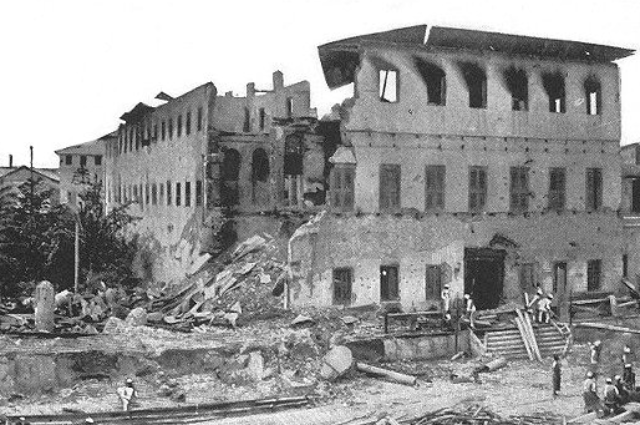
At approximately 9:02 a.m. on 27 August, British warships opened fire on the palace. The bombardment was devastating. Much of the palace was constructed from wood, making it particularly vulnerable to explosive shells and fire. Within minutes, the defending artillery had been largely disabled, and the palace was engulfed in flames. British guns also targeted Zanzibar's small naval force. The royal yacht HHS Glasgow was sunk, along with smaller vessels, leaving the defenders with little chance of resisting the British fleet. The fighting continued as the palace and its surroundings came under attack. Khalid's forces were unable to match the firepower of the British warships, and their resistance gradually collapsed. Accounts differ slightly about the precise duration of the conflict. It is commonly described as lasting 38 minutes, although some historical accounts place its end at approximately 9:40 a.m., giving a duration closer to 38 minutes from the opening bombardment at 9:02 a.m. By around 9:40–9:46 a.m., the bombardment had ended, and the fighting was over. Estimates suggest that approximately 500 people on the Zanzibari side were killed or wounded, including defenders and other people caught in the attack. British casualties were dramatically lower: one British sailor was reported injured. The contrast revealed the overwhelming military advantage enjoyed by the British forces. Khalid escaped from the palace and sought refuge at the German consulate, where he received asylum before eventually making his way to German East Africa. The war was over, but its political consequences would shape Zanzibar for decades.
With Khalid removed from power, the British quickly installed Hamoud bin Mohammed as the new sultan. His appointment secured the outcome Britain had wanted and strengthened its control over the island. Although Zanzibar retained a sultan and some of its traditional institutions, its political independence was severely diminished. The new ruler governed under strong British influence, making the conflict a clear example of what is known as gunboat diplomacy—the use or threat of naval military force to achieve political objectives. The war also exposed the unequal relationship between a colonial power and the territory it controlled. Britain's military superiority allowed it to settle a dispute over Zanzibar's leadership through a brief but destructive bombardment. Slavery was another important issue in the relationship between Britain and Zanzibar. The island had long been connected to the East African slave trade, and British authorities had pressed successive sultans to restrict and abolish slavery. Sultan Hamoud, who came to power after the conflict, agreed to reforms, and slavery was formally abolished in Zanzibar in 1897, although the end of the legal institution did not immediately eliminate every form of exploitation or the consequences of the trade. This development formed part of a wider transformation in the island's political and social history. However, the abolition of slavery should not obscure the imperial interests behind Britain's intervention. British policy combined opposition to the slave trade with a determination to maintain strategic and political dominance in the region. The war therefore brought significant changes, but those changes took place under conditions shaped by colonial power rather than an equal agreement between independent states.
The Anglo-Zanzibar War remains remarkable because of the extraordinary contrast between its short duration and its lasting consequences. In less than an hour, a sultan was removed, a palace was devastated, a small naval force was defeated, and a new ruler was installed with British support. The conflict became a striking illustration of the military imbalance that characterised much of the colonial era, when European powers used superior weapons and naval strength to extend or defend their influence in Africa. Zanzibar remained a British protectorate until 1963, when it regained independence and became a sovereign state. In 1964, Zanzibar united with Tanganyika to form the United Republic of Tanzania. Its history therefore extends far beyond the brief battle of 1896, encompassing trade, slavery, political change, colonial rule and the struggle for self-determination. The war is often remembered for its record-breaking brevity, but its historical significance lies in more than the number of minutes it lasted. It raises important questions about sovereignty, the use of military force and the rights of a people to determine their own political future. The conflict also reminds us that the length of a war does not determine the depth of its impact. Although the guns fell silent within minutes, the consequences of British intervention continued long after the smoke had cleared from the palace. The Anglo-Zanzibar War was, in this sense, a brief battle with a lasting historical legacy.
References:
- The Shortest War in History: It Lasted Just 38 Minutes! — Pulse.ng
- On This Day: Anglo-Zanzibar War, History’s Shortest War, Begins and Ends — The Jerusalem Post
- The War Britain Won in 38 Minutes — HistoryExtra
- What Was the Shortest War in History? — Encyclopaedia Britannica
- The World’s Shortest War Lasted an Incredibly Brief 38 Minutes — We Are The Mighty