
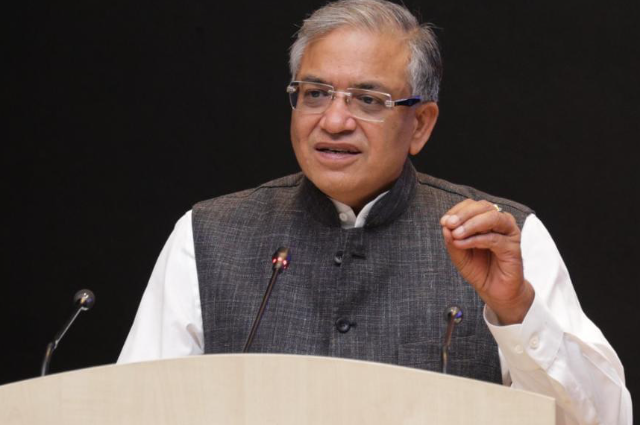
In India’s vast administrative system, some bureaucrats remain largely invisible to the public even after occupying important positions. Others suddenly find themselves at the centre of national political debate. Gyanesh Kumar belongs to the latter category. A 1988-batch Indian Administrative Service officer of the Kerala cadre, Kumar rose through a long administrative career before becoming the Chief Election Commissioner of India on February 19, 2025. His appointment placed him at the head of an institution whose credibility is inseparable from the credibility of every election held in the country. Born on January 27, 1964, in Agra, Uttar Pradesh, Kumar studied Civil Engineering at the Indian Institute of Technology, Kanpur. He later pursued studies in business finance at the Institute of Chartered Financial Analysts of India and environmental economics at Harvard University. His career subsequently took him from district administration in Kerala to senior positions in the Union government. He served in areas including defence production, parliamentary affairs, cooperation and home affairs. He was also involved in significant administrative work connected with the reorganisation of Jammu and Kashmir and later in arrangements surrounding the Shri Ram Janmabhoomi Teerth Kshetra. These assignments placed him within some of the most consequential areas of India's public administration. After retiring from the IAS, Kumar entered the Election Commission as an Election Commissioner in March 2024, alongside Sukhbir Singh Sandhu. Less than a year later, he became the 26th Chief Election Commissioner. His rise seemed to mark the culmination of decades in government. But instead of remaining a relatively distant constitutional authority, Kumar has increasingly become the subject of intense political criticism, especially over the revision of electoral rolls.
The Kerala Years and the 2006 Controversy
Long before the present electoral controversy, Kumar's career had already intersected with a contentious episode in Kerala. In 2006, while he was serving as Secretary of the state's Public Works Department, the Kerala State Transport Project faced disputes over payments, delays, land acquisition, and the implementation of road works. The project involved the upgrading of the Main Central Road through a consortium involving Malaysian interests and Bhageeratha Engineering. During this period, Malaysian project official Lee See Been died by suicide in Kuala Lumpur after returning from Kerala. Reports published at the time stated that notes left by Lee contained allegations of pressure and harassment by government officials and that Kumar was among the officials named. The controversy led to a Vigilance inquiry, and Kumar was transferred out of the PWD before the end of 2006. However, the existence of an inquiry should not be confused with a finding of guilt. The material available on the episode does not establish that Kumar was convicted or that a judicial authority conclusively held him responsible for Lee's death. Later accounts have differed over how far the original investigation progressed and why it did not produce a conclusive outcome. Former Kerala Finance Minister T. M. Thomas Isaac revived the issue in 2026, while acknowledging that he had not personally read Lee's alleged suicide note. Other reports have described difficulties in locating old records and questions surrounding the earlier investigation. In October 2026, Kerala's Home Department ordered a fresh Vigilance inquiry following a complaint alleging corruption and irregularities during Kumar's PWD tenure. The government also sought files relating to the earlier inquiry. These developments have renewed public attention to an episode that occurred almost two decades ago, but the fresh investigation remains an investigation. It does not, by itself, establish criminal wrongdoing by Kumar.
From Senior Bureaucrat to Election Commissioner
Kumar's career after the Kerala controversy moved steadily towards the highest levels of the Union bureaucracy. He served in the Ministry of Defence, including work connected with defence production, and later held senior positions in the Ministries of Parliamentary Affairs and Cooperation. His administrative experience also brought him into the Ministry of Home Affairs, where he was associated with important constitutional and governmental assignments. This background eventually led to his appointment as an Election Commissioner in 2024. His elevation to Chief Election Commissioner in February 2025 came under the framework created by the Chief Election Commissioner and Other Election Commissioners (Appointment, Conditions of Service and Term of Office) Act, 2023. The new appointment mechanism itself had already become politically contentious because the selection committee included the Prime Minister, the Union Home Minister and the Leader of the Opposition in the Lok Sabha. Congress leader Rahul Gandhi had recorded dissent during the selection process that preceded Kumar's elevation. Once Kumar assumed office, however, the debate moved beyond the method of his appointment to the functioning of the Election Commission itself. The constitutional importance of the CEC makes the office different from an ordinary government post. The Election Commission is expected to conduct elections independently, maintain electoral rolls and protect the integrity of the voting process. Every controversy surrounding its decisions therefore carries consequences beyond the individuals involved. For Kumar, the challenge has been particularly significant because questions over electoral rolls have become intertwined with a much wider political argument about the independence and credibility of India's democratic institutions.
SIR: The Electoral Exercise Behind the Political Battle
The most significant controversy surrounding Kumar's tenure concerns the Special Intensive Revision, or SIR, of electoral rolls. The stated purpose of an intensive revision is to verify voter information and ensure that electoral rolls contain eligible voters while removing names belonging to deceased, permanently shifted or duplicate voters and other entries that should not remain on the rolls. The exercise involves verification and scrutiny of electoral data, making it one of the most sensitive responsibilities of an election authority. Under Kumar, the Election Commission announced the nationwide SIR exercise in October 2025. Opposition parties, however, argued that the process could result in genuine voters being excluded, particularly where citizens faced difficulties producing documents or proving their eligibility. Rahul Gandhi transformed the issue into a broader political campaign under the phrase “vote chori”, alleging that electoral manipulation and weaknesses in the voter-registration system had undermined democratic representation. He cited allegations concerning voter entries in Karnataka and elsewhere and demanded greater transparency from the Election Commission. The Commission rejected the allegations as baseless and defended its procedures. The controversy eventually reached the Supreme Court, which in May 2026 upheld the legal validity of the SIR exercise and recognised the Election Commission's constitutional responsibility to maintain accurate electoral rolls. Yet a legal validation of the exercise did not end the political dispute. Opposition parties continued to question its implementation, the handling of voter data and the safeguards available to citizens whose names might be removed. The argument therefore shifted from whether the Commission had the power to revise electoral rolls to whether it was exercising that power transparently and fairly.
The Questions Raised Inside the Election Commission
The controversy deepened in September 2026 when a report by The Indian Express said Election Commissioners Sukhbir Singh Sandhu and Vivek Joshi had recorded objections on at least 14 occasions over a period of around ten months. According to the report, the objections concerned issues such as voter registration, deletion and restoration of names, appeals against electoral-roll decisions, changes to Form 6 and the management of electoral-roll data. One reported disagreement concerned a change to the Form 6 process on the ECINet platform. Form 6 is used by citizens seeking registration as voters, and the reported addition of a question concerning the electoral-roll status of applicants or their parents and grandparents became a point of contention. The report also raised questions about the centralisation of electoral-roll software and access to databases. Opposition parties interpreted the reported objections as evidence of serious internal disagreement within the Commission and intensified their demand for Kumar's resignation. The Election Commission, however, rejected the characterisation of the exchanges as institutional rebellion or a breakdown of decision-making. It said that queries, suggestions, operational inputs and objections during the drafting process were part of normal administrative functioning and maintained that final decisions concerning the SIR schedule were unanimous. This difference in interpretation is crucial. The reported objections are matters of public record and legitimate scrutiny, but they do not automatically establish that Kumar acted illegally or that the electoral process was manipulated. The dispute is ultimately about transparency, institutional accountability and whether disagreements within a constitutional body should be regarded as ordinary administrative debate or as evidence of a deeper problem.
Rahul Gandhi's Campaign and the Crisis of Public Trust
Rahul Gandhi has made Kumar one of the central figures in the Opposition's campaign over electoral integrity. Gandhi has accused the Election Commission of failing to protect the sanctity of the vote and has demanded Kumar's resignation. In one of his recent presentations, Gandhi linked what he described as “vote chori” with wider concerns about the functioning of democratic institutions. He argued that elections form the foundation upon which governments, laws and constitutional institutions derive legitimacy. Gandhi has also referred to the appointment process through which Kumar became CEC and to his own dissent during the selection process. In his strongest criticism, Gandhi has called upon Kumar to become an “approver” and has demanded investigations into senior political figures whom he accuses of being connected to electoral wrongdoing. These are serious political allegations, but political claims must remain distinguishable from facts. The Election Commission has consistently rejected the charge that it is working to favour the ruling party. The Supreme Court's May 2026 decision upholding the legal validity of SIR also provides an important institutional counterpoint to the Opposition's criticism. At the same time, court validation of the legal framework does not mean that every individual allegation about implementation has automatically been resolved. The continuing controversy demonstrates a larger problem: democracy depends not only on conducting elections but also on citizens believing that the electoral process is fair. When opposition parties question the electoral machinery and the Commission responds by dismissing those allegations, the resulting political confrontation can itself weaken public confidence unless supported by transparent evidence, clear explanations and credible institutional review.
October 2: Protest Moves from Parliament to Shivaji Park
The dispute moved from political speeches and institutional arguments to the streets on October 2, 2026, when opposition parties, student organisations and civil-society groups held demonstrations demanding Kumar's resignation. In Delhi, protesters attempted to gather around Jantar Mantar, while police imposed restrictions and detained hundreds, according to reports. Rahul Gandhi criticised the police response and said that peaceful protest was a constitutional right. In Mumbai, the Cockroach Janta Party organised a large demonstration at Shivaji Park in Dadar. Protesters carried placards, raised slogans and demanded Kumar's resignation, the freezing or reversal of aspects of the SIR process and changes to the system governing appointments to the Election Commission. The demonstration also attracted prominent cultural figures, including Shabana Azmi, Naseeruddin Shah, Vishal Dadlani and filmmaker Vishal Bhardwaj, according to reports. Their presence brought greater public visibility to a controversy that had largely been discussed in political and legal circles. But the Shivaji Park protest generated another debate: the rights of protesters versus the concerns of residents. Some residents objected to repeated demonstrations at the venue, citing noise, traffic and disruption to neighbourhood life. Mumbai Police subsequently registered an FIR against the organisers and 400–500 unidentified participants in connection with the October 2 gathering, citing alleged unlawful assembly and disobedience of lawful orders. No arrests had been reported at the time of the reports cited here. The episode illustrated how a national institutional controversy can rapidly become a local civic issue, bringing together questions of democracy, public protest, policing and the rights of residents.
A Career Now Judged Through Two Very Different Lenses
Gyanesh Kumar's story is therefore no longer simply the story of a bureaucrat who reached one of India's most important constitutional offices. It is a story about how institutional credibility can become contested when administrative decisions acquire political meaning. His career contains substantial experience across state and Union governments, yet his tenure as Chief Election Commissioner has placed him under unprecedented political scrutiny. The SIR controversy has raised questions about voter-list verification, data management and the protection of genuine voters. Reports of objections by fellow Election Commissioners have intensified those questions, although the Election Commission maintains that such exchanges are part of normal administrative functioning. At the same time, the revival of allegations dating back to his 2006 Kerala PWD tenure has added another layer to the controversy. The fresh Vigilance inquiry ordered in October 2026 deserves to be followed based on evidence rather than political rhetoric. If the investigation establishes wrongdoing, the findings must be dealt with according to law. If it does not, that conclusion too must be respected. The same principle should apply to the electoral controversy. Allegations of “vote chori” are serious because the right to vote is not merely a political privilege; it is the mechanism through which citizens participate in constitutional government. But accusations of electoral manipulation also require evidence, verification and due process. Gyanesh Kumar's legacy will therefore depend not only on the decisions he has taken but on whether India's institutions can provide convincing answers to the questions now being asked about them. For the Election Commission, the challenge is larger than one individual. It is the restoration and preservation of public trust in the ballot itself. In a democracy of more than a billion people, that trust is perhaps the most important electoral asset of all.
References:
- The Hindu — “Kerala Government Orders Anti-Corruption Enquiry Against CEC Gyanesh Kumar Over 2006 Graft Allegations.”
- South First — “‘Justice Delayed, But…’: CPI(M)’s Isaac Welcomes Vigilance Probe Against CEC Gyanesh Kumar.”
- The New Indian Express — “Kerala Home Department Summons Vigilance Inquiry Files Against Gyanesh Kumar.”
- The Indian Awaaz — “‘Vote Chori, Kanoon Chori’: Rahul Gandhi Targets Gyanesh Kumar, Demands Probe Into Modi-Shah.”
- The Times of India — “Rahul Gandhi Demands CEC Gyanesh Kumar’s Resignation as Protests Erupt in Delhi, Mumbai.”
- The Indian Express — “Gyanesh Kumar Must Turn Approver: Rahul Gandhi on Express Investigation.”
- NDTV — “Kerala Orders Vigilance Probe Against Poll Body Chief Gyanesh Kumar in 2006 Case.”
- Newslaundry — “Kerala Orders Fresh Probe Into 2006 Graft, Harassment Allegations Against Gyanesh Kumar.”
- The New Indian Express — “When Gyanesh Kumar Was Named Accused in a Suicide Note.”
- The Assam Tribune — “CEC Gyanesh Kumar Faces Fresh Vigilance Probe Over 2006 KSTP Allegations.”
- Rediff — “400–500 Persons Booked for CJP Protest at Shivaji Park.”
- The New Indian Express — “‘Gyanesh BRO, JUST RESIGN’: Thousands Rally in Mumbai Seeking CEC’s Ouster, CJP Warns of ‘Jantar Mantar 2.0’.”
- The Economic Times — “Shabana Azmi, Vishal Dadlani, Naseeruddin Shah and Other Bollywood Celebs Turn Up to Support CJP Protest at Mumbai’s Shivaji Park.”
- The Hindu — “Protests Held Across Country Demanding CEC Gyanesh Kumar’s Ouster, Hundreds Detained.”
- The New Indian Express — “Mumbai Shivaji Park Residents Seek Action Against CJP After 75-Year-Old Dies During Protest.”
- Hindustan Times — “They Were Not Granted Permission’: Shivaji Park Resident Files Complaint Over CJP Protest in Mumbai.”