
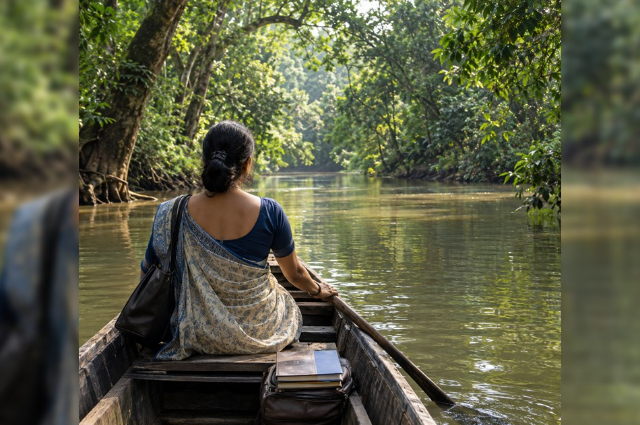
At 7.30 every morning, when much of the world is beginning an ordinary working day, K. R. Ushakumari begins a journey that is anything but ordinary. She leaves her home in Amburi, in Thiruvananthapuram district of Kerala, and travels to Kunnathumala, where a small school sits deep inside the Agasthyarkoodam Biosphere Reserve. Her destination is not a large campus filled with classrooms, laboratories and hundreds of pupils. It is a modest single-teacher school serving children from a nearby tribal settlement. For years, reaching that classroom required Ushakumari to travel by two-wheeler to Kumbikkal Kadavu, cross the water by boat and then walk several kilometres through a steep forest path. Reports describe the final trek as about four kilometres, making her daily journey roughly eight kilometres on foot and much longer when you include the scooter and boat sections. The forest route is not merely physically exhausting; it can become hazardous during heavy rain, landslides, and adverse weather. The surrounding landscape is also known for wildlife, including elephants and leopards. Yet Ushakumari repeatedly made the journey because she believed that geographical isolation should not become an educational sentence for children. She was not simply commuting to work. She was travelling towards a group of children whose access to education depended heavily upon her presence. At the Agasthya Ega Adhyapaka Vidyalaya, she taught Classes I to IV and handled subjects ranging from mathematics and English to language and environmental studies. She also supervised cultural activities, sports, and other aspects of the children's development. At times, she had to take responsibility for school administration and even ensure that children received their meals. Her story became widely known because the journey itself appeared extraordinary, but the deeper story lies in why she continued making it. She understood that the distance between a village and a school can become the distance between a child and an opportunity. For the children of Kunnathumala, therefore, her arrival each morning represented something larger than the arrival of a teacher. It represented continuity, stability, and the promise that someone outside their immediate circumstances believed their education mattered. Her journey eventually became a powerful illustration of the physical and institutional barriers that still affect education in remote parts of India.
Ushakumari's commitment to education did not begin when she was appointed to the forest school. Long before she became known for rowing across a river and trekking through woodland, she had already developed an interest in literacy and social service. In the 1980s, she worked with P. N. Panicker, widely associated with Kerala's library movement, in literacy initiatives that included efforts to educate adults and improve access to learning. She was still in Class X at the time she received the Saksharatha Puraskaram from KANFED for her work in literacy. That recognition appears to have reinforced an idea that would shape much of her later life: education should not be restricted by age, geography or social background. Ushakumari has recalled that she initially wanted to join the police and even passed the Public Service Commission test, but her family did not allow her to pursue that path. Rather than allowing that disappointment to determine her future, she moved towards social work. She became involved in projects connected with the Amboori Gram Panchayat and later worked as a field volunteer, identifying children who were outside the education system and attempting to bring them into schools. Her work exposed her to the realities of families living in remote and economically vulnerable communities. In tribal settlements, the problem was not necessarily a complete absence of parental concern for children. Physical isolation itself could make education difficult. Roads were inadequate, forest routes were dangerous, and wild animals created genuine anxiety among parents. Ushakumari therefore realised that simply constructing a school was not enough. Someone had to build trust between the school and the community. Someone had to convince parents that sending their children to class was worth the difficulty. In the early period, she visited homes and spoke with families about the importance of education. Children who initially preferred accompanying their parents to agricultural work gradually began attending classes. The transformation was slow because educational habits cannot be imposed overnight upon communities facing economic and geographical constraints. Her own experience as a social worker therefore prepared her for a role that demanded much more than teaching lessons from a textbook. She had to become an organiser, counsellor, advocate and community worker. Her early education activism eventually became the foundation upon which her later teaching career was built.
The story of Ushakumari is also a reminder that teachers themselves often carry complicated personal histories before entering a classroom. Public reporting provides limited information about her early household circumstances, but it records important details about her family life and professional aspirations. She is a native of Amburi and has been married to K. Mohanan, who has been reported to work as a loading labourer. The couple has two children, Monish and Reshma. Her family therefore did not belong to an elite professional environment that could automatically provide financial security or institutional influence. Her path was shaped by work, public service and a sustained commitment to education. Her son later became a qualified teacher and, according to reports, sometimes substituted for her when she was unable to attend to school duties. This detail is significant because it suggests that her commitment to education influenced the next generation within her own household. Her family was also part of the practical support system that enabled her to continue her demanding work. Ushakumari has spoken about occasionally using groceries from home for the school when necessary, while her family understood the unusual demands placed upon her. Her professional life could not be neatly separated from her domestic responsibilities. She had to travel for hours, teach several classes, manage school-related responsibilities, and then return home, sometimes reaching only in the evening. Yet the school remained a priority because she regarded the children as her responsibility. Her educational background also needs to be understood within the context of her early social-service work rather than through the conventional model of a teacher who follows a straightforward academic route into the profession. She was already involved in literacy work while she was still completing her own schooling. The experience of working with adult learners and disadvantaged children became an informal education in itself. It taught her how to communicate with people who might distrust institutions, how to encourage families and how to adapt education to circumstances. Her story therefore challenges the narrow belief that the value of an educator can be measured solely through certificates. Qualifications are important, particularly within a formal education system, but Ushakumari's career demonstrates the significance of field experience, perseverance and social understanding. Her knowledge was accumulated not only in classrooms but also in villages, forest settlements, community meetings and conversations with parents.
The decisive chapter of Ushakumari's career began when Kerala introduced single-teacher schools in remote tribal areas to provide primary education where conventional schools were difficult to establish. The programme was designed for settlements in which the number of children was too small to support a conventional multi-teacher school. Ushakumari joined this system after years of field-based educational work. Between 1999 and 2002, she taught at another single-teacher school in the Kottoor forest area before moving to Kunnathumala, where she remained for more than two decades. The institution at Kunnathumala, known as Agasthya Ega Adhyapaka Vidyalaya, served children from the surrounding tribal settlement. The school offered Classes I to IV, meaning that one teacher was responsible for several age groups simultaneously. This arrangement demanded considerable versatility. Ushakumari had to shift between subjects, learning levels, and individual educational needs throughout the day. A conventional teacher may prepare lessons for one grade and one subject, but a single-teacher school requires a much broader pedagogical range. One child might be learning basic reading while another is preparing for a more advanced primary-level lesson in mathematics. Ushakumari nevertheless understood that the children's transition after Class IV would depend on how well she prepared them for mainstream schools. She therefore emphasised not merely academic content but confidence, communication, extracurricular participation and general competence. The school became a bridge between a remote tribal settlement and the wider education system. Before the school had adequate premises, teaching sometimes took place on verandahs, rock surfaces or beneath trees. Establishing a permanent structure required years of persuasion and community engagement. Ushakumari's role in that process demonstrates that teachers in underserved regions may participate in institution-building as much as instruction. The school was not simply a workplace assigned to her; it became an educational institution whose survival was closely connected with her presence. She also had to understand the children's cultural environment rather than imposing an entirely external model of education. Her work involved incorporating their language, traditions, and experiences into learning while preparing them to enter a wider academic environment. In this sense, she functioned as both teacher and bridge-builder between two worlds.
The most widely remembered part of Ushakumari's story is her daily journey, and the details reveal why it demanded extraordinary endurance. Her route began from Amburi, where she lived, and continued towards Kumbikkal Kadavu. She travelled by scooter to the riverbank, parked the vehicle, and then crossed the water by boat. When a boatman was available, she travelled with him, but when conditions required it, she also helped row. Strong winds could make the crossing more difficult, while heavy rain could transform the entire journey into a hazardous undertaking. After reaching the opposite bank, the most demanding stage began. She had to trek approximately four kilometres through the hills of Kunnathumala, including an uphill section through forest terrain. She sometimes walked with children who joined her on the way, turning part of her commute into an informal procession towards school. The entire journey could take around two to two-and-a-half hours in one direction depending on circumstances, although accounts differ slightly because of the route and mode of transport described. By the end of the day, she had to undertake the same difficult journey in reverse. On some occasions, she reached home around 8 p.m. The physical strain was intensified by her health, as reports note that she suffered from asthma and had fallen during the trek on several occasions. The forest itself added another layer of uncertainty. She had heard warnings about elephants and leopards in the area, although she said she had not personally encountered them during the years of her commute. Landslides, unpaved paths and torrential rain could make the route impassable. During particularly difficult weather, she sometimes stayed overnight at a student's home rather than risk travelling back through dangerous conditions. Such decisions demonstrate that her relationship with the community extended beyond the formal school timetable. She was embedded in the lives of the families whose children she taught. Her journey therefore cannot be reduced to a romantic image of a teacher walking through a forest. It was a physically demanding routine that exposed her to genuine risks and consumed a significant portion of every working day. Yet she continued because the alternative could have been a classroom without a teacher and children without consistent access to education.
Inside the classroom, Ushakumari's responsibilities were almost as extensive as the journey that brought her there. She was not merely responsible for teaching a few lessons and leaving when the school day ended. As the lone teacher, she was effectively the principal, administrator, classroom instructor, and, at times, caretaker of the children's daily needs. The school served children from Classes I to IV, and she taught mathematics, English, language, and environmental studies. She also encouraged cultural programmes, sports, music, art and other extracurricular activities because she believed the children needed to become confident before entering larger schools. This was particularly important because children from remote settlements could find themselves entering mainstream educational environments where other pupils had enjoyed more consistent access to resources. Ushakumari therefore tried to prepare her students not simply to pass examinations but to participate confidently in a wider social environment. She paid close attention to individual children's abilities and interests. One of the most memorable examples involved a boy named Jayachandran, who had difficulty speaking and had a cleft lip. Initially, he appeared uninterested in studying. Instead of concluding that he was incapable of learning, Ushakumari searched for a subject that could engage him. She discovered his interest in vehicles and began bringing him pictures of cars and buses. Gradually, his interest became a bridge into reading. By Class IV, he was reportedly able to read well. The child's response to her encouragement was equally memorable: after she jokingly said that she deserved an award for trying so hard, he brought her a packet of tamarind as his own idea of an award. For Ushakumari, that small gesture represented something more valuable than a formal prize. It demonstrated that the child had begun to understand affection, effort, and recognition in his own way. Her teaching philosophy therefore depended on patience rather than rigid uniformity. She looked for the individual interest that could unlock a child's attention. This approach is especially relevant in communities where children may arrive at school with different levels of preparation, confidence and familiarity with formal education. Her success cannot be measured only by examination results. It can also be seen in children who developed enough confidence to continue studying after leaving her school.
The nutritional and administrative responsibilities attached to the school added another dimension to Ushakumari's work. The children needed more than lessons, particularly because many came from economically vulnerable families. Ushakumari helped ensure that they received food such as milk and eggs along with the midday meal. A caretaker was involved in cooking and assisting with the school, while other organisations also supported breakfast arrangements at different points. Yet when official funds or payments were delayed, Ushakumari sometimes spent her own money on necessities for the children. This reveals the contradiction at the heart of her career. She was performing a public educational function in a remote area, but the institutional support available to her was not always sufficient or timely. Her remuneration was described in reports as a salary or honorarium that could arrive irregularly, sometimes after several months. In 2020, she publicly protested because she had not received her salary for five months and because teachers working in single-teacher schools faced uncertainty about permanent employment. She argued that the dedication of teachers should not be celebrated through awards while their basic employment security remained unresolved. The financial reality of her life therefore deserves to be included in any honest biography. It would be misleading to portray her as a wealthy philanthropist who sacrificed money for education. She was herself a modestly paid educator whose financial position could become precarious when remuneration was delayed. Reports from 2022 indicate that after the single-teacher schools were closed or restructured, Ushakumari was appointed as a permanent sweeper at a government higher secondary school in Thiruvananthapuram. At the time, she was reported to be 54 and said she was relieved to have obtained a permanent government position with better remuneration, even though she missed teaching the young children. This later development is particularly important because it gives the story an ending grounded in reality rather than mythology. A person can devote decades to public service and still face institutional insecurity. Recognition does not automatically guarantee financial stability. Ushakumari's experience therefore raises a wider question about how India values teachers who work in the most inaccessible regions. The admiration generated by photographs of a teacher crossing a river should ideally be accompanied by reliable salaries, professional security, adequate infrastructure, and additional teaching staff.
Money was never the central measure by which Ushakumari evaluated her work, but financial hardship remained an undeniable part of her professional life. Unlike an entrepreneur who can potentially build wealth through a growing enterprise, she worked within a public educational arrangement where her remuneration was modest and, at times, delayed. There is no credible public evidence establishing her personal net worth, and assigning a figure would therefore be irresponsible. Her standard of living should likewise not be exaggerated. Available reporting instead portrays a working family in which her husband was a loading labourer and where she occasionally used household resources to support the school. The financial sacrifices were small in monetary terms compared with the value of what she provided, but they were still sacrifices for a family living on ordinary incomes. Her scooter, which she eventually purchased to reduce the walking portion of her commute, was not a symbol of luxury but a practical investment to make an exhausting journey marginally more manageable. In some circumstances, she had to pay for transport herself, while reports during the COVID period recorded substantial travel costs if she used alternative routes to reach the school. Her experience demonstrates an important distinction between social impact and personal prosperity. A person can create enormous social value without becoming financially affluent. In fact, Ushakumari's life illustrates how people working at the margins of public systems can sometimes subsidise those systems through their own time, money and labour. She bought food for children when funds were unavailable. She travelled for hours without receiving additional benefits. She managed responsibilities beyond her formal teaching role. She continued despite uncertainty regarding her employment. These facts make the story more compelling because the achievement was not purchased through wealth. It emerged from persistence under financial constraints. Her eventual permanent government appointment as a sweeper provided greater employment security, although it also meant moving away from the teaching role that had defined much of her adult life. In financial terms, that transition may have improved stability. In professional terms, it represented a profound change. She had spent more than two decades building relationships with children and communities, only to find herself in another government role after the educational programme changed. Her story therefore contains both inspiration and injustice: inspiration because of what she achieved, and injustice because such extraordinary dedication coexisted with years of insecurity.
The strongest evidence of Ushakumari's impact is not the number of kilometres she travelled but what happened to the children after they left her classroom. She has taught more than 200 students over the course of her work at the school, according to reporting, and many of her former students went on to complete higher education or obtain employment. She took particular pride in hearing that former pupils had pursued courses such as teacher training and science degrees and had entered government employment. For children growing up in isolated tribal settlements, these achievements represented a considerable expansion of possibility. Ushakumari understood that the primary school was only the beginning. The more difficult question was whether children would continue studying after Class IV and beyond. Girls sometimes had better access to hostel facilities that enabled them to continue education outside their settlement. Boys, she observed, often faced greater difficulties finding accommodation and consequently returned to traditional forms of work after Class X. This problem illustrates why educational access cannot be separated from infrastructure, residential facilities and household economics. A child may complete primary school and still face barriers to secondary or higher education. Ushakumari's concern therefore extended beyond the immediate classroom. She wanted her pupils to become capable of navigating a larger educational system. Her relationship with former students also demonstrates how teaching creates effects that cannot be measured within a single academic year. A former student meeting her years later as a government employee could remember the teacher who had once walked through the forest to reach their classroom. Such encounters became a form of recognition more meaningful than a certificate. One former pupil even became a government-office clerk and, upon recognising Ushakumari, treated her with special warmth and respect. These moments reveal the reciprocal nature of education. The teacher gives knowledge, but the student's later achievements return meaning to the teacher's labour. Ushakumari has repeatedly said that seeing her students succeed is her greatest reward. That philosophy is important because it shifts attention away from individual heroism towards long-term social transformation. Her achievement is not that she became famous. It is that children who might otherwise have remained trapped by geography were allowed to move beyond it.
Ushakumari's later struggle also reveals the uncomfortable side of a system that celebrates exceptional teachers without always protecting them. In 2020, after decades of work in single-teacher schools, she went on hunger strike to demand permanent employment and the payment of salary arrears. The protest followed years of uncertainty surrounding teachers working under the single-teacher-school model. These schools had originally been supported through programmes connected with the central government's educational initiatives before responsibilities shifted to the state's General Education Department. Changes in educational regulations, including requirements related to teacher training qualifications, complicated the future of teachers who had entered these remote schools at a time when few formally qualified candidates were willing to work in such difficult locations. Ushakumari argued that the teachers had served where the system urgently needed them and deserved a secure professional future. Her protest exposed a broader structural issue: remote education often depends upon individuals willing to accept conditions that more formally structured institutions struggle to fill. The public may celebrate such teachers precisely because their work is exceptional, yet the fact that their working conditions are exceptional can also indicate a failure of the system to provide ordinary institutional support. Ushakumari's story therefore should not be reduced to the sentimental idea that teachers must sacrifice everything for their students. Sacrifice can inspire society, but sustainable education requires systems that do not depend indefinitely on personal sacrifice. Teachers need dependable salaries, adequate training, safe transport, housing where necessary, and colleagues who can share the workload. A single teacher should not have to become an entire school administration. Nor should a teacher's commitment be used as an excuse to postpone legitimate employment rights. The later government decision to provide permanent positions to former single-teacher-school educators brought some stability to their lives. By 2022, Ushakumari had accepted a permanent sweeper position and expressed relief that she finally had job security. Her acceptance was pragmatic rather than triumphant. She missed teaching children, but she recognised the importance of a stable livelihood. This final chapter makes her biography more human. She was not an invincible figure untouched by exhaustion, disappointment, or financial anxiety. She was a worker who continued serving children while simultaneously trying to secure a dignified livelihood for herself.
The story of K. R. Ushakumari ultimately asks a simple but powerful question: what does it mean to become a teacher when the road to the classroom is itself an obstacle? For more than two decades, she answered that question through action. She travelled from Amburi towards Kunnathumala, crossed water, climbed forest paths and entered a classroom where children were waiting for her. She taught them mathematics, languages, environmental studies and the skills necessary to enter a wider educational world. She encouraged children who struggled, supported those who lacked confidence and tried to make sure that education was not interrupted by poverty or geography. She also carried the less visible burdens of teaching: arranging meals, managing school needs, using household resources when necessary and working through uncertain financial circumstances. Her career began with literacy activism and social work and developed into a teaching mission that brought education closer to a community that had once found school physically inaccessible. Her family remained part of the story, as her husband and children supported a life that demanded unusual commitment. Her son eventually became a teacher, suggesting that the values she cultivated within her own family travelled into another generation. Her financial circumstances remained modest, and there is no reliable evidence for a personal net-worth figure. Her real wealth was measured differently: in students who continued their studies, former pupils who found employment, children who learnt to read and communities that gradually became more confident about education. Even her later appointment as a permanent sweeper does not erase the significance of her teaching years. Instead, it reveals the complicated relationship between individual dedication and public institutions. Ushakumari's life demonstrates that education in rural and tribal India is not only a question of school buildings, textbooks, and government schemes. It is also a question of human presence. A school becomes meaningful when someone is willing to reach it, teach within it, and remain committed to the children who depend upon it. Her journey reminds us that the distance of education is sometimes measured not in kilometres but in opportunity. Every morning, she crossed that distance. Every evening, she returned carrying the fatigue of the journey and the knowledge that another day of learning had been completed. Her story is inspiring not because she travelled eight kilometres, but because she refused to believe that eight kilometres should decide the future of a child.