
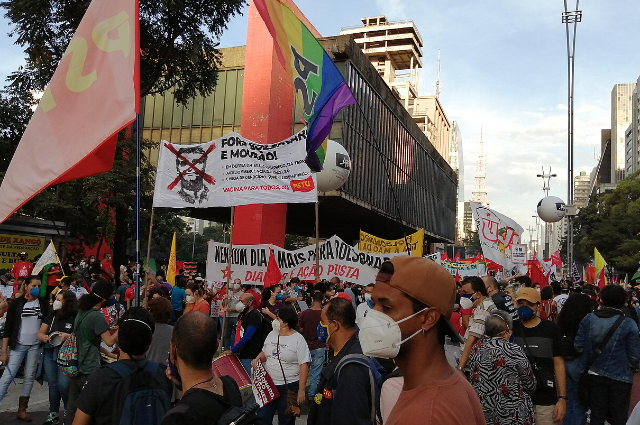
RIO DE JANEIRO, Brazil, Thousands of students and other demonstrators marched through downtown Rio de Janeiro on October 7, 2026, to protest against the possibility of far-right senator Flávio Bolsonaro becoming Brazil’s next president. The demonstration took place three days after the first round of the presidential election, in which Bolsonaro finished ahead of incumbent President Luiz Inácio Lula da Silva but failed to secure an outright victory. The two candidates were scheduled to face each other in a second round on October 25. The march reflected growing political tensions in Brazil, where voters were divided over democracy, national sovereignty, social equality and the country’s future direction. Many demonstrators wore red clothing and carried banners defending democratic values. Others displayed messages opposing the Bolsonaro family’s return to power. The protesters said their movement was about protecting Brazil’s future rather than simply supporting Lula. Their demonstration came at a crucial moment, as the country prepared for a closely contested election that could determine its political direction for the next four years.
The first round of voting on October 4 produced a strong result for Flávio Bolsonaro, who received approximately 47 per cent of the valid votes, compared with about 45 per cent for Lula. Neither candidate crossed the 50 per cent threshold required to win the presidency outright, making a runoff necessary. Bolsonaro finished roughly two million votes ahead of the incumbent, giving his campaign an early advantage. Candidates who placed third, fourth and fifth, all from the political right, collectively received more than eight million votes. Their supporters could therefore influence the outcome of the second round. However, the first-round result did not guarantee Bolsonaro victory, and Lula’s campaign continued to seek support among undecided voters and younger people. The narrow difference between the two leading candidates highlighted the divisions within Brazilian society. For students and other demonstrators in Rio, the election represented more than a contest between two political figures. They saw it as a decision about the kind of government Brazil should have and the values that should guide its future.
The protest moved through central Rio de Janeiro between historic public squares, including the area around Cinelândia, where demonstrators chanted slogans and raised banners. Many participants wore red, a colour associated with Lula’s Workers’ Party, while others used Brazil’s national colours to express their own understanding of patriotism. Talita Amaral, a 19-year-old environmental science student, wore the country’s familiar yellow and green football jersey, colours often associated with Bolsonaro’s supporters. She explained that her choice was an attempt to reclaim the national colours rather than leave them identified with one political side. “We’re fighting for Brazil, not for Lula,” she said. Amaral also urged fellow citizens to remain active, communicate through WhatsApp groups and persuade others to participate in the political debate. Her words reflected the determination of young demonstrators who believed that public participation was essential during the election. Other protesters carried messages such as “Never again Bolsonaro” and “No to the father, no to the son.” Their slogans showed that opposition to the Bolsonaro family was closely linked to wider concerns about democracy and political accountability.
Much of the opposition to Flávio Bolsonaro was connected to the record of his father, former president Jair Bolsonaro, who governed Brazil from 2019 to 2023. Jair Bolsonaro’s presidency was marked by controversy over his political statements, his handling of the COVID-19 pandemic and his attacks on the credibility of the country’s electoral system. Brazil recorded approximately 700,000 reported COVID-19 deaths during the pandemic. Critics also accused the former president of encouraging political hostility and weakening public confidence in democratic institutions. Following Lula’s victory in the 2022 presidential election, Bolsonaro’s supporters stormed government buildings in Brasília in January 2023, in an attempt to challenge the transfer of power and encourage military intervention. Jair Bolsonaro was later convicted of plotting a coup and sentenced to 27 years in prison. He was also barred from holding elected office for eight years under an earlier electoral ruling. His son’s presidential campaign therefore raised concerns among people who feared that the country could return to a period of political confrontation. Flávio Bolsonaro’s support for amnesty for his father added to those concerns. For many protesters, the election was also a judgment on the political legacy of the former president.
Concerns about corruption, economic interests and foreign influence also shaped the demonstrations. Flávio Bolsonaro faced scrutiny over alleged links to the failed Banco Master, with allegations involving corruption, money laundering and tax evasion. These matters were under investigation, and allegations should not be treated as proof of guilt. Protesters also criticised the possibility that a Bolsonaro-led government could bring Brazil closer to the United States under President Donald Trump. The political relationship between Trump and the Bolsonaro family had become a subject of debate, particularly after Washington imposed a 50 per cent tariff on Brazilian goods and sanctions on a Brazilian Supreme Court justice in 2025. Trump described Jair Bolsonaro’s trial as a “witch hunt.” Some demonstrators feared that closer political alignment with Washington could affect Brazil’s independence in international affairs. João Victor Vieira, a 20-year-old literature student, warned that a Bolsonaro victory could make Brazil excessively dependent on the United States. He also expressed concern about the rights of women, people of colour and LGBTQ+ communities, pointing to Jair Bolsonaro’s past homophobic remarks. Such concerns helped explain why protesters connected the presidential election with national sovereignty, social protection and the rights of minority groups.
The election debate later extended beyond the streets to the role of social media platforms. Before the runoff, Lula’s campaign accused Meta, the company that owns Facebook, Instagram and WhatsApp, of restricting the reach of content associated with the incumbent while allowing content supporting Bolsonaro to circulate more widely. Meta denied treating the campaigns unequally. The dispute raised questions about how digital platforms distribute political messages and whether their systems can affect voters’ access to information during an election. Reports of differences in audience reach, content visibility and account restrictions also attracted attention from experts concerned about freedom of expression. Brazil’s Superior Electoral Court subsequently required Meta and X to provide technical explanations about the distribution of political content, the use of artificial intelligence and electoral advertising. The companies faced a 24-hour deadline to respond to the court’s order issued shortly before the runoff. On October 19, protesters were also reported to have gathered outside Meta’s São Paulo offices over allegations of electoral interference. The accusations remained allegations rather than established proof that the company had deliberately favoured one candidate. The controversy nevertheless showed how social media had become an important part of the wider political struggle.
On October 25, Lula won the presidential runoff, securing approximately 51.8 per cent of the valid votes against Bolsonaro’s 48.2 per cent. According to Brazil’s Superior Electoral Court, Lula received 64,256,232 votes, while Flávio Bolsonaro received 59,826,041. The difference was approximately 4.43 million votes. The result gave Lula a fourth presidential term, making him the first person in Brazil to be elected president four times through direct democratic elections. His victory also marked a major turnaround after Bolsonaro had led the first round. However, the result was followed by a dispute over the extension of voting hours. Supreme Court Justice Cristiano Zanin ordered voting to continue until 7 p.m. after reports of transport difficulties affecting voters. The decision initially applied nationwide, while the electoral authorities subsequently clarified its implementation for polling stations that remained open. Bolsonaro criticised the ruling, arguing that the rules had been changed too late in the process. However, reports also stated that his own campaign had requested an extension because of weather-related difficulties in some regions. Bolsonaro refused to accept the result and announced that he would pursue legal action to seek annulment of the election. The dispute raised further questions about public confidence in the electoral process, but the objections themselves did not establish that the result was fraudulent.
The outcome of Brazil’s election has left the country facing the challenge of maintaining democratic stability amid deep political divisions. Lula’s victory allows his government to continue its left-wing programme, while the strong support for Flávio Bolsonaro demonstrates that the political movement associated with his father remains influential. The campaign exposed disagreements over economic management, public security, national sovereignty, social rights and Brazil’s relationship with the United States. It also highlighted the role of students, social movements and digital communication in shaping political debate. During the October 7 march, literature student João Victor Vieira said the demonstration showed that social movements remained active and prepared to resist political changes they considered dangerous. His statement captured the determination of demonstrators who believed that democracy required continued public participation. Although no election can immediately resolve every division within society, the peaceful exercise of voting and the lawful handling of electoral disputes remain central to democratic government. As Brazil moves towards Lula’s new term, the challenge will be to respect the result, address citizens’ concerns and protect democratic institutions. The protests in Rio demonstrated that, for many Brazilians, the country’s political future is not merely a matter of choosing a president but also of deciding what kind of nation they want to build.
References:
- “Lula Says Rival Should Be Disqualified Over Alleged Meta Interference Ahead of Brazil Vote.” BBC News.
- “‘No to the Father, No to the Son’: Thousands March in Rio Against Bolsonaro.” Al Jazeera.
- “Brazilian Students in Rio de Janeiro March Against the Prospect of Another Bolsonaro Presidency.” The Hindu.
- “Brazilian Students in Rio de Janeiro March Against the Prospect of Another Bolsonaro Presidency.” Associated Press (AP News).