
In an age where social media erupts daily over gender equality, women's rights, consent and personal freedom, it is easy to assume these are distinctly modern concerns. Politicians debate them, activists campaign for them, and Generation Z passionately discusses them across digital platforms. Yet, long before hashtags and legislative reforms entered public discourse, some of India's indigenous communities had already built societies that quietly embodied many of these values.
Among them are the Muria tribe of Chhattisgarh and the Khasi tribe of Meghalaya—two communities separated by geography but united by remarkably progressive social traditions. Their stories challenge conventional assumptions about Indian society and offer lessons that remain profoundly relevant in the twenty-first century.
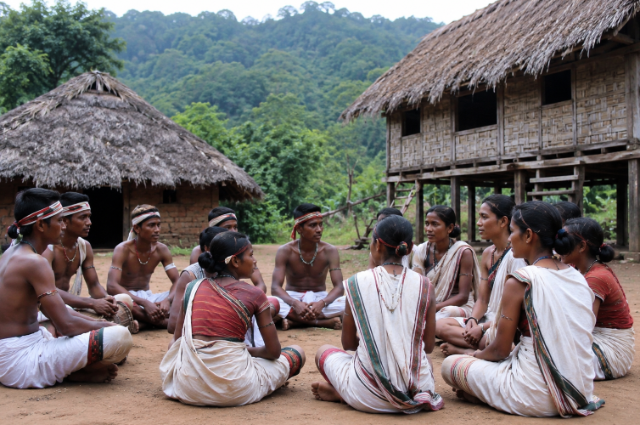
The Muria are an indigenous Adivasi community belonging to the larger Gondi people of Bastar in Chhattisgarh. Historically, they have been known for a unique social institution called the Ghotul—a communal dormitory where unmarried young men and women gather, learn, socialise, and prepare for adulthood.
To an outsider, the concept may appear unconventional. However, the Ghotul was never merely a place for companionship. It functioned as a cultural academy, a democratic social space, and an educational institution where tribal youth learned responsibility, cooperation, folklore, music, dance and community values.
Most strikingly, it recognised the autonomy of young people in choosing their life partners. Relationships were based on mutual affection and consent rather than coercion or family pressure. A young man could express his desire for commitment, but the woman retained the unquestionable right to accept or reject his proposal. In a world where conversations about consent often seem revolutionary, the Muria had embedded this principle into their social fabric generations ago.
Ironically, while modern India celebrates the language of freedom and individual choice, many young people continue to struggle against rigid social expectations regarding marriage and relationships. The Muria experience reminds us that progress is not always a linear journey from tradition to modernity. Sometimes, traditions themselves can be remarkably progressive.
Yet the Muria story is not merely one of cultural sophistication. It is also a story of displacement, resilience, and survival.
Thousands of Muria families were forced to flee their ancestral lands in the Dandakaranya region during the violent conflict between Maoist insurgents and Salwa Judum, a controversial anti-Naxalite movement supported by the state government in Chhattisgarh. Seeking safety, many crossed into the forested border regions of Andhra Pradesh and established new settlements.
Today, these settlements exist in a legal and humanitarian limbo. Located within reserved forest areas along India's Red Corridor, they remain vulnerable to eviction despite decades of habitation. Access to necessities such as quality education, healthcare, clean drinking water and social welfare schemes remains severely limited.
These displaced communities are classified as Internally Displaced Persons (IDPs)—people who have been forced to leave their homes without crossing an international border. Their population in Andhra Pradesh is estimated at around 6,600. Locally, they are often referred to as "Gutti Koyas."
The contradiction is striking. A community that once pioneered progressive social practices now struggles for fundamental rights and recognition. Their story raises uncomfortable questions about development, citizenship and the invisibility of indigenous peoples within mainstream narratives.
If the Muria represent a unique approach to personal freedom, the Khasi people of Meghalaya offer an equally fascinating model of gender relations.
The Khasi society is one of the world's few surviving matrilineal cultures. Here, lineage is traced through the mother rather than the father. Property passes from mother to daughter, and the youngest daughter, known as the Ka Khadduh, inherits ancestral assets and assumes responsibility for caring for elderly parents.
Marriage in Khasi society also reverses many conventional expectations. Husbands traditionally move into the wife's household, and children inherit their mother's clan identity. The birth of a daughter is celebrated not because sons are unwanted, but because daughters ensure the continuity of family lineage and heritage.
For many Indians raised in patriarchal settings, such customs can seem astonishing. Yet for the Khasi, these practices are neither radical nor political—they are simply part of everyday life.
Importantly, matriliny should not be confused with matriarchy. Khasi society does not exclude men from leadership or community decision-making. Rather, it distributes responsibilities differently, creating a balance between maternal inheritance and broader social participation.
The experiences of both tribes reveal a profound truth often overlooked in mainstream discourse: gender equality and personal autonomy are not exclusively Western ideas, nor are they recent inventions. Indigenous communities across India have long experimented with social systems that challenge rigid hierarchies and prioritise human dignity.
For Generation Z, these stories hold particular significance. Young people today are increasingly questioning inherited norms about relationships, marriage, gender roles and identity. The Muria and Khasi demonstrate that alternative social arrangements have existed for centuries—not as theoretical concepts, but as lived realities.
At the same time, these communities remind us that cultural progress alone does not guarantee economic security or political protection. The Muria, despite their rich traditions, continue to face displacement and marginalization. Their predicament illustrates how indigenous wisdom is often celebrated symbolically while indigenous people themselves remain excluded from development.
As India advances toward a technologically sophisticated future, it would be wise to remember the lessons preserved within its oldest communities. The Muria teach us that consent and personal choice can flourish within tradition. The Khasi demonstrate that women can occupy central positions in family and property structures without social collapse.
Perhaps the real question is not whether these tribes were ahead of their time. The question is whether the rest of society is finally beginning to catch up.
In the forests of Bastar and the hills of Meghalaya, ideas that dominate modern debates have existed quietly for centuries. We would do well to listen.
Resource
- United Nations Guiding Principles on Internal Displacement.
- Anthropological studies on the Muria tribe and Ghotul institution in the Bastar region, Chhattisgarh.
- Supreme Court of India – Judgment declaring the arming of civilians through Salwa Judum unconstitutional (2011).
- Verrier Elwin – The Muria and Their Ghotul.
- United Nations Guiding Principles on Internal Displacement.