
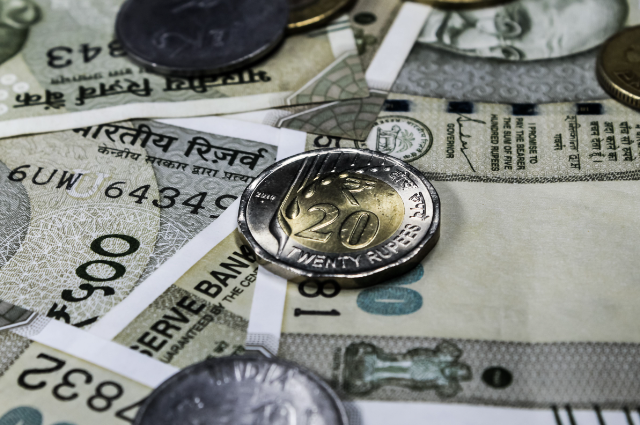
There was a time when the number attached to the Indian rupee against the U.S. dollar seemed like a distant figure, something discussed by economists, bankers and traders rather than ordinary households. In 2026, however, the number has become increasingly difficult to ignore. On September 24, the Indian rupee weakened by 23 paise to close provisionally at ₹95.96 against the U.S. dollar after touching an intraday low of ₹95.98. The previous day, it had closed at ₹95.73, after gaining 16 paise on September 22. The currency has therefore come remarkably close to the psychologically important ₹96-per-dollar level, with the Reserve Bank of India repeatedly intervening to prevent a disorderly breach. Reuters reported that state-owned banks, likely acting for the RBI, were selling dollars as oil prices rose and concerns about further global rate increases intensified. Yet ₹96 is not merely a number on a foreign-exchange screen. It represents the cumulative effect of several forces moving through India's economy at the same time: expensive crude oil, strong demand for dollars, higher U.S. yields, geopolitical uncertainty, foreign portfolio outflows and a widening merchandise trade deficit. On September 24, Brent crude was trading around $105.90 a barrel, sharply above the roughly $72 level seen in late February before the Iran conflict, while the U.S. dollar index was around 100.99. The pressure is particularly important because India's economy remains heavily dependent on imported energy. Every rise in the international price of oil increases the number of dollars Indian importers need, while every large foreign-investor withdrawal can reduce the supply of dollars entering financial markets. The rupee's story, therefore, is not simply about a currency becoming weaker. It is about the relationship between the dollars India earns, the dollars it needs and the confidence of investors deciding where their capital should remain. This is why the foreign-investor question matters. When overseas investors sell Indian assets, the transaction can eventually involve converting rupees into dollars and taking the funds abroad. That does not mean every rupee of foreign selling causes an equal fall in the exchange rate; domestic investors, exporters, banks and the RBI can absorb some of the pressure. But when capital outflows occur alongside an oil shock and a stronger dollar, the exchange rate becomes much more vulnerable. The current episode is therefore best understood as a slow-moving external pressure rather than a single-day collapse.
The scale of foreign portfolio selling makes that pressure easier to understand. Foreign Portfolio Investors, or FPIs, have withdrawn ₹2.45 lakh crore from Indian equities so far in 2026, according to data reported by CDSL, already exceeding the ₹1.66 lakh crore withdrawn during the whole of 2025. In September alone, FPIs had withdrawn ₹20,974 crore from equities up to September 18. That followed a brief reversal in July and August, when foreign investors invested ₹20,200 crore and ₹29,630 crore respectively. Before those two months of buying, FPIs had remained net sellers for four consecutive months from March through June. The significance of these numbers lies not simply in the amount of money leaving Indian shares, but in what drives investors to make that decision. Higher U.S. interest rates and Treasury yields can make dollar-denominated assets relatively more attractive. On September 16, the U.S. Federal Reserve raised its federal funds target range by 25 basis points to 3.75–4.00%, its first rate increase since 2023. The Federal Reserve's current policy rate is officially listed at 3.75–4.00%. At the same time, rising oil prices increase India's import bill and revive concerns about inflation. For an international investor, these forces can change the calculation behind holding an Indian asset. The investor is not only asking whether an Indian company can generate profits; the investor is also considering what those profits will be worth after being converted back into dollars. A weakening rupee can reduce dollar-denominated returns even when the underlying Indian investment performs reasonably well. This creates a complicated feedback mechanism. Foreign selling can increase demand for dollars, putting pressure on the rupee. A weaker rupee can then reduce the attractiveness of Indian assets for some overseas investors, particularly when U.S. yields are rising. That can encourage further caution. But this should not be exaggerated into a simple automatic cycle in which every foreign sale causes another fall. India's domestic savings pool, services exports, remittances, foreign direct investment and central-bank intervention provide counterweights. Indeed, foreign investment is not disappearing from India altogether; capital continues to enter through primary markets and other channels. The latest FPI numbers therefore tell a story of changing composition and risk appetite rather than the disappearance of foreign confidence in the Indian economy. The distinction matters because India is still growing strongly. The economy expanded 7.8% year-on-year in the April–June quarter of 2026, supported by investment and manufacturing activity. A strong growth rate and a weak currency can exist at the same time. One measures the expansion of economic activity; the other reflects the price of the currency in international markets.
The other major force is oil, and this is where India's structural vulnerability becomes visible. India is one of the world's largest oil importers, and a large share of its crude requirement is met through imports. Oil is traded internationally in dollars, which means that when crude becomes more expensive, Indian refiners and importers need more dollars to purchase broadly the same physical quantity of energy. The result is straightforward: demand for dollars rises, and the rupee comes under pressure. The problem becomes more severe when geopolitical tensions simultaneously push oil prices higher and encourage global investors to seek the U.S. dollar as a safe-haven asset. That is precisely the combination visible in September 2026. Reuters reported on September 24 that renewed concerns surrounding the U.S.-Iran conflict and limited diplomatic progress had pushed oil higher, while the stronger dollar and expectations of further global rate increases added pressure to emerging-market currencies. India's merchandise trade figures show why this matters beyond the oil market. In FY2025–26, merchandise exports were $441.78 billion, compared with merchandise imports of $774.98 billion, leaving a merchandise trade deficit of $333.19 billion. The deficit had been $283.50 billion in FY2024–25. Services exports and remittances provide important support, and they prevent the merchandise deficit from translating mechanically into an equal deterioration in the current account. RBI Deputy Governor Poonam Gupta recently highlighted the resilience of India's services exports and remittances and said they are large enough to help keep the current-account deficit below 1% of GDP. She also said India's balance of payments had recorded deficits of about $5 billion in 2024–25 and $23.6 billion in 2025–26, as the capital-account surplus fell short of the current-account deficit. The trade picture therefore contains two stories at once. India has a powerful services sector, a large domestic market and substantial remittance inflows, but it also has a large merchandise import bill, particularly when energy prices rise. This explains why oil shocks can reach households indirectly. A more expensive dollar raises the rupee cost of imported crude; imported fuel affects transport and production costs; higher input costs can spread through goods and services; and imported products such as electronics, medicines, machinery, fertilisers and gold can become more expensive in rupee terms. The impact is also visible in international education and travel. A student paying university fees in dollars, a family purchasing an international flight or a consumer paying for an imported product is effectively exposed to the exchange rate. A weaker rupee does not mean that every domestic price rises immediately or by the same proportion, because companies can absorb some costs and government policy can cushion others. But the direction is clear: the weaker the rupee becomes, the more expensive foreign currency becomes for Indian consumers and businesses.
The United States adds another layer to the story because the dollar does not operate merely as another currency; it remains the principal international reserve and settlement currency. When U.S. yields rise, international investors can reassess the relative attractiveness of emerging-market assets. The September 2026 rate increase by the Federal Reserve to 3.75–4.00% has therefore mattered for currencies far beyond the United States. Rising Treasury yields can attract capital towards dollar assets, while higher U.S. interest rates can reduce the yield advantage previously available in emerging markets. For India, that global shift has arrived at an inconvenient moment. Oil prices are elevated, geopolitical tensions remain intense and foreign investors have been reducing their exposure to Indian equities for much of 2026. The United States has also created additional uncertainty through its trade policy. Earlier tariff measures affecting Indian exports reached 50% during a particular tariff episode, while subsequent policy developments have continued to create uncertainty around trade and Russian-oil purchases. In September, Reuters reported that proposed U.S. legislation could impose tariffs of up to 100% on countries purchasing significant quantities of Russian oil, including India, raising concerns about India's energy security and access to its largest export market. It would nevertheless be inaccurate to attribute the rupee's decline to U.S. tariffs alone. Exchange rates respond to several variables simultaneously, and the September pressure has been especially closely connected with oil, U.S. yields, dollar demand and capital flows. Trade policy matters because it can influence export competitiveness, corporate earnings expectations and investor sentiment, but it is only one part of the larger equation. There is an important irony here. A weaker rupee can make Indian exports cheaper in foreign-currency terms, potentially improving competitiveness. But that advantage is not automatic. Indian exporters may themselves depend on imported machinery, components, energy or raw materials. If imported inputs become more expensive, part of the benefit of currency depreciation disappears. India's challenge, therefore, is not simply to have a cheaper currency. It is to build an export structure capable of generating sustained foreign-exchange earnings without depending excessively on imported inputs. The government has been pursuing manufacturing and production-linked incentives, while India has also been expanding trade agreements. The India–New Zealand free-trade agreement, signed in April 2026, is scheduled to enter into force on October 20 and is part of India's broader effort to diversify export markets. The long-term question is whether such measures can expand India's export capacity sufficiently to reduce vulnerability to global dollar cycles.
The comparison with Pakistan makes the currency story more interesting, but also more complicated than a headline suggesting that the Pakistani rupee is “overtaking” the Indian rupee. It is not. On September 24, 2026, the INR/PKR exchange rate was around ₹1 = PKR 2.89. That means one Indian rupee still buys more than one Pakistani rupee. What has changed is the gap. Around May 2025, one Indian rupee was worth roughly 3.3 Pakistani rupees; by September 2026, it was around 2.9. In other words, one Indian rupee now buys fewer Pakistani rupees than it did before. That movement is meaningful, but it should not be interpreted as proof that Pakistan's economy has suddenly become stronger than India's or that the Pakistani rupee has become the more valuable currency in absolute terms. Currency units themselves are arbitrary measures of value. Japan's yen, for example, has a lower nominal value against the dollar than the currencies of some much smaller economies, but that does not make Japan economically weaker. What matters is the direction and context of the exchange rate: inflation, productivity, reserves, external debt, trade, interest rates, capital flows and the credibility of economic policy. Pakistan's recent currency stabilisation also has a particular background. The Pakistani rupee went through severe pressure in 2022–23, when foreign-exchange shortages, inflation and financing difficulties created significant instability. Subsequent stabilisation measures supported by the International Monetary Fund helped improve external buffers and reduce some of the immediate pressure. The IMF's 2026 programme documents show a substantial improvement in Pakistan's projected gross official reserves compared with the very low levels reached during the earlier crisis, although the country continues to face significant external financing and debt-service obligations. The IMF's latest payment schedule also shows that Pakistan continues to have substantial obligations to the Fund during 2026, demonstrating why the stabilisation should not be confused with the disappearance of economic vulnerabilities. Pakistan's currency story is therefore one of stabilisation under a programme of tight macroeconomic management and external support, rather than a simple transformation into a stronger currency. The bilateral INR/PKR movement reflects the fact that the two currencies have been moving at different speeds against the dollar and against their own domestic pressures. If the Indian rupee depreciates faster than the Pakistani rupee, the INR/PKR exchange rate naturally moves downward. That is what makes the comparison relevant. It shows that India's currency weakness is not occurring only against the dollar; the rupee has also lost ground against another regional currency that itself has a history of severe financial stress. Yet the correct conclusion is not that Pakistan has solved its economic problems. The more precise conclusion is that the gap between the two currencies has narrowed.
The deeper issue is that the rupee's weakness has been building for decades. The Indian currency became increasingly market-oriented after the liberalisation reforms of the early 1990s, and its long-term movement against the dollar has generally been one of depreciation, although individual years have seen appreciation. RBI historical exchange-rate data illustrate this gradual shift: the annual average exchange rate was around ₹31.45 per U.S. dollar in 1993 and had reached ₹78.60 by 2022. The movement should not be interpreted as a simple measure of whether the Indian economy has succeeded or failed. Exchange rates are shaped by inflation differentials, productivity, capital flows, interest rates, commodity prices and the international role of the dollar. A country can grow rapidly while its currency depreciates if its inflation rate is higher than that of its trading partners or if capital and import dynamics place sustained pressure on the exchange rate. The 2026 episode is therefore unusual more for the combination and intensity of pressures than because depreciation itself is new. RBI Deputy Governor Poonam Gupta said the rupee had depreciated 13.1% on a point-to-point basis between March 31, 2025 and September 16, 2026. She argued that the cumulative depreciation could prove temporary and that improvements in India's external position could allow the currency to stabilise or potentially appreciate from current levels. Her assessment is important because it brings balance to a story that can otherwise become excessively pessimistic. India still has substantial structural strengths: a large domestic economy, strong services exports, resilient remittances, growing manufacturing capacity, significant foreign-exchange reserves and an expanding investment cycle. India's economy grew 7.8% in the April–June quarter of 2026, with manufacturing and investment contributing strongly to the expansion. At the same time, growth alone cannot remove external vulnerabilities. A fast-growing economy can still face a large import bill, a wide merchandise trade deficit and volatile capital flows. This is why the debate over the rupee should move beyond the question of whether ₹96 is “good” or “bad”. The more useful question is what lies beneath ₹96. If the number reflects temporary oil shocks and global dollar strength, some pressure can ease when those conditions change. If it reflects persistent weaknesses in exports, imported energy dependence and unstable capital flows, the problem is more structural. The answer is likely to contain elements of both. That distinction is crucial because policy should respond differently to a temporary external shock and a long-term structural imbalance.
The Reserve Bank of India is therefore managing a difficult balance: it must prevent excessive volatility without attempting to fix the rupee permanently at a particular number. In September, the RBI and state-owned banks intervened in the foreign-exchange market, while the central bank also used liquidity operations and foreign-exchange swaps. Reuters reported that the RBI's measures, including bond sales and FX swaps, were helping reduce excess banking-system liquidity while supporting orderly currency conditions. The central bank has also attracted large foreign-exchange inflows through a concessional swap facility, illustrating that currency management involves both supplying dollars to the market and creating conditions for foreign currency to enter the financial system. Such intervention can smooth a fall, prevent panic and reduce disorderly movements, but it cannot permanently eliminate the economic forces behind the exchange rate. The same applies to interest rates. Higher Indian rates can make rupee assets more attractive, but they can also increase borrowing costs for households and businesses and potentially slow domestic investment. Selling foreign-exchange reserves can support the rupee, but reserves are a buffer rather than an unlimited resource. The more durable answer lies in strengthening the external earning capacity of the economy. India needs stronger merchandise exports, deeper high-value manufacturing, better logistics, more competitive trade infrastructure and lower dependence on imported energy. Greater domestic production of energy and fertilisers can reduce the dollar requirement, while recycling and efficient use of imported commodities can reduce unnecessary foreign-exchange leakage. Gold is another important consideration because India remains a major consumer and importer, although the precise scale of annual gold imports varies by year and source; policy should therefore focus on recycling, financial alternatives and productive uses rather than relying only on higher import duties. The same principle applies to electronics and semiconductors: the objective should not be isolation from global markets but the creation of domestic capabilities that can eventually generate exports. Fiscal policy also matters. Government spending can support growth when directed towards infrastructure, education, health, technology and productive capacity, while poorly targeted subsidies or politically driven giveaways can leave fewer resources for long-term investment. Yet it is important not to treat every subsidy as an economic mistake. Food, health, education and social-security programmes can serve legitimate welfare objectives. The economic question is whether expenditure is fiscally sustainable and whether it strengthens productive capacity. India's Chief Economic Adviser said in September that the government intended to maintain prudent fiscal management despite uncertainty in oil and fertiliser markets. The challenge is therefore not simply to spend less, but to spend in ways that improve productivity, resilience and future foreign-exchange earning capacity.
Ultimately, the rupee's journey towards ₹96 is a story about India's place in the global economy. A weaker currency is not automatically a sign of economic failure, just as a stronger currency is not automatically proof of economic strength. The real significance of the present episode lies in the pressures arriving together. Foreign portfolio investors have withdrawn ₹2.45 lakh crore from Indian equities so far in 2026; oil prices have risen sharply amid geopolitical tensions; the U.S. Federal Reserve has moved its policy rate to 3.75–4.00%; India's merchandise trade deficit reached $333.19 billion in FY2025–26; and the rupee has remained close to ₹96 per dollar. Yet the same economy recorded 7.8% growth in the April–June quarter, continues to generate substantial services exports and remittances, and retains policy tools through the RBI to manage external shocks. That contradiction is perhaps the most important part of India's currency story. The country can be growing rapidly and still experience a weakening currency. It can attract investment in one channel while losing capital in another. It can have a huge domestic market and still depend heavily on imported energy. It can possess considerable economic strength while remaining exposed to decisions made in Washington, movements in global oil markets and conflicts thousands of kilometres away. For ordinary Indians, these forces eventually become tangible. A weaker rupee can make an overseas degree more expensive, raise the rupee cost of an international flight, increase the price of imported goods and place pressure on businesses that depend on foreign inputs. It can also benefit exporters by increasing the rupee value of foreign earnings, provided those exporters are not excessively dependent on imported inputs. The answer, therefore, is not to chase an exchange rate at any cost. It is to build an economy capable of earning enough foreign currency through competitive exports, services, investment and productive domestic capacity to withstand external shocks. The India–Pakistan comparison reinforces the same lesson: one rupee buying around 2.89 Pakistani rupees today does not mean the Pakistani rupee has become more valuable than the Indian rupee; it means the gap between the two currencies has narrowed. The real measure of India's economic strength will not be whether the exchange-rate screen reads ₹85, ₹90 or ₹96. It will be whether India can reduce its vulnerability to imported energy, sustain productive investment, expand exports, attract stable long-term capital and maintain macroeconomic stability while continuing to grow. The rupee's fall did not happen overnight, and it will not be reversed by a single intervention. The number ₹96 is therefore less a destination than a warning signal: it shows how global capital, oil, trade and domestic economic structure eventually meet in the value of one Indian rupee.
References:
- “Rupee plunges 23 paise to 95.96 against U.S. dollar amid spike in crude oil” — The Hindu.
- “FPIs turn cautious; withdraw ₹20,974 crore from equities in September amid global uncertainty” — The Hindu
- “Rupee may stabilise, appreciate from current levels: RBI Dy Guv Poonam Gupta” — Fortune India