
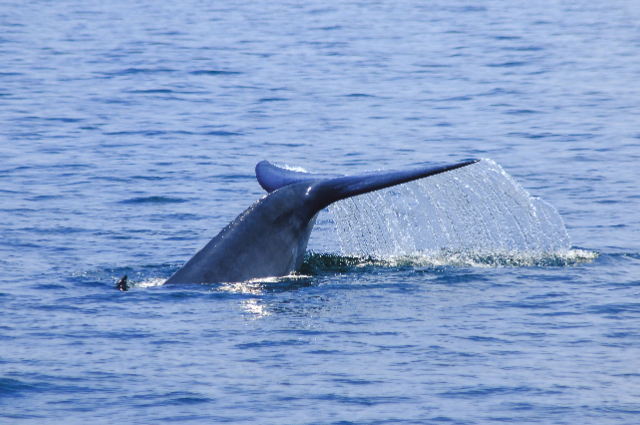
When people think of the blue whale, they usually think of extraordinary size. Balaenoptera musculus is the largest animal known to have ever lived on Earth, growing beyond 30 metres and, in some cases, weighing more than 190 tonnes. NOAA records exceptionally large individuals reaching about 110 feet and 330,000 pounds. Yet the most remarkable thing about this giant may not be its enormous body, but the invisible ecological work connected to it. The blue whale lives in an ocean where microscopic organisms can influence the entire planet. These organisms are phytoplankton, tiny photosynthetic organisms that float mainly in sunlit surface waters. Using sunlight, carbon dioxide and nutrients, they grow through photosynthesis and form the foundation of most marine food webs. The ocean produces roughly half of Earth’s oxygen, with oceanic plankton responsible for much of that production. This does not mean that humans breathe a separate supply of “ocean oxygen”, because oxygen is continuously consumed by marine life and decomposition. However, it demonstrates the enormous planetary importance of microscopic life in the sea. The connection between the world’s largest animal and these microscopic organisms is where the story of the whale pump begins.
The relationship becomes even more remarkable when we look at how whales evolved. The earliest relatives of whales were land-dwelling mammals, and the first whale ancestors appeared roughly 50 million years ago, with important early fossils found in South Asia. Over millions of years, these mammals gradually adapted to life in water, eventually producing the enormous baleen whales seen today. Modern blue whales feed mainly on krill, tiny shrimp-like animals that themselves depend on phytoplankton. A large blue whale can consume several tonnes of prey in a day, creating a striking ecological circle in which a giant animal depends upon microscopic life. The whale eats krill; krill feed on organisms lower in the food chain; and those organisms ultimately depend on phytoplankton. But the relationship does not end when the whale has fed. Whales move through different depths of the ocean and, in many species, travel between distant feeding and breeding grounds. Their movements help transport nutrients through the marine environment. In this sense, the blue whale is not simply a consumer within the ocean; it is also part of the system that helps recycle the nutrients on which ocean productivity depends. The evolution of such enormous animals therefore created an ecological role far greater than their appearance might suggest. Their size allows them to consume huge quantities of food, but it also allows them to return substantial quantities of nutrients to the environment.
The whale pump sounds complicated, but its basic idea is surprisingly simple. Some whales feed at depth and then return to the surface to breathe, where they release nutrient-rich faeces and urine. These waste products can contain important elements such as nitrogen, phosphorus and iron. Sunlight is abundant near the surface, but nutrients can be limited there, restricting the growth of phytoplankton. When whales move nutrients upwards, they can improve the conditions needed by these microscopic organisms to grow. This creates a natural chain: whales feed → nutrients are released near the surface → phytoplankton use those nutrients and sunlight → phytoplankton grow and absorb carbon dioxide → the carbon becomes part of the marine food web. Research has found that whale-derived nutrients can contribute to primary production, particularly in offshore areas where other nutrient sources are limited. A recent ecosystem-modelling study found that the annual effect was modest in most areas, generally below 2%, but could reach about 10% during summer stratification and in offshore regions. This is important because it prevents an exaggerated interpretation of the whale pump: whales do not single-handedly control the ocean’s productivity. Instead, they are one part of a much larger nutrient cycle. Their contribution becomes particularly meaningful where nutrients are scarce and where even additional fertilisation can influence phytoplankton and the wider food web.
The next part of the story connects whales with carbon and climate, but the science needs to be understood carefully. Phytoplankton absorb carbon dioxide through photosynthesis, and when some of this organic material sinks into deeper water, part of its carbon can remain away from the atmosphere for long periods. Krill and other zooplankton feed on phytoplankton, while their movements through the water column can also help transport carbon-rich material downwards. Whales strengthen this cycle indirectly by helping fertilise the organisms at the base of the food web. Scientists therefore sometimes describe whales as “gardeners of the sea”, because their nutrient recycling can support the growth of the ocean’s microscopic plants. NOAA estimates that marine phytoplankton capture an amount of carbon dioxide equivalent to the carbon captured by roughly four Amazon rainforests each year, while producing about half of the oxygen generated on Earth. This figure describes the enormous global role of phytoplankton, not a quantity of carbon captured by whales alone. Whales also store carbon directly in their enormous bodies during their lifetimes. NOAA estimates that one whale can capture an average of about 33 tonnes of carbon dioxide over its lifespan. When a whale dies and sinks to the seafloor, the event is known as a whale fall, and its body can carry carbon into the deep ocean. Such falls can support deep-sea communities while keeping carbon away from the atmosphere for hundreds to thousands of years.
The significance of this natural system becomes clearer when history is considered. Industrial whaling did not simply remove individual animals; it dramatically reduced populations that had once played their ecological roles across vast areas of the ocean. Technological advances such as mechanised harpoons and factory ships made it possible to hunt even the enormous blue whale on an industrial scale. The International Whaling Commission records that more than 300,000 blue whales were killed in the Southern Hemisphere alone, with another 20,000 killed in the North Atlantic and North Pacific combined. In the Antarctic, the blue whale population fell from an estimated 200,000–300,000 animals before industrial whaling to fewer than 400. Blue whales received international protection from hunting in the 1960s, and the wider commercial-whaling moratorium adopted by the IWC in 1982 took effect from the 1985–86 season. Some populations have since shown signs of recovery, but the species remains endangered, and several populations remain severely depleted. The ecological consequences of removing whales are also becoming clearer. Research has suggested that the disappearance of large whale populations altered marine ecosystems and, in some regions, coincided with declines in productivity and changes in species composition. The Southern Ocean provides a striking example of how removing whales can have consequences extending beyond the animals themselves. When whales disappeared in enormous numbers, scientists later began to recognise that the loss also meant the loss of nutrient recyclers capable of supporting the food web below them.
Today, protecting the blue whale therefore means protecting an ecological system as well as a remarkable animal. Blue whales continue to face threats including ship strikes, entanglement in fishing gear, changes in prey availability, ocean noise and the wider effects of climate change. Conservation measures include reducing dangerous encounters with ships, preventing fishing-gear entanglements, protecting important feeding and breeding areas and maintaining international cooperation. The whale pump gives these efforts another dimension because a whale is not simply a giant creature moving through an apparently empty ocean. It is connected to deep water, surface water, nutrients, phytoplankton, krill, fish, carbon and the wider marine food web. The whale feeds, travels, dives and returns, while nutrients move through its body and back into the surrounding environment. Phytoplankton use some of those nutrients, marine organisms feed on phytoplankton, and some carbon eventually moves into deeper parts of the ocean. When whales die, their bodies can create whale falls that support another community of deep-sea life. None of this means that whales are a substitute for reducing greenhouse-gas emissions, nor does it mean that every whale directly removes a fixed amount of atmospheric carbon. The stronger scientific lesson is more precise: healthy whale populations contribute to functioning marine ecosystems and natural carbon cycles. The world’s largest animal is therefore linked to some of the smallest forms of life in the sea—and the whale pump shows just how deeply connected the ocean’s giants and its microscopic life really are.
References:
- PANS. Impact of Baleen Whales on Ocean Primary Production Across Space and Time.
- LiveOceans. The Whales That Help Cool the Planet.
- NOAA Ocean Service. How Much Oxygen Comes from the Ocean?
- NOAA Fisheries. Whales and Carbon Sequestration: Can Whales Store Carbon?
- Smithsonian Institution. When Did Today’s Whales Get So Big?