
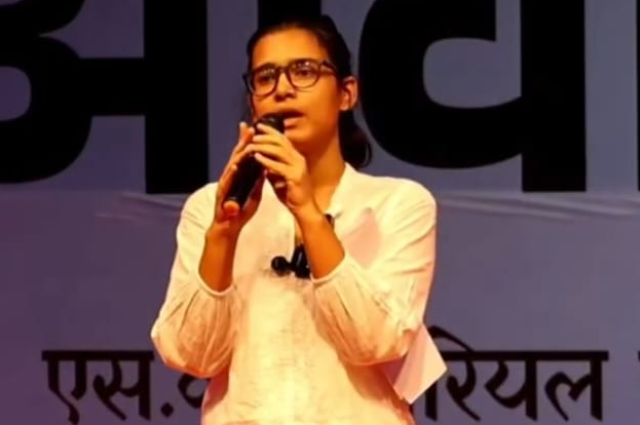
NEW DELHI, October 15, 2026: All India Students’ Association (AISA) national president Neha Bora was detained again by Delhi Police on Sunday, October 11, as protesters attempted to march towards Jantar Mantar, demanding the resignation of Chief Election Commissioner (CEC) Gyanesh Kumar over alleged irregularities in the revision of electoral rolls. The detention followed a day of widespread restrictions, barricading and mass detentions across the national capital, where demonstrators continued to assemble at alternative locations after being prevented from reaching the designated protest site. Bora, a 29-year-old doctoral researcher at Jawaharlal Nehru University (JNU), became one of the most visible figures in the demonstrations after videos showed her running through central Delhi, attempting to evade police personnel and raising slogans before being taken into custody. The protests, organised by the youth-led Cockroach Janta Party (CJP) and supported by student organisations, activists and opposition parties, have intensified the debate over electoral transparency, the right to peaceful assembly and the handling of public demonstrations.
The latest confrontation unfolded against the backdrop of restrictions imposed ahead of the planned October 10 demonstration at Jantar Mantar. Police barricades and a heavy security deployment prevented protesters from assembling at the site, prompting organisers to redirect participants towards other parts of the city. On Saturday, Bora called on demonstrators to gather at Dilli Haat, the crafts market in the INA area, and wrote on X, “Dilli Haat becomes Jantar Mantar today.” She subsequently joined activists, including political commentator Yogendra Yadav, senior advocate Prashant Bhushan and Communist Party of India (Marxist-Leninist) Liberation general secretary Dipankar Bhattacharya. Police detained the group as it attempted to move towards Jor Bagh, while smaller gatherings continued elsewhere. The following day, Bora called for further mobilisation near RK Ashram Marg Metro station. As police personnel moved to stop the gathering, protesters attempted to move through central Delhi, with Bora eventually detained near Vijay Chowk after a chase that took her towards Connaught Place. According to media reports, she was subsequently released. The changing locations of the demonstrations reflected how protesters continued their agitation despite being denied access to the original venue.
Bora’s detention on Sunday followed the detention of thousands of people across Delhi on Saturday. Reuters reported that more than 2,000 protesters had been detained, citing a Home Ministry official, as authorities deployed police and paramilitary personnel across the capital to prevent the planned rally. The scale of the operation was accompanied by extensive barricading, checkpoints and restrictions on movement. Reuters also reported that mobile internet services had been suspended in the central business district and that dozens of metro stations and markets had been closed. Among those detained on October 10 were CJP founder Abhijeet Dipke and co-convenors Saurav Das and Ashutosh Ranka, who had travelled from Mumbai to participate in the demonstration. Several opposition leaders and former chief ministers were also detained, according to Reuters. Police said the protest had not been authorised, while organisers and activists criticised the restrictions and the detention of participants. The following day, demonstrations continued in smaller groups across the capital, with student organisations and civil society activists attempting to maintain pressure on the authorities. Although reports provided different figures for individual locations and groups, the overall response involved a substantial number of detentions.
After her detention on Sunday, Bora circulated a video from inside a police bus in which she alleged that demonstrators were being held in cramped conditions. “This bus has four ‘cells’, and there is no place to breathe,” she said, questioning whether detention vehicles were being used like jails. She also accused police and Central Reserve Police Force personnel of excessive force against protesters and asked why such measures were being used to protect the Chief Election Commissioner. These statements were allegations made by Bora and should be distinguished from independently established findings about police conduct. Other student organisations also raised concerns about the treatment of detainees. The Students’ Federation of India (SFI) alleged that its activists had been assaulted inside police vehicles and that CPI(M) Rajya Sabha MP John Brittas had been attacked and left by the roadside in an injured condition. The organisation further alleged that Father Biju Xavier, a vicar of Sacred Heart Church in Delhi, was detained while recording what it described as police violence. These claims added to the controversy surrounding the handling of the protests. On October 12, Reuters reported that journalists covering the demonstrations had also alleged rough handling, detention and seizure of their devices. Press organisations criticised the reported treatment of media personnel, while police had said in a video posted on X that some protesters had posed as journalists and interfered with their work. The allegations concerning protesters, journalists and police conduct have therefore become a separate point of dispute alongside the demands directed at the Election Commission.
The immediate issue driving the demonstrations is the Special Intensive Revision (SIR) of electoral rolls and allegations that changes to voter lists have undermined electoral fairness. Protesters have demanded Kumar’s resignation, arguing that the deletion of large numbers of voter entries requires greater accountability from the Election Commission. Opposition parties have alleged that the revisions affected the outcome of recent Assembly elections and disproportionately benefited the ruling Bharatiya Janata Party (BJP). Reuters reported that approximately 130 million voter entries had been removed during the verification exercise, citing Election Commission data. The Commission’s explanation, as reported by Reuters, was that the entries included people who had relocated, individuals who could not be traced and deceased voters; it also said eligible voters whose names had been incorrectly deleted could re-enrol. The Election Commission and the BJP have denied allegations of wrongdoing. The dispute therefore concerns not only the scale and process of voter-list revision but also the interpretation of its consequences for electoral participation. Protesters have called for the suspension of the SIR exercise and the restoration of deleted voter names, while opposition leaders have demanded wider changes to the election process. The claims of manipulation remain contested, and the allegations of electoral malpractice should not be treated as established findings without further evidence.
The demands associated with the demonstrations extend beyond Kumar’s resignation. Opposition representatives have called for the repeal of the 2023 law that provides legal protection to the Chief Election Commissioner and other election commissioners in the performance of their official duties. Their demand charter has also called for an immediate suspension of the SIR exercise, the restoration of the 13.3 crore voter entries they say were deleted, a return to paper ballots for all elections and the annulment of Assembly elections held over the previous two years in cases where they claim conclusive evidence of electoral malpractice exists. These are demands made by the opposition and protest organisers, rather than measures that have been accepted by the authorities. The agitation has also acquired a wider political dimension because of its association with the CJP, a youth-led movement that first gained attention through protests over education reforms and examination-related controversies. The movement’s earlier campaign targeted the Union Education Ministry over alleged examination paper leaks and irregularities, and the demonstrations were followed by the resignation of Education Minister Dharmendra Pradhan in July 2026. The current mobilisation has brought together student activists, political campaigners, civil society representatives and opposition leaders around demands concerning electoral accountability. The BJP has rejected the allegations and accused opposition groups of spreading misinformation and creating disorder. As the dispute has developed, the authorities’ restrictions on demonstrations and the protesters’ continued attempts to assemble have become central to the public debate.
Bora’s growing prominence has drawn attention to her background as a student, theatre artist and political activist. Born in Khatima in Uttarakhand, she moved between cities during her childhood because her father served in the Indian Army. She studied at the University of Delhi before completing a postgraduate degree at Dr B. R. Ambedkar University Delhi and beginning doctoral research at JNU’s School of Arts and Aesthetics. Her academic interests include theatre and performance studies, and she has been associated with the Delhi-based street theatre group Sangwari. She has said that theatre taught her to understand people whose perspectives differ from her own. In an interview with Reuters, she explained that performing a character requires an actor to understand where that person comes from, even when the actor might disagree with them in real life. Bora has been associated with AISA for approximately a decade and has served as its national president for the past two years, according to reporting by the BBC. Her activism has addressed issues including education, examination paper leaks, privatisation, mob lynching and civil liberties. She also participated in protests against the Citizenship (Amendment) Act in 2019–20. Her public profile expanded significantly during the July 2026 demonstrations over examination-related issues, when she joined a hunger strike alongside fellow student activists and activist Sonam Wangchuk. Reports said the fast continued for 23 days and that Bora lost approximately eight kilograms. The episode brought wider attention to her speeches and her role in student mobilisation.
Bora’s subsequent involvement in protests in other states has added to her public visibility. During a student demonstration near the Jharkhand Assembly on August 7, ink was allegedly thrown at her, and police detained a man in connection with the incident, according to reports. She has also faced police complaints in Uttar Pradesh over remarks directed at Chief Minister Yogi Adityanath; the complaints reportedly accused her of making objectionable statements. These allegations and complaints form part of the wider political disputes surrounding her activism and should be understood in their respective contexts. Her participation in the October demonstrations has drawn particular attention because of the videos circulating on social media that show her running through central Delhi, attempting to cross barricades and being pursued by police personnel. Her followers have responded with a mixture of humour, admiration and political defiance, and some have described her as “Sherni”, meaning lioness. Others have highlighted the repeated cycle of detention and renewed participation in demonstrations. Bora has herself sought to place the current protests within a longer history of public discontent. In an interview with Reuters, she said, “Fear is infectious, of course. But hope is also infectious.” She has argued that grievances over education, employment, political accountability and public institutions have accumulated over time. Her statements reflect her interpretation of the movement’s appeal, rather than an independently established assessment of the views of all young Indians.
The CJP leadership has said that the protests will continue despite the detention of its organisers. After their release, co-convenors Ranka and Das reiterated the demand for Kumar’s resignation and said the agitation would spread beyond Delhi. CJP founder Dipke was also released, according to reports, after his detention on October 10. Demonstrations were reported in other cities, including Mumbai, as the dispute moved beyond the capital. Meanwhile, Congress leader and Leader of the Opposition in the Lok Sabha Rahul Gandhi was reported to be preparing to lead a march towards the Supreme Court on Monday, October 12, to submit a memorandum to Chief Justice of India Surya Kant. Reports said the Chief Justice had declined a meeting. The proposed march represented another attempt by opposition leaders to bring the dispute before constitutional institutions. The wider political confrontation has also prompted debate over the limits of public protest and the restrictions that authorities may impose in the interest of public order. The United Nations human rights office expressed concern about the mass detentions and called on Indian authorities to respect the right to peaceful assembly. India’s mission to the United Nations in Geneva rejected the criticism as misplaced interference in the country’s internal affairs, while stressing that the constitutional right to assembly is subject to reasonable restrictions in the interest of public order. These contrasting positions underscore the legal and political questions raised by the events in Delhi.
As of October 12, the immediate confrontation remained unresolved. Protest organisers continued to demand Kumar’s resignation and changes to the electoral-roll revision process, while the Election Commission and the BJP maintained that the allegations of wrongdoing were unfounded. The repeated detention of Bora and other activists has become one of the most visible aspects of the demonstrations, but the central dispute concerns the credibility of electoral procedures, the accountability of public institutions and the ability of citizens to organise peaceful protests. Bora’s rise from university theatre and student politics to the centre of a national political controversy has also brought renewed attention to the role of younger activists in public life. Whether the demonstrations will lead to any institutional changes remains uncertain. For now, the protests have continued to shift between locations as authorities restrict access to Jantar Mantar, while organisers attempt to sustain their mobilisation. The events of October 10 and 11 have placed electoral accountability, police conduct and the right to peaceful assembly at the forefront of the national conversation.
References:
- BBC News. “Meet India’s Feisty Gen Z Protester Who Is Taking on Modi.” BBC News.
- Rediff.com. “Continue Jantar Mantar Protest Even If Leaders Are Arrested: Neha Bora.” Rediff.com.
- Gulf News. “Who Is Neha Bora? Meet the 29-Year-Old Gen Z Activist and Theatre Actress Rattling India’s Political Establishment.” Gulf News.
- The New Indian Express. “No Turning Back: AISA Chief Urges People to Continue Jantar Mantar Protest Despite Arrests.” The New Indian Express.
- The Times of India. “No Place to Breathe: AISA’s Neha Bora Detained Again, Alleges Police Brutality.” The Times of India.
- NDTV. “‘Where Is Neha Bora Today?’ AISA Chief a Running Motif as Delhi Protests Go Hybrid.” NDTV.
- The Hindu. “Delhi Protest: AISA Leader Neha Bora Released from Detention.” The Hindu.
- Firstpost. “Meet India’s ‘Sherni’ Neha Bora, Who Gave Police a Chase During Jantar Mantar 2.0 Protests.” Firstpost.