
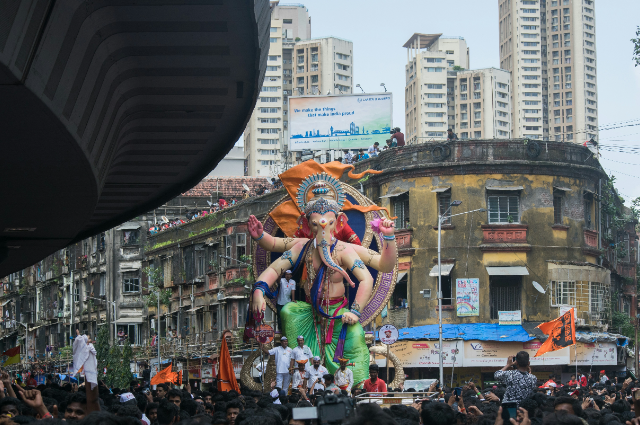
When I stood among the crowds in Lalbaug and Chinchpokli, Ganesh Chaturthi did not look like a festival that belonged to billionaires. It looked like Mumbai itself. Narrow roads were filled with devotees, volunteers, police barricades, flower sellers, shopkeepers, and children and families waiting patiently for darshan. People had travelled from different parts of the city to see Bappa. Volunteers worked continuously to control the crowds and keep the movement of devotees organised. Older people stood in queues despite the exhaustion, while parents tried to keep children close in the massive crowd. The sound of drums and devotional chants travelled through the streets. Yet alongside this familiar public energy, another presence has become increasingly visible. Corporate names are now appearing closer to some of Mumbai's most iconic Ganpati mandals. In 2026, the Adani Group became the exclusive sponsor of Chinchpokli Cha Chintamani, while the Ambani family's association with Lalbaugcha Raja has already become a prominent part of the festival's public image. That contrast made me wonder whether I was simply watching a bigger Ganeshotsav or witnessing a change in who has the power to shape it. Ganeshotsav may still belong emotionally to millions of devotees, but the economics around it are changing rapidly. The question is therefore uncomfortable but necessary: when corporate giants enter a people's festival, does it remain entirely a people's festival?
To understand why this question matters, we have to remember that Maharashtra's public Ganeshotsav has a history far older than today's corporate sponsorships. Public Ganesh celebrations became an important part of Maharashtra's social and public life in the late nineteenth century. Bhausaheb Rangari of Pune is widely associated with the early development of the public Ganesh festival, while Lokmanya Bal Gangadhar Tilak played a major role in transforming it into a much larger public movement during the 1890s. The historical details surrounding the origins of the public festival involve several organisers and should not be reduced to the story of one individual. But one fact remains important. The strength of the public Ganesh festival came from collective participation. It was not created as a luxury spectacle for the wealthy. It brought people into shared public spaces at a time when political gatherings under British rule were heavily restricted. Ganeshotsav became a platform for meetings, cultural programmes, social interaction and eventually nationalist mobilisation. In Mumbai, the festival gradually became deeply connected with neighbourhoods, chawls, workers and local communities. Areas such as Girgaon, Lalbaug, Byculla, Chinchpokli, Parel and Dadar developed their own strong Ganpati traditions. The word sarvajanik itself carries an important meaning because it refers to something public. That public character was built by ordinary people contributing according to their capacity. Someone could give money, another person could provide labour, and someone else could help with decoration, music or organisation. The festival's greatness therefore came from participation, not from the size of an individual bank account.
This history makes the developments around Lalbaug and Chinchpokli particularly significant. These are not ordinary Ganpati locations that suddenly became popular because of corporate advertising. They are among the places most closely associated with Mumbai's Ganeshotsav culture. In 2026, the Adani Group entered into an exclusive sponsorship arrangement with the historic Chinchpokli Cha Chintamani mandal for the festival. Reports have described the mandal as being 107 years old and among the prominent Ganeshotsav institutions in Mumbai's old mill belt. The arrangement means that the corporate group becomes the sole sponsor for the celebration, receiving advertising and branding rights in return for funding the festival's expenses. The development comes against the background of the Ambani family's long association with Lalbaugcha Raja. Anant Ambani's involvement with the Lalbaug mandal has received considerable public attention, following years of support by the Ambani family and the Reliance Foundation. In 2024, Anant Ambani and the Reliance Foundation were reported to have gifted a 20-kilogram gold crown to Lalbaugcha Raja. For 2026, the Lalbaug celebration has again attracted attention because of its elaborate theme, decorations, and the continued presence of the Ambani family's patronage. None of this means that either company has legally taken ownership of a Ganpati mandal. That would be an inaccurate claim. The more important development is subtler. Corporate sponsorship is moving closer to the centre of some of Mumbai's most recognisable Ganeshotsav institutions. Money is becoming increasingly important in determining how large, secure, organised and visually spectacular these celebrations can become. And once money becomes highly concentrated, the question of influence naturally follows.
But there is another side to this story that cannot be ignored: the people who actually make Ganeshotsav happen. They are the mandal volunteers who work late into the night. They are the artisans who spend weeks or months preparing idols and decorations. They are the flower sellers, electricians, transport workers, sound technicians, and small shopkeepers whose businesses depend on the festival season. They are the residents of old neighbourhoods who have watched Ganeshotsav change across generations. They are the families who contribute small amounts rather than crores. They are the elderly devotees who still want to stand in the queue because they have been doing so for years. They are the young people who volunteer for crowd management without expecting their names to appear on a banner. They are the women who prepare food, arrange puja materials and keep family traditions alive. They are the children who grow up watching the procession and learning that Ganpati is not merely a religious ritual but part of Mumbai's identity. A festival becomes public because people participate in building it, not simply because millions come to watch it. That distinction matters. The corporate sponsor may provide money, but money alone cannot create cultural memory. A company can fund infrastructure, but it cannot manufacture the generations of emotional attachment that a neighbourhood develops with its Ganpati. The real strength of Ganeshotsav is therefore still visible among ordinary people. The most powerful people in the streets are often not those whose names appear on the largest banners, but those who keep the festival functioning when the cameras are not watching.
At the same time, it would be unfair to pretend that corporate participation has no legitimate purpose. Mumbai's major Ganpati festivals have become enormous public events, attracting huge crowds and requiring sophisticated arrangements. Security, medical facilities, sanitation, crowd management, barricading, digital communication and infrastructure all cost money. Large mandals also run social initiatives throughout the year, including medical assistance, ambulance services, education support, blood donation activities and other community programmes. Corporate funding can help such organisations expand these activities. It can also reduce the financial burden on local donors and provide resources that small contributions alone may not always cover. The problem, therefore, is not that a company gives money to a Ganpati mandal. The problem begins when sponsorship becomes so dominant that financial power starts shaping the public identity of the celebration. There is an important difference between supporting a tradition and becoming the face of that tradition. A sponsor can help a festival without becoming larger than the festival itself. This is where transparency and boundaries become important. Devotees deserve to know how sponsorship arrangements work, what rights companies receive and how much control remains with the mandal. If corporate money genuinely strengthens public facilities while respecting the mandal's traditions, there is a strong argument in its favour. But if the festival gradually becomes a platform for corporate branding, then society has every right to ask whether the balance has shifted too far.
The debate becomes especially sensitive when people describe this development as a Gujarati-versus-Marathi conflict. I do not think that is the right way to understand it. Mumbai has always been a city shaped by people from different communities, languages and regions. Gujarati families have lived, worked, and contributed to Mumbai for generations, just as Maharashtrians have. A Gujarati devotee has the same right as a Marathi devotee to stand before Ganesha and say, “Ganpati Bappa Morya.” The issue is not someone's surname, mother tongue, or place of origin. The issue is the enormous concentration of economic power held by India's largest corporate groups. When a wealthy individual visits a Ganpati mandal as a devotee, that is participation. When a corporation becomes the exclusive sponsor of a major public festival, that is an institutional relationship. Those two things should not be treated as identical. Maharashtra does not need to shut its doors to anyone to protect its cultural identity. Instead, it needs to protect the principle that its public cultural institutions should remain rooted in the communities that created them. Political statements describing corporate involvement as an attempt to capture Marathi culture have made the debate more heated. Such concerns should be examined seriously, but without turning them into hostility towards an entire linguistic community. A Gujarati businessman is not the problem. A Maharashtrian businessman is not automatically the solution. The real question is whether economic power is becoming cultural power. That is a question worth asking regardless of which company or community is involved.
There is also a media and visibility problem that deserves much more attention. Ganeshotsav has increasingly become a visual economy in which spectacle attracts attention. The larger the decoration, the more elaborate the theme, the bigger the crowd and the more famous the visitor, the more likely the festival is to dominate social media and news coverage. Corporate involvement fits naturally into this system because companies understand visibility. A major festival provides access to enormous crowds, repeated media coverage, and high public recognition. Advertising is no longer limited to a banner outside the mandap. Roads, barricades, welcome arches, digital screens and routes used by devotees can all become valuable spaces for branding. The festival itself can therefore become part of a larger marketing ecosystem. But there is a strange irony in this transformation. A mandal may have hundreds of volunteers and thousands of small contributors, yet the name of a major corporate sponsor can become one of the first things people notice. The artisan who spent months creating the idol may receive a few lines, while the sponsor receives extensive visibility. The local volunteer who works throughout the night may remain anonymous, while celebrity visitors become headlines. Money does not only purchase materials. At this scale, money can also purchase visibility. That does not automatically make corporate sponsorship wrong, but it should make us think carefully about whose story we are telling when we talk about Ganeshotsav.
When I look back at the streets of Lalbaug and Chinchpokli, however, the festival still feels larger than any corporate name. I remember the crowds moving slowly through the streets. I remember people carrying children, older devotees walking carefully, and volunteers repeatedly asking people to keep moving. I remember the flowers, the drums, the noise, the excitement and the unmistakable feeling that an entire part of Mumbai had temporarily reorganised itself around Bappa. That experience cannot be reduced to sponsorship. The person who waits for hours for darshan does not stand there because of an advertising campaign. The resident who tolerates traffic restrictions during the festival does not do it because a corporation asked them to. The volunteer who spends sleepless nights managing crowds does it because the festival means something to them. This is the emotional economy of Ganeshotsav, and no balance sheet can measure it. Yet corporate branding is increasingly becoming part of the physical landscape surrounding this devotion. That is where the tension becomes visible. The sponsor may fund the stage, the lights, or the infrastructure, but the devotee gives the festival its meaning. The company may have advertising rights, but it does not own the memories of generations. The festival may become more professionally managed, but it should not become emotionally privatised. The soul of Ganeshotsav is not the sponsor's name on a banner; it is the person standing in the queue. That person should never become secondary in a festival that is supposed to be public.
Maharashtra therefore does not need to choose between tradition and modernity, nor between Marathi identity and outsiders. It needs to decide what kind of public culture it wants to preserve. Corporate participation can exist. Wealthy families can celebrate. Businesses can support mandals. Modern technology can improve security and crowd management. Festivals can become safer, cleaner and better organised. None of these developments has to destroy tradition. But the communities that built Ganeshotsav must remain at its centre. The mandal should remain accountable to devotees rather than becoming defined primarily by its largest sponsor. The artisan should remain as important to the story as the celebrity. The volunteer should matter as much as the billionaire. The small donor should not feel insignificant simply because another organisation can contribute crores. Most importantly, Maharashtra should not allow its cultural conversation to become trapped in a Gujarati-versus-Marathi argument. The real conversation is about power, money and influence. It is about whether a public tradition can accept corporate support without surrendering its public character. Maharashtra does not need to close its doors to wealth; it needs to remember whom those doors were built for. Ganeshotsav was carried through generations by ordinary people who gave what they could and celebrated what they believed. Corporate money may help build a bigger festival, but it cannot be allowed to become the definition of the festival. The question is not who can afford to sponsor Ganpati. The question is who still gets to feel that Ganpati belongs to them. And perhaps the answer should always be the same: Bappa belongs to the people.
References:
- “How Corporate Backing Is Jazzing Up Ganpati Lane: Sponsorship Deals Are Changing How Mumbai’s Biggest Mandals Brand, Market and Manage the City’s Favourite Festival” — Mumbai Mirror
- “Corporatisation of Ganesh Mandals Affects Devotees” — The Perfect Voice
- “Adani Group Enters Mumbai’s Ganeshotsav Space with Chintamani Mandal Tie-Up” — The Times of India
- “The Changing Economics of Mumbai’s Ganpati Festivals” — Frontline
- “Adani at Chintamani, Ambani at Lalbaug: Mumbai’s Ganesh Mandals Are Getting a Corporate Makeover” — ThePrint