
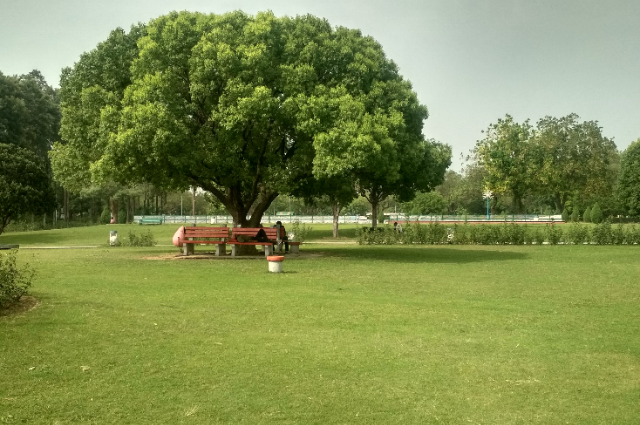
The alleged gang rape of a 17-year-old girl at Aastha Kunj Park near Kalkaji Mandir on September 21 has forced Delhi to confront uncomfortable questions about the safety of its public parks. The teenager, a resident of Faridabad, had travelled to southeast Delhi with a 17-year-old male friend on her birthday. After visiting Kalkaji Mandir, the two entered the DDA-maintained park through Gate No. 7. According to her statement to police, three men approached them, claimed to be policemen and used police and legal terminology to intimidate them. They allegedly told the teenagers that they were minors and had committed an offence, before taking away their mobile phones. The girl’s friend was allegedly assaulted and restrained while she was taken towards a secluded part of the park. She told investigators that the men threatened her with a firearm and knives before allegedly sexually assaulting her one after another. Police identified the accused as Asif, Hemant and his younger brother Mukesh. Asif was allegedly injured in a police operation while officers were trying to apprehend him. A Delhi court later sent all three accused to 14 days’ judicial custody. The case has been registered under relevant provisions of the Bharatiya Nyaya Sanhita and the Protection of Children from Sexual Offences Act, and the allegations remain subject to the judicial process.
The teenager’s distress call brought police to the park at around 8.45 p.m., after which she was medically examined at AIIMS and the crime scene was examined by forensic teams. Investigators subsequently used her account, CCTV footage, technical surveillance and local intelligence to trace the suspects. Police have said that footage from more than 300 cameras was examined and that witness statements were recorded as part of the investigation. The survivor also helped investigators identify locations inside the park connected with her account, while forensic teams collected evidence for scientific examination. The investigation has included examination of digital evidence, call-detail records and the mobile phones of the accused. Police are also checking whether the accused could be connected with any other incidents, although no formal complaint concerning similar offences has been confirmed so far. The incident has nevertheless raised concerns beyond the criminal investigation because residents say safety problems at Aastha Kunj did not begin on September 21. They have previously complained about poor lighting, damaged boundary sections, open stretches and inadequate surveillance. The park is a large public space used not only for recreation but also as a daily shortcut between surrounding neighbourhoods. Its 29 gates and multiple access points make monitoring movement more difficult, particularly after evening crowds begin to thin.
For residents living around Aastha Kunj, the alleged assault has therefore revived older fears about what happens inside the park after dark. Residents have described poorly lit stretches, groups consuming alcohol or drugs and areas where the absence of adequate surveillance can make people feel vulnerable. One resident recalled being robbed inside the park years earlier after being confronted by men carrying knives. Another resident said the incident had changed her willingness to allow her daughters to play there in the evening. Residents have also pointed to an abandoned guard room near the Nehru Place Metro entrance, while damaged or missing grills and open portions of the boundary have added to concerns about access and monitoring. The park had also witnessed a separate robbery and attack on two US nationals in June 2025, according to police reports, demonstrating that concerns about crime in the area predated the latest case. Residents’ Welfare Associations have consequently questioned whether public parks are receiving sufficient security and maintenance for spaces of their size. Ruby Makhija of Navjiwan RWA suggested that neighbourhood park safety committees involving residents, police officials and RWAs could help identify local vulnerabilities. Residents have also called for clearly displayed timings and continuous illumination rather than leaving safety dependent on whether visitors can avoid darker parts of a park.
The immediate administrative response, however, has focused partly on controlling access after sunset. The DDA directed parks with multiple gates to adopt controlled entry during late hours, allowing visitors to use selected gates while security personnel maintain greater vigilance. It also ordered additional lighting, CCTV coverage, security personnel and increased night patrolling at vulnerable locations. Safety information boards carrying park rules and emergency contacts were also ordered. The measures came alongside a wider safety audit ordered after the Aastha Kunj incident, with attention to lighting, security, patrolling and cleanliness. Delhi Lieutenant Governor Taranjit Singh Sandhu also directed the Delhi Police to strengthen beat patrolling around parks and called for a women-centric ‘Pink Force’ for high-visibility deployment around vulnerable locations. The DDA has said additional guards were deployed during night shifts, bike patrols were introduced, and lighting was being improved at identified dark spots. Yet the question remains whether restricting entry addresses the underlying weakness or merely reduces the number of people exposed to an unsafe environment. A park that is difficult to monitor because of darkness, open boundaries and limited surveillance does not become secure simply because fewer gates are available for entry. Restriction can be one layer of prevention, but it cannot replace visible policing, functioning lights, surveillance and accountable security personnel.
The scale of the subsequent DDA audit has made that question more difficult to ignore. The authority examined 736 parks and classified 190 as high-risk, 258 as medium-risk and 288 as low-risk. It found that 520 parks required additional lighting, while only 16 had CCTV surveillance at the time of the audit. The DDA identified 323 parks where additional CCTV cameras were proposed, while access-control problems were flagged in 163 parks. Boundary walls and missing grills were identified as concerns in 399 parks. The authority said night patrolling had begun in 245 major parks, bike patrolling had started in all 190 high-risk parks and 134 parks required armed guards or gunmen. Biometric attendance for security guards was operational in 602 parks, according to the DDA. The audit also led to plans for safety signage, repairs, coordination with local police and structured meetings with RWAs. These figures show that the Aastha Kunj case exposed a wider infrastructure and management problem rather than a concern confined to one park. If only 16 of 736 DDA parks had CCTV at the time of the audit, surveillance remains a substantial gap in a city where parks can become isolated spaces after dark. The findings also explain why residents are asking not only when gates should close, but how public spaces should be secured while they remain open.
The Aastha Kunj case has therefore turned a question about one park into a larger test of how Delhi protects public spaces. The objective of park safety cannot be limited to preventing people from entering after sunset; it must also include making legitimate public use safer for women, children, senior citizens, joggers and residents who depend on parks as everyday routes. That requires functioning lights, clearly defined entry and exit points, working CCTV systems, trained guards, regular police patrols and rapid response when suspicious activity is reported. It also requires clear responsibility between the DDA, Delhi Police, local authorities and the communities surrounding these spaces. The DDA has begun implementing several of these measures following the audit, while the police investigation into the Aastha Kunj case continues. For residents, however, the central concern is simple: a public park should not become safe only when its gates are closed. Security should be strongest precisely when the park is open, and people have a legitimate reason to be there. The tragedy at Aastha Kunj has already prompted restrictions and audits; the more important measure of those decisions will be whether they produce safer, properly monitored public spaces rather than simply less accessible ones.
References:
- The Hindu — “Girl gang-raped on her 17th birthday at a Delhi park by three men posing as police personnel.”
- NDTV — “Days After Rape of 17-Year-Old, Delhi Restricts Entry to Parks After Sunset.”
- The Hindu — “Safety Concerns at Astha Kunj Park Not New, Say South-East Delhi Residents; DDA Reviewing Security.”
- Brut — “Kalkaji Gang Rape Survivor Tells Police What Happened Inside Aastha Kunj Park on Her Birthday.”
- The Hindu — “After Aastha Kunj Incident, Residents Seek Safer DDA Parks, Proper Lighting, Upkeep.”
- NDTV — “190 Delhi Parks Marked High Risk After Kalkaji Gang Rape, Only 16 Have CCTV.”
- Outlook — “Restricted Entry in Delhi Parks After Sunset Post Astha Kunj Gang-Rape.”