
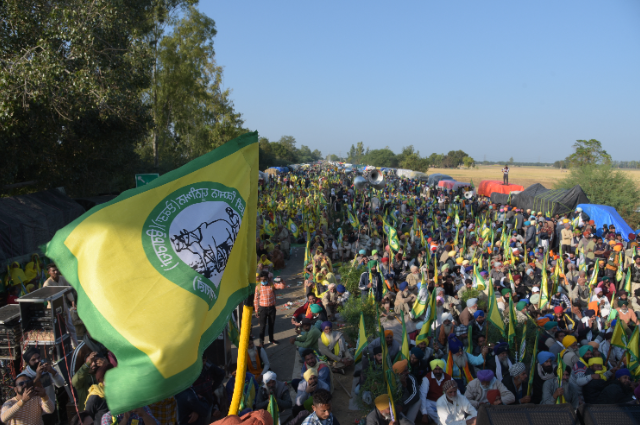
The return of farmers to the streets of Delhi has once again placed India's agricultural economy at the centre of a national debate. The political landscape of northern India has once again transformed into a theatre of profound agrarian discontent as thousands of cultivators from Punjab, Haryana, and neighbouring states converge on national transit arteries under the banner of the "Desh Bachao Morcha". This is a huge and valid reason for people to be disturbed about and affected by such major changes. The protest took place due to the India–US trade agreement, arguing that greater access for American agricultural products could threaten the livelihoods of millions of Indian cultivators. Indian agriculture has always been a source of pride for the country and has been majorly helpful in cultivation within the nation with a lot of hard work and sacrifice.
This took a major place; the demonstrations were accompanied by heightened security, with reports of road barricades, restrictions on movement, and the detention of at least one farmer leader before the gathering. This clash highlights a complex friction point between India's integration into global trade architecture and the socio-economic survival of millions of smallholder farmers whose livelihoods hang in the balance. If even these things are imported, the people of the country will be affected and face huge loss and backlash. Thousands of people are in this field, and disturbing their livelihood, source of income, efforts and hard work will get disrupted.
At the heart of the protest lies a basic economic concern. Agriculture in the United States benefits from extensive mechanisation, larger average farm sizes, advanced storage infrastructure, and substantial government support through various subsidy programmes. Indian farmers argue that if tariffs are significantly reduced under a future trade agreement, imported products could depress domestic prices, particularly in sectors where Indian producers already operate with thin profit margins.
According to India's Agriculture Census, more than 86% of Indian farmers own less than two hectares of land. These small and marginal farmers typically depend on family labour, limited irrigation, and fluctuating market prices. They work on a small scale involving their entire family to earn and work on these lands; unlike large commercial farms, they often have little bargaining power or financial resilience to absorb prolonged price declines. They anyway don't have much option or power to sell things according to their price budget but more according to mediators or other m. Even a modest reduction in market prices for certain crops can substantially reduce annual household income, making farmers particularly sensitive to trade liberalisation that could increase competition from imported agricultural commodities.
American agriculture is defined by hyper-capitalised, highly mechanised mega-farms operating on expansive landholdings and manpower. They argue that competing against industrialised agriculture without comparable direct income supports or legal minimum support price (MSP) guarantees creates an inherently unequal playing field, threatening to convert domestic markets into dumping grounds for foreign surpluses. India today imports a significant share of its edible oil requirements, exposing consumers to global price volatility during international supply disruptions. Many farmer organisations cite this experience as evidence that excessive dependence on imported agricultural goods can weaken domestic production over time. When things start getting imported and that too not with a huge price difference, it’s unsaidly known that in the country these will get affected and people will get hampered. Their selling capacity will fall at a higher rate, with not having much option to bargain with or much capacity to reach.
Another frequently cited case involves dairy products. India is the world's largest milk producer, supported primarily by millions of small dairy farmers owning two or three cattle rather than large industrial farms. Organisations representing dairy producers fear that increased access for American dairy exports—produced with significantly larger herds and highly mechanised operations—could gradually affect India's cooperative dairy system if import restrictions are eased. We can see any sector: if things start getting imported, country people will get disrupted due to outside products.
Although the government has consistently described dairy as a sensitive sector in trade negotiations, farmer unions remain cautious because trade agreements often evolve through multiple negotiation rounds over several years. Even if it’s said or assured that country goods won’t get affected or similar things, these deals or new products do bring changes in society and buying patterns.
Farmer organisations have demanded greater transparency in trade negotiations, arguing that Parliament and stakeholders should have more opportunities to examine proposed agreements before finalisation. Which is, somewhere, fair; I guess at least they will have a real picture of how things will take place, what they will be like. Several unions have requested that negotiation documents be made public and debated openly. So that people of the country will also know how things will take place.
Government representatives, meanwhile, have repeatedly stated that India will safeguard its "red lines" during negotiations. And red lines generally mean non-negotiable conditions they won’t compromise and stick to. India has certain core interests or positions that it will not give up or weaken during the negotiations.
At the end, the protest is for one thing, which is agriculture, and today’s time illustrates the broader challenge of balancing global economic integration with the protection of domestic livelihoods. Today, this protest was for one thing. In the future, it can take place for other things too. The future of Indian agriculture may ultimately depend not only on what is negotiated internationally but also on how effectively domestic reforms strengthen the resilience of those who cultivate the country's fields. It depends on how things will work and how the country will help them grow and protect their individuality too.
References
- India Today – Farmers heading to Delhi for Mahapanchayat against the proposed India–US trade deal: https://www.indiatoday.in
- India Today Business – Why farmers are protesting the proposed India–US trade deal: https://www.indiatoday.in
- Down To Earth – Farmers protest against India–US trade talks: https://www.downtoearth.org.in.
- OECD – Agricultural Policy Monitoring and Evaluation: https://www.oecd.org
- Government of India, Agriculture Census (latest available): https://agcensus.nic.in