
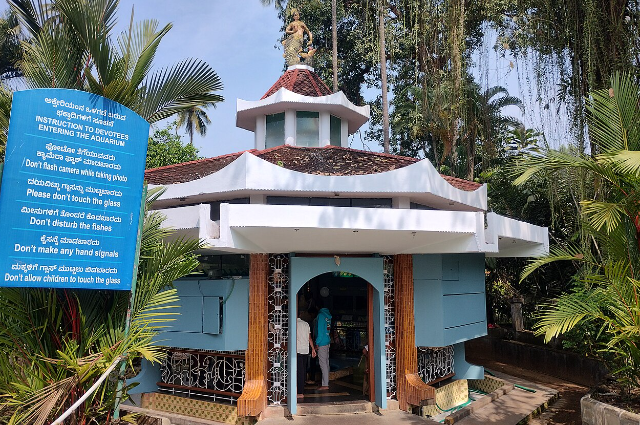
There is a particular kind of horror that hides in plain sight for decades, protected not by secrecy but by scale. Dharmasthala is not some obscure village. It is one of Karnataka's most powerful temple towns, a pilgrimage site with money, political access, and a name that opens doors. And for nearly two decades, according to one man, it was also a burial ground.
In June 2025, two Bengaluru lawyers released a letter saying they represented a client willing to reveal where he had buried bodies himself. On 3 July, that client came forward: a 48-year-old former sanitation worker named C N Chinnaiah, who said he had been forced, under threat of death, to bury hundreds of bodies between 1995 and 2014. He said he had been in hiding for twelve years, and that the victims included a schoolchild and a twenty-year-old acid attack survivor, buried along the Netravathi River, many showing signs of strangulation and sexual assault. He later pinpointed thirteen burial sites.
This wasn't the first time Dharmasthala's name had come up in connection with disappearances. The temple has faced protests from local families and political groups over sexual violence, murders, and burials going back to the 1980s, and things boiled over again in 2012 after the rape and murder of Sowjanya, a seventeen-year-old girl whose case was investigated by state police, the CID, and even the CBI, without ever landing on an answer her mother could live with. That mother, Kusumavati, is still fighting for justice today, which tells you everything about how long institutional power can outlast a grieving family's patience.
The public pressure that followed Chinnaiah's statement was immediate. A police case opened on 4 July, he was granted protection on 10 July, and by 19 July the Karnataka government had constituted a Special Investigation Team led by DGP Pronab Mohanty. Excavations began at the sites he named. This is where the story should have delivered its reckoning. Instead, it delivered a mess.
Of the thirteen sites, most turned up nothing. A couple yielded partial skeletal remains, a skull, some bones. Then, on 23 August 2025, the SIT arrested Chinnaiah himself for perjury. The bones he had handed over as belonging to a woman turned out, on forensic testing, to belong to a man, and some of the samples he provided were later found to be sourced from a medical institution rather than an actual burial site. His identity, previously protected by a gag order, was made public. A second complainant, Sujata Bhat, who had claimed her daughter was murdered, later said the girl was actually a friend's daughter, not her own, further muddying an already chaotic evidentiary trail.
This is the part that makes the story genuinely uncomfortable rather than just tragic. It would be easier if Chinnaiah were simply a hero who cracked under cross-examination. What we actually have is a man whose core claims triggered a real state investigation, real excavations, real skeletal remains found in the ground, and yet whose own conduct under oath has now become part of the case against credibility itself. The SIT has been explicit that his arrest does not end the inquiry. As of late August 2025, officials said the investigation was only about a quarter complete, with forensic work still pending.
And it kept moving. By November 2025, the SIT filed a nearly 3,900-page charge sheet naming six accused, a list that, in a twist almost nobody could have scripted, includes Chinnaiah himself alongside several of the activists who had originally helped file the FIR. More remains were reportedly found later near the Netravathi bathing ghat in the Banglegudde forest area. A judge assigned to the case recused himself after it emerged he had been educated at Dharmasthala-run institutions and had once worked for a firm representing the temple family, which is its own quiet indictment of how deep this town's influence runs into the machinery meant to hold it accountable.
Then the story did what these stories so often do. It went quiet. As of early 2026, a court declined to treat the SIT's submission as a final report because forensic lab results were still pending. By April 2026, activists were standing in Bengaluru asking why the SIT's findings still weren't public, nearly nine months after the team was formed. Advocate S Balan, representing Kusumavati, said plainly that the entire system, from the CID to the CBI to successive state governments, had failed to answer one basic question: who killed these women. Kusumavati has now taken her fight to the Supreme Court.
So what do we actually know? We know a man says he buried the dead of a system too powerful to be questioned by anyone who wasn't willing to disappear into it. We know his testimony brought real skeletal remains out of real forested riverbanks, which no one can spin away. We know his own credibility has since collapsed under forensic scrutiny, and that this collapse has been seized on by people invested in making the whole thing vanish. And we know that none of that makes Sowjanya any less dead, or Kusumavati's decade of unanswered questions any less real.
That is the real lesson here, and it's a harder one than "the powerless hold the truth." Sometimes the powerless hold a truth that is tangled up with their own desperation, their own damage, maybe even their own lies, and the system uses that tangle as an excuse to stop looking. The measure of whether Karnataka actually wants justice here won't be whether Chinnaiah turns out to be a perfect witness. It will be whether the SIT's findings ever see daylight, and whether a mother's nine-year-old question finally gets answered.
References:
- en.wikipedia.org/wiki/Dharmasthala_mass_burial_case
- thenewsminute.com/karnataka/dharmasthala-mass-burial-case-sit-questions-whistleblower-for-over-five-hours
- outlookindia.com/national/sit-arrests-sanitation-worker-who-alleged-multiple-burials-in-dharmasthala