
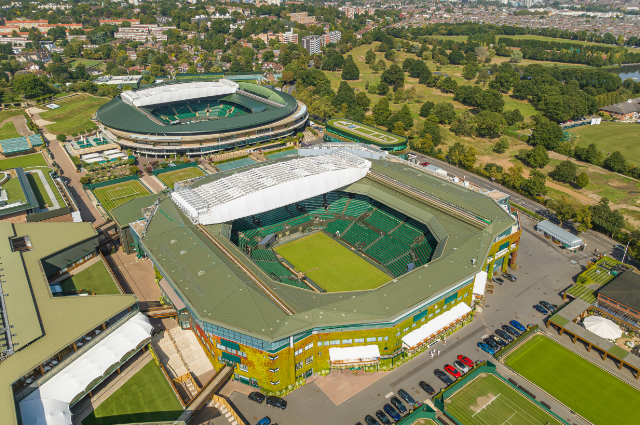
If you’ve watched Wimbledon, you know the towels. Deep green, with purple and gold trim, folded perfectly on the chairs of Centre Court. They look quintessentially British. The joke among fans is that even a champion's sweat feels more prestigious on them.
Here’s what most people don’t know: for more than 15 years, those towels have not been made in Britain at all. They’ve been made in Vapi, Gujarat, India. The design heritage is still British. The weaving, the yarn, the finishing — all of it is Indian. It’s a quiet story of globalisation, heritage brands, and how a 200-year-old English name found its second life on the shop floors of Gujarat.
The Icon: What Makes a Wimbledon Towel Special- Wimbledon towels are not just any towels. They are part of the tournament’s visual identity.
The colour scheme — Wimbledon Purple and Green with a hint of gold — was standardised decades ago to match the club’s crest and branding. The towels are oversized, about 40 x 70 inches for players, made to be highly absorbent without being heavy. They also have to look perfect on TV, so they are yarn-dyed rather than piece-dyed. That means the colour goes all the way through the thread, so even after 50 washes the stripes don’t fade.
Until the early 2000s, they were made by Christy, a British towel company founded in 1850 in Hyde, near Manchester. Christy held the Wimbledon contract and manufactured in the UK. For fans, “Made in England” was part of the romance.
The Shift: From Hyde to Vapi-
Around 2009-2010, production moved. The reason was simple: scale, cost, and capacity.
In 2006, Welspun, one of India’s largest home textiles companies based in Mumbai, acquired Christy. Welspun kept the Christy brand and its British heritage, but shifted manufacturing to its own facilities. The main plant for Wimbledon towels is now in Vapi, Gujarat — a textile hub on the Maharashtra-Gujarat border.
Welspun has been making the official Wimbledon towels at Vapi for well over a decade. The same plant also produces towels for other global retailers under the Christy and Welspun Living brands. The move didn’t change the design or the quality standards. Wimbledon still approves every sample. But the looms that make them now run in India, not England.
How They’re Made: 18 Months and 7 Days Per Towel- A Wimbledon towel starts long before the tournament.
Planning: 18 months ahead. The All England Club and Christy’s design team finalise colours. Men’s towels keep the classic green/purple/gold. Women’s towels get a new seasonal accent colour each year, which is why you’ll sometimes see a hint of coral or blue in the trim.
Weaving: Yarn-dyed jacquard. The towels use jacquard looms to create the pattern and club logo directly in the weave, not printed on top. Each thread is dyed before weaving. That’s what gives them colourfastness and that plush feel.
Fabric: HygroCotton. Christy’s signature technology uses cotton with a special cross-section that absorbs water faster and feels softer. It was developed in the UK but is now produced at Welspun’s Vapi facility.
Time: ∼7 days per towel. From yarn to finished, hemmed, and packaged towel, it takes about a week. The plant runs strict quality checks because every towel that goes to Centre Court has to meet Wimbledon’s standards.
By the time players walk out, the towel in their hand was spun, woven, and finished in Gujarat.
Why India?
- The Business Logic: This wasn’t an accident. It was a deliberate supply-chain decision.
- Scale: Welspun is one of the world’s largest home textile exporters. It can produce millions of towels and handle the sudden spike in demand around Wimbledon. A UK factory couldn’t match that volume at the same cost.
- Vertical integration: Welspun controls everything from spinning to finishing in Vapi. That means better control over colour matching, quality, and delivery timelines for a global event.
- Heritage + manufacturing: By buying Christy, Welspun’s got the brand and the Wimbledon contract. By moving production to India, it got the efficiency. The result: a British icon that is now proudly “Designed in the UK, Made in India.”
This model is common now. Burberry, Jaguar Land Rover, and many other British heritage brands are owned by or manufactured in other countries, while keeping their design roots.
The Cultural Angle: A British Symbol With Indian Hands- For many Indian workers at Vapi, weaving a Wimbledon towel is a point of pride. It’s not mass-market. It’s a premium product with exacting standards.
For Wimbledon, it solves a problem. They get to keep the tradition and quality without the cost and capacity constraints of UK manufacturing. For India, it’s proof of capability. A product associated with royalty, tennis, and British summer is being made to world-class standards in Gujarat and shipped back to London.
Fans rarely notice. The towel still looks, feels, and performs exactly like it did 20 years ago. That’s the point. The move was never about changing the product. It was about how to keep making it sustainably.
What This Says About Modern Manufacturing-
The Wimbledon towel story is a small example of a big shift.
Heritage no longer equals geography. A brand can be British in design, Indian in manufacturing, and global in consumption. Consumers care about quality and story, not just the “Made in” label.
It also shows how India has moved up the value chain in textiles. This isn’t basic commodity towel production. This is technical, design-led, brand-sensitive manufacturing for one of the most watched sporting events in the world.
And it’s durable. Even as conversations about “reshoring” happen, Wimbledon has kept production in Vapi because the quality and reliability are there.
The Final Word- Next time you see a player towel off between points at Centre Court, look at the label. It won’t say “Made in England.” It will carry the legacy of Christy and the craftsmanship of Welspun’s Living in Vapi, Gujarat.
The design was born in Britain. The icon was adopted by the world. And for the last 15+ years, the actual weaving has been done in India.
That’s modern luxury: British heritage, Indian manufacturing, and a green-and-purple towel that travels 7,000 km to end up in the hands of a Grand Slam champion.
References:
- Welspun’s Living Ltd. Official Website – Christy Brand and Manufacturing Facilities. https://www.welspunliving.com
- Wimbledon.com. Official Suppliers and Licensing. https://www.wimbledon.com
- The Economic Times. “How Welspun’s Vapi plant makes Wimbledon’s iconic towels.” https://economictimes.indiatimes.com
- Business Standard. “From Hyde to Vapi: The journey of Christy towels.” https://www.business-standard.com
- UNESCO/Industry Reports on Indian Home Textiles Exports. https://www.texprocil.com