
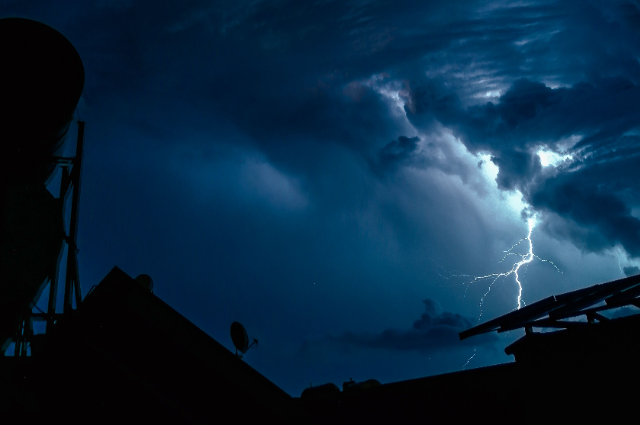
How Lightning Quietly Feeds the Earth
When monsoon clouds roll in, farmers watch the sky with a mix of hope and calculation. Rain means life for their fields, but the real magic isn’t just the water. Hidden in every thunderstorm is a powerful, free fertiliser factory happening 5 kilometres overhead. The secret ingredient? Lightning.
We all know rain waters crops. But lightning does something water alone can’t: it makes food. Specifically, it makes nitrogen, the single most important nutrient for leafy growth and crop yield, and delivers it straight to the soil. Every time a monsoon storm crackles, it’s literally feeding the earth.
Why Plants Are Desperate for Nitrogen
To understand why lightning matters, you have to understand nitrogen. Plants need it to build chlorophyll, proteins, and DNA. It’s what turns a pale, struggling seedling into a deep-green, productive crop. The problem is that 78% of the air around us is nitrogen, but plants can’t use it. Atmospheric nitrogen exists as N₂, two nitrogen atoms locked together with one of the strongest triple bonds in nature. Roots can’t break it. Leaves can’t absorb it. For a plant, absorbing pure nitrogen is like starving in a grocery store with locked doors.
That’s why farmers spend billions on synthetic fertilisers every year. But nature has its own method, and it’s been working for millions of years before urea was invented. It’s called nitrogen fixation, and lightning is one of its most dramatic tools.
How a Lightning Bolt Builds Fertiliser in the Sky
A single lightning strike is hotter than the surface of the sun, up to 30,000°C. That insane burst of energy does something extraordinary to the air. It rips apart the N₂ and O₂ molecules that make up our atmosphere. For a fraction of a second, those nitrogen and oxygen atoms float free, highly reactive and looking to bond.
What happens next is basic chemistry with massive consequences. The free nitrogen and oxygen atoms combine to form nitric oxide, NO. More lightning, more heat, and that NO reacts with more oxygen to become nitrogen dioxide, NO₂. When NO₂ meets rainwater in the cloud, it dissolves and converts into nitric acid, HNO₃. That acidic rain doesn’t stay acidic for long. As it falls, it reacts with dust, ammonia, and other compounds in the air and soil. By the time it hits the ground, it has become nitrate, NO₃⁻ , the exact form of nitrogen that plant roots love to drink up.
In short: lightning → broken N₂ bonds → NO₂ → nitric acid in rain → nitrate in soil. The storm just turned useless air into plant food.
How Much Nitrogen Does Monsoon Lightning Actually Deliver?
It sounds poetic, but is it significant? Yes. Scientists estimate that lightning fixes about 10–20 million tonnes of nitrogen globally every year. That’s roughly 5% of all the global natural nitrogen fixation on Earth. In a heavy monsoon region like India, a single season of storms can deposit 2–10 kg of nitrogen per hectare directly into farmland, completely free.
For context, that’s equivalent to spreading a small bag of urea across your field, delivered by the clouds. During a good monsoon with frequent thunderstorms, this natural dose can reduce the amount of fertiliser a farmer needs. It won’t replace all synthetic inputs for high-yield crops, but it’s a critical supplement, especially for smallholder farmers who can’t afford heavy fertiliser use. It also explains why rain-fed crops often look greener and healthier after a night of thunder compared to crops watered by irrigation alone.
Why Monsoon Rain Is “Better” Than Canal Water
Farmers have noticed this for generations. Crops watered by monsoon rain just grow better than crops watered from a bore well or canal, even if the total water amount is the same. Agronomists used to credit this to cooler temperatures or lower salt content. Those help, but the lightning effect is a huge piece of the puzzle.
Irrigation water has zero nitrate unless fertiliser is added. Monsoon rain, charged by lightning, arrives pre-loaded with plant-ready nitrogen. It’s also slightly acidic, which helps dissolve minerals like phosphorus and iron in the soil, making them easier for roots to absorb. So every thunderstorm is a two-part gift: water + nutrients, delivered together at the perfect time.
This natural fertilisation is also why the tropics stay so green despite heavy rains leaching nutrients from soil. Lightning constantly replenishes the nitrogen bank. Without it, monsoon regions would be far less fertile.
A Sustainable Process We Shouldn’t Take for Granted
In an age of climate change and rising fertiliser costs, this lightning-driven cycle is a reminder of how interconnected Earth’s systems are. The same storm that might scare us is quietly sustaining food security. It’s also completely carbon-neutral nitrogen: no factory, no natural gas, no transport emissions. Just physics, chemistry, and clouds.
Researchers are now studying whether climate change will alter this cycle. More heat could mean more thunderstorms, which might mean more natural nitrogen. But it could also mean more violent, erratic storms that damage crops before the fertiliser helps. What’s clear is that we depend on this process more than we realise.
The Bottom Line for Farmers and the Rest of Us: So the next time monsoon clouds gather, and lightning splits the sky, remember: it isn’t just rain. It’s the planet’s oldest fertiliser plant firing up. The flash you see is energy breaking the unbreakable, turning air into food for the soil. The rumble you hear is the sound of your crops being fed.
Monsoons don’t just water the earth. Thanks to lightning, they actively replenish it. Every storm is a quiet act of renewal, one that keeps fields green, yields high, and farming sustainable. That’s the real reason monsoon rains are good for crops. They don’t just quench thirst. They deliver dinner.
References:
- Does lightning add nitrogen to the soil? | The Weather Guys https://share.google/gd8kqxh9kcYLwm2a3
- TBI_nitrogen_cycle.pdf https://share.google/ZxnIvLYcLtiUFi4yF
- Lightning Produces Nitrates | NOVA: Earth From Space | PBS LearningMedia https://share.google/yiyIIIQfQCN55QcKM
- From Flash to Fertiliser: How Lightning Feeds Plants – Walking Mountains Science Centre https://share.google/pHzllv4g12SvwJ8Pp
- https://youtu.be/9yZkEZ_CwBA?si=1FHT80TWl9Kp4p0s
- Global Nitrogen: Cycling out of Control – PMC https://share.google/KR1qXyzmKOYGegjb9
- Nitrogen Fixation Process | Overview & Types – Lesson | Study.com https://share.google/3AZGOnr8QqCmq7HUT