
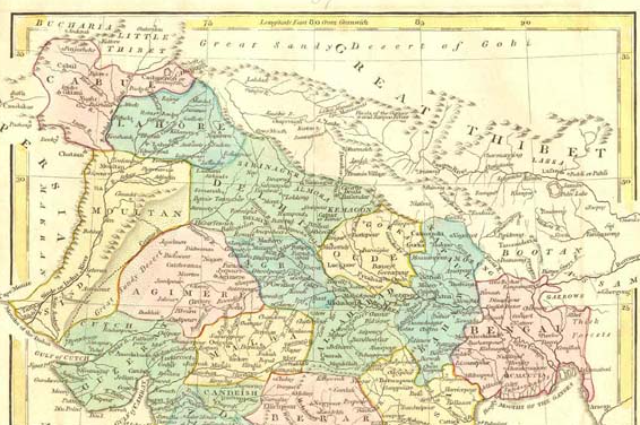
Every Indian schoolchild has asked it at some point: Why does the national anthem mention Sindh—which is now entirely in Pakistan—but not Rajasthan, the largest state in India? Or Kashmir? Or the Northeast? The answer is not politics. It is history. And it goes back to what India looked like in December 1911, when Rabindranath Tagore wrote Bharata Bhagya Vidhata.
What Tagore Wrote In 1911 And Why
Tagore’s song was first sung on 27 December 1911 at the Calcutta Session of the Indian National Congress. It was not written as a national anthem for a country that did not yet exist. It was written as a song praising the dispenser of India’s destiny, listing the regions that made up British India as Tagore saw them.
The original line—“Punjab Sindh Gujarat Maratha Dravida Utkala Banga”—referred to specific territories. In 1911, these words meant:
- Punjab: The British province of Punjab
- Sindh: The British province of Sindh (part of Bombay Presidency till 1936, then a separate province)
- Gujarat: Part of Bombay Presidency
- Maratha: The Marathi-speaking region, Bombay and Central Provinces
- Dravida: South India (Madras Presidency)
- Utkala: Odisha region
- Banga: Bengal Presidency
These were the provinces directly under British rule. That is the key filter Tagore used.
Why Rajasthan Is Missing: Rajputana Was Not British India
Modern Rajasthan did not exist in 1911. What we call Rajasthan today was then the Rajputana Agency—a collection of 22 princely states like Jaipur, Jodhpur, Udaipur, Bikaner, Jaisalmer, and Kota. Princely states were not ruled directly by the British; they were ruled by Maharajas under treaties with the Crown and were not considered part of “British India” for administrative purposes.
Tagore did not name any princely state in the anthem—not Rajputana, not Kashmir, not Mysore, not Hyderabad, nor the princely states of the Northeast. He named only the British provinces.
After independence, Rajputana was integrated through stages. In 1948–49, Sardar Vallabhbhai Patel and V.P. Menon merged the 22 states into the United State of Rajasthan, which became Rajasthan on 30 March 1949 and was later reorganised in 1956. By then, Jana Gana Mana had already been sung for 38 years. When the Constituent Assembly adopted it as the National Anthem on 24 January 1950, it kept Tagore’s original 1911 text exactly as it was. So Rajasthan is not missing because it was ignored; it is missing because, in 1911, there was no single Rajasthan to name.
The Sindh Puzzle: Why A Province Now In Pakistan Still Remains
Sindh became part of Pakistan at Partition in 1947, with its entire territory going to Pakistan. Unlike Punjab and Bengal, which were partitioned and kept portions in India, Sindh left completely. Since then, there have been repeated attempts to remove or change it:
- Parliament: In the 1960s and again in recent years, MPs have asked whether Sindh should be replaced with Sindhu or removed, raising questions in both Lok Sabha and Rajya Sabha.
- Supreme Court: Petitions have been filed arguing that keeping Sindh violates sentiments and should be amended. In 2005 and again in 2022, the Supreme Court dismissed petitions seeking deletion or change, stating that the anthem is to be respected as adopted and no change is warranted.
- The “Sindhu vs Sindh” argument: Professor and former MP Balraj Madhok and others argued that the Constituent Assembly’s officially adopted Hindi version actually says “Sindhu”, referring to the Indus River, not “Sindh” province, and was mispronounced over time as Sindh. Government records show both usages in early translations, but the officially published version by the government today clearly prints “Sindh”.
The government’s answer across Congress and BJP governments has been consistent: do not tinker with the original poet’s creation. There are two practical reasons it has survived every challenge.
First is consistency. If you remove Sindh because it is now in Pakistan, you would logically have to remove other 1911 names too. Utkala is not a state today (it’s Odisha), Banga is not a state (it’s West Bengal), and Dravida covers four southern states. The anthem uses cultural-geographic names, not today’s administrative map.
Second, and more emotionally important, is the Sindhi community.
For Sindhis, That One Word Is Homeland
At Partition, about 1.2 million Sindhi Hindus left Sindh and came to India as refugees. Unlike Punjabis and Bengalis, who still have a Punjab and a Bengal in India, Sindhis have no Sindh in India; they lost their entire homeland.
For the Sindhi community in India—now about 4 to 5 million people—the presence of the word “Sindh” in the national anthem is often described as the only official, daily acknowledgement that their origin is part of India’s history. Sindhi organisations have strongly opposed removing it, stating that removal would be a second displacement: first physical, then from memory. That argument has weighed heavily on governments, as removing Sindh would be seen as erasing a community that already lost everything.
Why The Government Says Leave The 1911 Text Untouched
In replies to Parliament, the Home Ministry has maintained three points:
- Jana Gana Mana is a historical composition whose value lies in being adopted as is on 24 January 1950.
- It represents the idea of India at the time of its composition, not a current political map. It is a poet’s vision of a cultural India from the Vindhyas to the seas.
- Changing one word would open demands to adding every region, leading to an unending list (Rajasthan, Kashmir, Northeast, Kerala, etc.) and destroying the literary integrity of Tagore’s work.
This is why official guidelines state that the anthem should be sung in 52 seconds in its original form, with the word Sindh, and with no state additions. In 2023, the Ministry of Home Affairs again reiterated in a written reply that there is no proposal to amend the National Anthem.
So Who Outranks Whom?
No one outranks anyone. The anthem was never a ranking of states. It was a 1911 map of British provinces set to music, adopted in 1950 exactly as written to honour Tagore.
Rajasthan is not in it because Rajputana was not British India in 1911. Sindh is still in it because history, law, and the memory of the Sindhi community have kept it there. The paradox is itself a lesson in what an anthem is: not a current atlas, but a poem that survived Partition.
Reference
- https://timesofindia.indiatimes.com
- https://www.thehindu.com
- https://rajasthan.gov.in
- https://www.livelaw.in
- https://indianexpress.com