
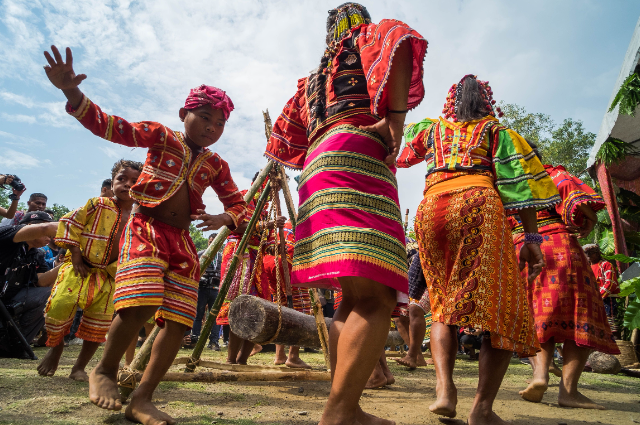
We talk about India as if it were one country with one fixed idea of marriage, family, and a woman's place in both. Patriarchy gets framed as tradition, and tradition gets framed as something we cannot question, because "that's how it's always been here."
Except it hasn't. Not everywhere.
Even long before the term 'consent' gained currency on talk shows and in college circles, the tribal culture of Muria in the state of Bastar, Chhattisgarh, had managed to construct an entire social institution dedicated to it. It is called the Ghotul – a dormitory that serves as a home for young male and female members of the community, allowing them to bond freely among themselves and to indulge in romantic relationships with multiple people before settling down with one person for life. The males in the Ghotul are termed Cheliks and females are termed Motiaris, while the dormitory itself operates through a self-sustaining structure that involves youth participation, headed by a Siredar and a Belosa.
When a Muria boy decides he's ready to commit to one girl, he doesn't ask her family. He doesn't go through an elder. He offers her a flower.
She can take it. Or she can refuse it.
If she refuses, there is no more to it. That's the end. He doesn't get to push, sulk, stalk, or "try again until she says yes." There's no badgering, no guilt-tripping, no family pressure layered on top of her decision. A no is a no, and the boy walks away and looks elsewhere — because her consent is not a formality, it's the entire mechanism.
Sit with that for a second. A community that the rest of the country has historically dismissed as "primitive" had institutionalised the idea that a woman's right to refuse a man is final — at a time when, in large parts of "modern" India, a woman saying no is still treated as an opening for negotiation rather than an answer. We are a country that, even today, argues in courtrooms over whether marital rape should count as rape at all, where the now-banned two-finger test on survivors lingered in practice for years after it was outlawed, and where "no means no" still has to be explained to grown adults as if it were a new concept. The Ghotul figured this out generations ago, without a single hashtag.
It isn't a flawless utopia, of course — and pretending otherwise would do the Muria a disservice. However, over the years, it has shrunk due to the encroachment from formal education, migration, and the judgmental attitude of mainstream India, which has sensationalised it in its ignorance. But that it has survived so long while imparting the lessons of consent and equality through practical experience and not legislative action is something to ponder over, especially when one thinks about who was there first.
There is also the case of the Khasi tribe of Meghalaya, where it wasn’t just about protecting a woman’s rights – they gave the women everything: the house, the land, and the name of the family.
Compare that to the rest of the country, where a daughter's birth can still be treated as a financial liability, where dowry deaths remain a current police statistic rather than a historical footnote, and where a woman's name on the family property is, even now, something she may have to fight for in court — the Hindu Succession Act itself was only amended to grant women equal inheritance rights in 2005.
Two tribal communities. Two completely different blueprints. One-handed women have the power to choose who touches their lives. The other-handed women have the power to own the roof over their heads. And both of them did it centuries before the rest of the country started having these conversations at all.
But even matriliny has its critics, and it would be dishonest to leave that part out. Since 1990, a Khasi men's rights group called the *Syngkhong Rympei Thymmai* has been arguing that the system leaves men sidelined — unable to pass on their name, often dependent on their wives or sisters for property and financial decisions, reduced in their own words to feeling "useful only as breeders." This is a genuine complaint, and it needs to be addressed without glorifying the Khasi system. Take note that what they are complaining about is the same as what men elsewhere in India who seek the equality of women in other parts of India are clamouring for. The argument among the Khasi isn't about whether women deserve power — it's about how that power should be shared. That's a different, and frankly more advanced, conversation than the one most of India is still stuck having.
So, here's the question I want you, the reader, to actually sit with: why do we call these communities "backward"?
Is it because they don't fit our cities, our television serials, our idea of what an "advanced" society looks like? Could it be that we have determined that progress is measured by appearances in courts, parliaments, or hashtags – and not by something that has been done over many years without fanfare inside a forest hut or a hill village?
We spend decades arguing about consent, arguing about ownership rights, and wondering whether one single "no" from a woman would be enough to protect her privacy. Meanwhile, the Muria and the Khasi have not been debating any of it. They simply built it into how they live, long before the rest of us had the vocabulary to even name what we were missing.
Maybe the real question isn't whether India's tribal communities are behind the times. Maybe it's whether the rest of India is still trying to catch up to them — and just too uncomfortable to admit it.
Are we the ones who are ahead? Or are we the ones who've spent generations calling "primitive" the very things we still haven't managed to get right ourselves?
References
- Ghotul — Wikipedia: https://en.wikipedia.org
- The Muria Tribe of Chhattisgarh — Swadesi: https://swadesi.com
- Ghotul, an Institution of Arts, Culture and Sex of Muria Tribes in Bastar — Ground Report: https://www.groundreport.in
- Khasi People — Wikipedia: https://en.wikipedia.org
- Matrilineal Society of Meghalaya — Wikipedia: https://en.wikipedia.org
- Ultimogeniture — Wikipedia: https://en.wikipedia.org
- Men Search for Equality in a Society Where Women Are First in Line — The Caravan: https://caravanmagazine.in
- Power, Property and Patriarchy Plague Meghalaya's Khasi Matrilineal Society — ThePrint: https://theprint.in
- Momma's Girls — The Tribune: https://www.tribuneindia.com
- Meghalaya: Where Women Call the Shots — Al Jazeera: https://www.aljazeera.com
- Khasi Women Reject Bill Discouraging Marriage Outside the Tribe — Gulf News: https://gulfnews.com