
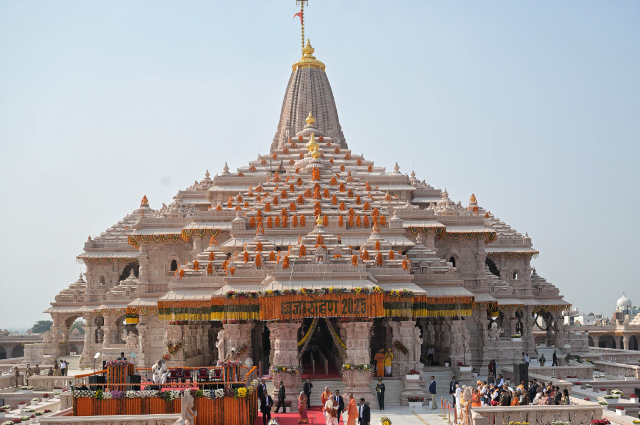
We are taught that giving to God is the one transaction in this country that nobody questions. You drop a note in the hundi box, you fold your hands, you walk away — and asking what happens next feels almost sacrilegious. Faith, we are told, doesn’t need a receipt.
But what happens when the people counting that money start buying things an honest salary could never explain?
In June 2026, a controversy erupted around the Shri Ram Janmabhoomi Teerth Kshetra Trust (SRJTKT), the temple trust that is responsible for constructing the Ram Mandir in Ayodhya, among India's most visited temples. What began as speculation regarding the alleged lavish living of some of the organisation's employees, due to no readily apparent reason, has escalated into full-blown investigations into a potential theft of over ₹200 crores through diversion.
The more useful question isn’t just how much went missing. It’s how a sum like that could go missing at all — inside a temple run by a 15-member trust, watched over by State Bank of India officials, audited by TCS, and built on what is supposed to be the most scrutinised religious project in the country.
How the money is supposed to move
There is a cash counting room in the temple where all cash collected in the hundi boxes placed in front of the deity ("Santum”) and along the "darshan" path is brought for counting or depositing. The exact location of this room is confidential, and access to the room is restricted. Inside, 24 privately hired employees count and bundle the notes, supervised by 12 trust staff, while SBI officials and TCS auditors are meant to monitor the process. On paper, that looks like a tight chain of custody. In practice, it had at least three soft spots: the counters were outsourced, not directly employed by the trust; the trust’s own audits were internal, run on its own terms, since the trust operates independently of state financial control; and for seven to eight months, the CCTV footage from that very room — the one piece of evidence that doesn’t rely on anyone’s honesty — was deleted.
That last detail surfaced not from a leak or an accusation, but from the trust’s own internal audit, conducted by statutory auditor V. Shankar Aiyar & Co. and TCS. The audit reportedly flagged ten chest boxes of gold and silver offerings removed with no accounting entries to explain where they’d gone, and one of the suspects under investigation, K.D. Tiwari — responsible for receiving gold and silver ornaments before handing them to trust officials — is alleged to have bought land worth ₹1.5 crore and built up assets of roughly ₹5 crore. He has denied wrongdoing, saying his role was limited to weighing ornaments and issuing receipts, and that his assets come from his family’s existing income.
This is not a rumour from a disgruntled ex-employee. This is what showed up when the trust’s own auditors finally looked.
The man who said something, and the man who said nothing, changed.
Mahipal Singh, the temple’s former chief accounts officer, says he tried to raise the alarm years before any of this became public. According to a petition now before the Allahabad High Court, Singh alleged that cash verification produced strange numbers — sums of roughly ₹12 lakh recorded in official vouchers as ₹9–10 lakh, again and again, with the difference simply gone. When he flagged it to General Secretary Champat Rai and trust official Gopal Rao, the petition claims, no inquiry was opened. Instead, Singh was quietly removed from the accounting process.
No dramatic sacking. No public confrontation. Just a man who noticed something wrong, and was moved out of the room where he could keep noticing it. By his own account, the matter only reached the public once it reached the media — and from there, almost immediately, the political class.
Who counted the gold after Singh was moved out? Who signed off on what was missing? Who decided the cameras in the one room handling crores in cash could simply stop recording for the better part of a year?
The lifestyle that gave it away
The most visible face of this scandal is Ramshankar Yadav, known locally as Tinnu Yadav, described as a close associate of General Secretary Champat Rai. Neighbours in Ayodhya say he once drove an auto-rickshaw and got around on a motorcycle. Today, investigators are examining assets worth nearly ₹50 crore allegedly linked to him — a 70-room hostel near the airport, stakes in three restaurants, a house in Lucknow, a second hostel in the Naka area, and a Toyota Fortuner. His nephew, Manish Yadav, who was reportedly brought onto the cash-counting team through his uncle’s influence, is also under investigation; sources say investigators recovered ₹36 lakh in cash from him based on information given during questioning.
Yadav has denied any role in counting donations, insisting his job was maintenance — cleaning, water arrangements, fixing fans — and that his money came from land bought back in 2008 and a hostel built afterwards. Nothing has been proven in a court of law, and that distinction matters. But the gap between a maintenance worker’s income and a ₹50 crore portfolio is not the kind of thing that closes itself on its own, and it is exactly the kind of gap an audit trail is supposed to explain. Here, for the months that mattered most, the audit trail had a hole in it shaped like a missing tape.
He is not the only one whose lifestyle did the talking before any investigator did. According to multiple reports, members of the counting team — among them Anukalp Mishra, Lavkush Mishra, Rajesh Pathak, and K.D. Tiwari — saw motorcycles replaced by SUVs and family names start appearing on land deeds and commercial properties, while drawing salaries of around ₹14,500 a month from the private agencies that employed them. It was reportedly one frustrated employee, tired of complaints going nowhere, who first spoke publicly about it, which is how a quiet internal matter became a national story.
Lavkush Mishra has since been arrested, after police recovered ₹10 lakh from his house — some of it, reportedly, hidden under cow dung. The state’s Special Operations Group has reportedly detained at least one other employee linked to the counting process as the questioning has widened. It’s a strange, almost dark detail, but a telling one: not a sophisticated financial cover-up, just an attempt to hide cash the old-fashioned way, inside a temple counting room run on twenty-first century compliance language — outsourcing, oversight, internal audit — and apparently very little of its substance.
₹2 crore recovered, and a number that keeps growing
By mid-June, the SIT had reportedly recovered around ₹2 crore in cash, an SUV, and three phones from individuals under suspicion. The figure attached to the scandal itself has been a moving target — first ₹5 to 7.5 crore, when former Samajwadi Party MLA Pawan Pandey raised it; then, as the probe widened, reports of a diversion that could exceed ₹200 crore. Officials have been careful to call that an early estimate rather than a confirmed figure. Around fifty people connected to the trust’s donation-counting process — staff, trust employees, and bank and audit personnel — are reportedly under investigation, and a senior IPS officer from Delhi has reportedly arrived in Ayodhya by special aircraft to run a parallel inquiry alongside the state SIT.
A co-accused in the Babri Masjid demolition case has separately filed a formal complaint alleging that General Secretary Champat Rai, trustee Anil Mishra, Gopal Rao, and Tinnu Yadav colluded to siphon money, gold and silver from the donation boxes, putting the figure at over ₹200 crore and accusing trust officials of forging account entries. AAP MP Sanjay Singh has filed his own complaint along similar lines, separately flagging a land deal in which a plot reportedly valued at ₹2.92 crore was purchased by the trust for ₹16.5 crore — a gap that, if accurate, has nothing to do with missing cash and everything to do with how money moves once it’s already inside the system.
What the trust says, and what the Chief Minister says
The trust has not stayed silent. Mahant Dinendra Das Maharaj, a trust member, said all donations and financial transactions were properly recorded and handled through a transparent process. Champat Rai said internal audits were underway and that no evidence had yet emerged to support the allegations. Kamal Nayan Das, successor to trust chief Nritya Gopal Das, called for a fair and unbiased probe and asked all trust members to cooperate. Notably, it was the trust itself that approached the Uttar Pradesh government and asked for an independent investigation — a fact its defenders point to as evidence it has nothing to hide, and its critics dismiss as a controlled gesture made only once the story had already broken.
Chief Minister Yogi Adityanath broke his own silence on the matter only this week. Speaking in Ayodhya, he asked people to “wait 15 days” for the SIT’s findings, comparing it to the five centuries devotees waited for the temple itself, and said no one would be spared “whoever they may be” if found guilty. He also asked critics to stop making public statements that could “influence the investigation” or be used to “defame Ayodhya Dham,” while accusing the Samajwadi Party and Congress of historically opposing the temple and exploiting the controversy now.
He repeated the warning days later at a separate public event in the Rudauli assembly segment, this time turning it into something close to a formal ultimatum: a fifteen-day window for the SIT to deliver answers, and a promise, in his words, that the probe would do “doodh ka doodh, paani ka paani” — separate the milk from the water, the truth from the noise. He posted the same line on social media. It’s a vivid phrase, and a confident one. It also doesn’t change the fact that the fifteen days hadn’t started ticking down from a fixed date when he first said it, and that “the truth will come out soon” is a sentence governments have a long history of saying about cases that take far longer than fifteen days to resolve.
It’s a careful line to walk — asking for patience while also asking critics to go quiet — and whether it reads as responsible caution or as an attempt to manage the story depends a great deal on who you already trusted going in.
That request for restraint is also where the real question in this piece sits. Waiting for the SIT to finish its job is reasonable; nobody benefits from a trial conducted on television. But waiting for the verdict and asking how the conditions for the crime were ever allowed to exist are two different things, and only one of them requires patience. You can respect an ongoing investigation and still ask, right now, why a religious trust handling thousands of crores was allowed to rely on outsourced counters on ₹14,500 salaries, internal audits answerable mainly to itself, and a CCTV system in its most sensitive room that nobody apparently checked for eight straight months. That isn’t a question the SIT needs to answer in fifteen days. It’s a question about design, and design questions don’t need to wait for a chargesheet.
The politics nobody can resist
It didn’t take long for this to become political, either. Samajwadi Party chief Akhilesh Yadav raised the donation allegations publicly on June 7, calling the matter one tied to the faith of crores of devotees and demanding judicial intervention; he later said the state, under BJP rule, was “corrupt,” joking that it should have built IITs instead of SITs. His wife, SP MP Dimple Yadav, has since joined him in publicly demanding accountability. On June 12, Shiv Sena (UBT) MP Sanjay Raut widened the circle further still, holding both the central and state governments responsible for the alleged misappropriation — pulling a Maharashtra-based party into what had, until then, mostly been an Uttar Pradesh story. Congress’s Priyanka Gandhi has previously gone further still on a related land-purchase controversy, calling an earlier probe an “eyewash” and saying the “moral responsibility” reaches all the way to the Prime Minister’s office. BJP leaders and trust representatives have pushed back, calling the allegations unproven and, in some cases, politically motivated.
What makes this round of outrage messier than the usual ruling party versus opposition script is that some of the loudest voices aren’t from the opposition at all. Vinay Katiyar — a founding figure of the Ram Janmabhoomi movement itself, who has separately accused Champat Rai of sidelining him from trust affairs for years — was blunt when reporters asked him about the allegations: “Ye jitney hain, sab chor hain.” All of them are thieves. Coming from a man who went to jail for the movement that built this temple, it landed differently than it would from a political rival, and it dragged the controversy out of a clean BJP-versus-opposition frame and into something messier — a fight within the very camp that built the temple, not just against it.
So, which is it? Is the political noise a genuine demand for accountability, or is a temple’s missing crores simply useful ammunition in a state where elections are never far away? Maybe it doesn’t have to be only one. But it’s worth asking why concern over temple finances tends to surface only when a camera and a microphone are already pointed at it, and so rarely when they aren’t.
Why was this never really about one temple
Because here is the part that should bother us more than any single missing crore: Ram Mandir is not unusual in how it is run. It is unusual only in how closely it is being watched right now. This is also not the first-time money around this exact project has raised questions — the Nirmohi Akhara has previously accused the VHP of diverting over ₹1,400 crore raised in earlier decades, and a separate land deal saw a plot reportedly bought for ₹2 crore resold to the trust for ₹18.5 crore within minutes. Patterns like that don’t prove this case, but they do suggest the structural gap — oversight that depends on the goodwill of the people being overseen — has been there for a while, and nobody closed it the first time either.
India’s temples collect an extraordinary amount of money from ordinary people every year — donations given freely, without contracts, without invoices, without any of the paperwork that would normally accompany a transaction of that size. Some of the country’s wealthiest temples operate with minimal external audit, limited public disclosure, and trust structures that answer mostly to themselves. The same god is worshipped in a roadside mandir with a steel donation box as in a temple with a cash-sorting room so sensitive its location is kept secret. The donor’s faith is identical in both places. The accountability is not.
Ordinary devotees who drop money into a hundi box have no mechanism to ask where it went, no seat at the table where it gets decided, and in most cases, no real expectation that asking would change anything. They are told their offering is between them and God. Somewhere between the donation box and the bank account, that offering also became someone else’s decision to make — and, for a while at least, allegedly someone else’s hostel, someone else’s Fortuner, someone else’s restaurant stake.
If the only reason any of this surfaced is that an internal audit happened to catch missing footage, and one frustrated employee refused to stay quiet even after being pushed out of the room, then the system was never built to catch this on its own. It was built to be trusted. And trust, it turns out, is not the same thing as accountability.
So, I’ll ask the question I keep coming back to: are we comfortable having faith in institutions that ask for everything and explain nothing, simply because asking feels disrespectful to what they represent? Or is it finally time we expected our temples to be at least as transparent as we are devoted?
And if the cameras can go dark for eight months in the single most-watched temple in the country, what exactly is being recorded in the thousands of smaller ones nobody is watching at all?
References
- OpIndia — "₹200 crore alleged Ayodhya Ram Mandir donation scam: from cash counting to SIT probe, all you need to know" https://www.opindia.com
- The Federal — "SIT details shocking lapses in Ram temple scandal; Rs 80L recovered from arrested" https://thefederal.com
- Hindu Post — "Rs 7.5 crore or Rs 200 crore? What is the alleged Ayodhya Ram Mandir donation scam?" https://hindupost.in
- India.com — "Missing crores, resignations, SIT and donation working system: The Ayodhya Ram Mandir donation controversy explained" https://www.india.com
- India Herald — "Ram Temple Trust FIR: SIT Flags Massive Procedural Lapses in Donation Handling, Eight Accused" https://www.indiaherald.com
- ETV Bharat — "Ayodhya Ram Temple Donation Case: SIT Begins Probe Into Alleged Financial Irregularities" https://www.etvbharat.com
- ThePrint — "Ram Temple donation 'fraud': Vinay Katiyar hints at possible role of trustees—' sab chor hain'" — https://theprint.in
- The Wire — "Ram Temple Donation Allegations Put Modi in the Line of Fire of Opposition Parties and Hindutva Veterans" — https://thewire.in
- India Legal — "PIL in Allahabad High Court seeks CBI probe into Ram Temple donation fund management" — https://indialegallive.com
- LiveLaw — "PIL In Allahabad High Court Seeks CBI Probe Into Alleged Embezzlement Of Ayodhya Ram Mandir Donation Funds" — https://www.livelaw.in
- The Wire — "Ayodhya's Ram Temple And Six Past Charges of Alleged Corruption" (Nirmohi Akhara/VHP ₹1,400 crore) — https://thewire.in
- National Herald — "Ram Naam ki loot: Nirmohi Akhara accuses BJP, VHP of swindling Rs 1400 crore" — https://www.nationalheraldindia.com
- ThePrint — "UP govt probe into Ayodhya land 'scam' an eyewash; SC should intervene: Priyanka Gandhi" — https://theprint.in