
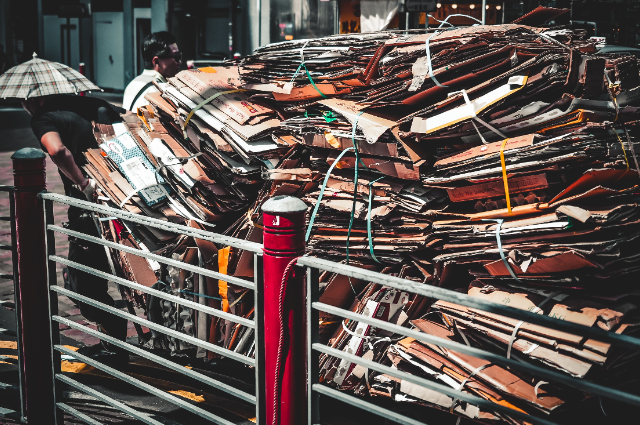
He is there every week. A long call down the lane, half announcement, half question; you don’t see him first – you hear him. By the time he reaches your door, the newspapers are already bundled, the bottles sorted, the old pressure cooker sitting by the threshold waiting to go.
Kabadiwaala.
Before sustainability became a movement, a brand strategy, or a policy framework, Indian households were running a material recovery system so efficient that it now outperforms the infrastructure of countries that consider themselves its teacher.
The world is spending billions trying to build a circular economy. India didn’t build one. It just never took it apart. We now spend hours going through our phones, trying to find places where we can sell our junk and apps that pick up and drop off things we don’t need anymore to support a better environment.
The kabadiwala didn’t need an app. He just needed a scale and a bicycle.
There are roughly 4 million informal waste workers in India. Together, they recover an estimated 60% of the country’s plastic waste – against a global average of 14%. No municipal contract. No government subsidy. No recycling bin with a cheerful logo on it. The system runs on a single incentive: materials have value, and the person who collects them gets paid by the kilo.
It is, in the language of economists, a near-perfect market. It is also, in the language of reality, backbreaking and dangerous. Workers sort through electronic waste with their bare hands. They breathe fumes from burning cables. They have no insurance, no sick leave, no legal standing. The system is efficient precisely because the person inside it have no alternative.
This is not a model. That is a condition.
In 1998, Forbes gave the Mumbai dabbawal network a Six Sigma rating – fewer than one error per six million deliveries. FedEx sent observers. Harvard wrote a case study. What they found was not a system. It was a practice: 5,000 men, most of them semi-literate, moving 200,000 home-cooked meals across one of the world’s most chaotic cities every day, using bicycles, trains, and a color-coded alphanumeric system stamped on tin lids.
No GPS. No app. No warehouse. What they had instead was something that logistics companies spend millions trying to stimulate: dense local knowledge. Every dabbawalla knows his route the way he knows his own name. The last mile isn’t a problem to be solved with technology. It’s a relationship.
There is a word in Hindi – jugaad - that has no clean English translation. It means something between a workaround and a reinvention. A fix that shouldn't work but does. It is sometimes romanticized as innovation. It is more accurately understood as the accumulated logic of scarcity: when you cannot afford to throw something away, you learn to see what it still is rather than what it no longer does.
Old steel dabbas become storage tins. Milk packets become pouches. Worn sarees become dusting cloths. This is not minimalism. It is not environmentalism. It is not a lifestyle choice. It is a default setting, laid down over generations, that the rest of the world is now trying to install from scratch.
Here is the question nobody is asking: "What can the world learn from India?"
Does this system work because it is ingenious, or because millions of people have no other choice?
As incomes rise in cities like Chennai and Bengaluru, informal recycling is already contracting. The kabadiwala's margins get squeezed when labor costs rise and material prices fall. The dabbawala network shrank during the pandemic and has not fully recovered. These are not anomalies. They are what happens when the economic conditions that make informal systems viable begin to shift. The world cannot import the practice without also reckoning with what made it necessary.
The lesson is not the kabadiwala. The lesson is the incentive structure behind him. Pune's SWaCH cooperative offers a glimpse of what it looks like when that structure is formalized: waste pickers licensed as municipal partners, issued ID cards, given health insurance, paid through Extended Producer Responsibility funds that make brands financially responsible for the waste their packaging generates. The recovery rates held. The workers gained rights. The city saved money.
Economic incentive beats moral persuasion, every time. The West built recycling on guilt. India built it on livelihood. One of those things scales.
India has something rare: a working circular economy, built not by policy but by practice, not by design but by default. The question is whether it will protect it — formalize, compensate, and extend it — before rising incomes and the seduction of modern waste infrastructure quietly dismantle it.
But for now, we still have the kabadiwala calling down the lane and our contribution in keeping this routine alive and breathing in our country.
References
- Earth5R — "India's Waste Crisis and the Cities Breaking the Pattern: An Earth5R Analysis" https://earth5r.org
- CEED India — "From Pollution to Prevention: Rethinking Plastic Waste Through Circular Design and Segregation" https://ceedindia.org
- The Edge Malaysia — "What Harvard is learning from the Mumbai dabbawalas" https://theedgemalaysia.com
- Wikipedia — "Dabbawala" https://en.wikipedia.org
- WRI Ross Centre Prize for Cities — "SWaCH Pune Seva Sahakari Sanstha" https://prizeforcities.org
- UNEP — "Empowering waste workers for a cleaner, safer city" https://www.unep.org
- Centre for Financial Accountability — "The SWaCH cooperative model of Pune: The 'Yes In My Back Yard' model of waste management" https://www.cenfa.org