
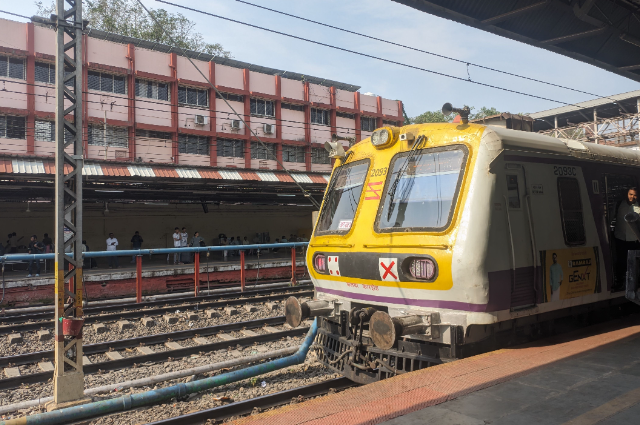
How small does an inconvenience have to be before it stops being worth killing someone over? Apparently, in Mumbai, the answer is: a train door, left open in the rain.
On the night of June 23rd, 22-year-old Mayank Lohar boarded the first-class compartment of the Churchgate–Nallasopara fast local, Train No. 90663, after finishing his shift as a salesman in Andheri. He was heading home to Virar. It was raining hard enough that he asked a co-passenger to shut the coach door.
That request killed him.
The argument escalated fast. Somewhere between Andheri and Borivali, with the train still moving, the other man pulled out a knife and stabbed Lohar in the abdomen. By the time the train pulled into Borivali at 11:04 PM, Lohar was dying on the floor of a compartment full of strangers, and his attacker had already jumped onto the platform near Gate No. 6 and disappeared into the crowd.
Mayank Lohar is not a statistic. He is someone's son, someone's brother, out of five siblings, a 22-year-old who, according to his own mother, would "never pick a fight with anyone." He had a job, a commute, a family waiting for him in Virar. He asked a stranger to close a door because of the rain. That is the entire offence he is on record as having committed.
The accused has since been identified and arrested; police named him as Roshan Suvarna (also reported in some accounts as Sachin Ramesh Suvarna), a 30-year-old from Mira Road who worked at a cargo handling unit near the airport alongside his own father and brother. He had, by his own account to investigators, finished his shift, gone through nearly a full bottle of rum, found no cab in the rain, and boarded the local instead. Fifteen-odd hours, almost 400 CCTV cameras, and one manhunt later, he was caught at Panvel, allegedly trying to get a bus home to Mangaluru.
So now we have a name, a face, a confession of sorts. What we don't have is an explanation that makes any of this make sense, because there isn't one. A man is dead because someone didn't want a train door closed in the rain.
Suvarna himself later told the rum bottle, the missed cab, the crowded compartment as if these were mitigating details rather than a checklist of ordinary, forgettable Tuesday-night frustrations. He had finished a work shift like millions of other people in this city finish every single day. He had been drinking, yes, but half of Mumbai has had a drink after a long day in the rain and still made it home without reaching for a blade. None of it explains the knife. None of it explains why a man would rather stab a stranger than simply let the argument die the way every other argument on every other train, on every other night, eventually does.
What does it say about us that this is no longer shocking? That somewhere in the back of our heads, before the headline even finishes loading, we already know how this ends: a fight, a blade, a body, a viral clip, a hashtag. We have seen this exact sequence of events enough times now that we can predict the next twelve hours of the news cycle before the body has even reached the hospital: the manhunt, the CCTV grids, the arrest, the mugshot, the "no prior criminal record" line that always seems to follow, as if that detail is supposed to be reassuring rather than terrifying. If men with "no prior criminal record" are the ones doing this, then the problem was never confined to a handful of known troublemakers. It is sitting next to us. It always was.
Passengers on that train reportedly stood back and watched, some recording, as Lohar collapsed near the door he'd asked to be shut. That is not a moral failing unique to those specific commuters; it is what fear does to a crowd, and nobody boards a local expecting to need the nerve of a hero. But it is still worth sitting with the image: a packed first-class compartment, dozens of people, and a 22-year-old bleeding out on the floor while the train kept moving toward its next stop, because nobody quite knew what else to do.
This is not the first time. In February, a 32-year-old college lecturer named Alok Singh was stabbed at Malad station after a dispute with a fellow passenger over how to get off a crowded train. The accused in that case, Omkar Shinde, was arrested within hours. Five months later, almost the same train line, almost the same circumstances, a different blade, a different name, and another family making the same impossible journey to a morgue.
Two stabbings. Same suburban network. Same city. Same year. And these are only the cases that ended in death the ones that made it past the local crime blotter and into the national news cycle because somebody filmed it, or because the victim didn't survive. Anyone who has actually ridden a Mumbai local during peak hours, or during a downpour, knows that the shoving, the shouting, the open threats over a seat or a door or a foot of standing space are not rare. They are Tuesday. What separates this incident from the hundreds of identical near-misses that happen every single day is not that the argument was worse; it's that, this time, someone happened to be carrying a knife and decided to use it.
That is the part that should actually frighten us. Not that Roshan Suvarna is some uniquely evil outlier, but that the conditions that produced him — heat, rain, fatigue, alcohol, a packed train, a stranger who wouldn't back down, and apparently no internal brake stopping him from pulling out a weapon — are not rare. They are the conditions of an ordinary Mumbai commute. If that combination is enough to get a man killed, then every single person packed into a first-class compartment tonight is one bad-tempered stranger away from becoming the next Mayank Lohar.
How many more of these do we need before "argument over a door" stops being treated as an isolated, freakish thing and starts being treated as a pattern? How much patience do we expect commuters to have with each other when a request as small as shutting a door, or stepping aside, can now end in a knife to the stomach?
There is a version of this story where Lohar simply gets annoyed, mutters something under his breath, and gets off at his stop in Virar like he has a thousand times before. No version of this story should have ended with him bleeding out on a train floor while strangers watched.
We talk endlessly about Mumbai's resilience, the city that "never stops," the spirit of the local trains that have carried this city to work and back for over a century, the soft-focus reels of commuters hanging off open doors with the wind in their faces, sold to the rest of the country as a kind of romance. There is a reason that image is everywhere, and this one isn't: nobody wants to admit that the same open door people pose against for a photo is the exact spot where Mayank Lohar made a request that got him killed. Resilience is not the same as safety, and a commute that depends on hoping the stranger next to you doesn't have a knife and a grudge is not something to romanticise. It is something to fix.
The Borivali GRP is now combing through CCTV and witness statements, and Western Railway says it is cooperating fully. That is the procedure. It is also, by now, a script we have all read before: register the case, comb the footage, make the arrest, issue the statement, wait for the next one. Nobody in that chain is lying or failing at their job; the GRP and RPF reportedly reached the coach within three minutes of the train stopping, which by most standards is a fast response. But a fast response to a stabbing is not the same as preventing one, and right now, the only thing standing between a minor disagreement and a murder on these trains is the temperament of whichever stranger you happen to be arguing with that night. That is not a safety system. That is luck, dressed up as one.
So I'll ask the question this city seems determined to keep avoiding: how much more of our patience, our restraint, our basic ability to share a crowded compartment with a stranger, has actually run out, and what is it going to take, after the second stabbing on the same line in a single year, before we admit that something on these trains is breaking, and it isn't just the doors?
Because the uncomfortable truth sitting underneath all of this is that Mayank Lohar didn't do anything wrong. He didn't provoke a fight, pick a side, or escalate a disagreement. He asked someone to close a door, the way thousands of people on thousands of trains ask each other for small, reasonable things every single night. The next person who makes that kind of ordinary request, to shut a door, to make room, to wait their turn, is trusting, whether they realise it or not, that the stranger standing across from them still has a line they won't cross. Two stabbings into this year alone, that trust is starting to look less like decency and more like a gamble nobody actually agreed to take.
References:
- Tribune India. (2026, June 25). Mumbai horror: 22-year-old stabbed to death on local train after fight over keeping doors open during rain. https://www.tribuneindia.com
- Free Press Journal. (2026, June 25). Mumbai local train stabbing over door dispute kills 22-year-old, accused arrested after 400-CCTV hunt. https://www.freepressjournal.in
- ThePrint (PTI). (2026, June 24). Man killed on Mumbai local train during fight over keeping doors open amid rains, accused held. https://theprint.in/india
- NewsGram. (2026, June 25). Mumbai local train murder: Mayank Lohar stabbed to death, accused arrested. https://www.newsgram.com
- Udaipur Times. (2026, June 25). Who is Roshan Suvarna? Mumbai local train murder accused arrested after 15-hour manhunt. https://udaipurtimes.com
Note: Some outlets identify the accused as "Roshan Suvarna" and others as "Sachin Ramesh Suvarna." This discrepancy appears across multiple reputable sources and could not be resolved through available reporting at the time of writing.