
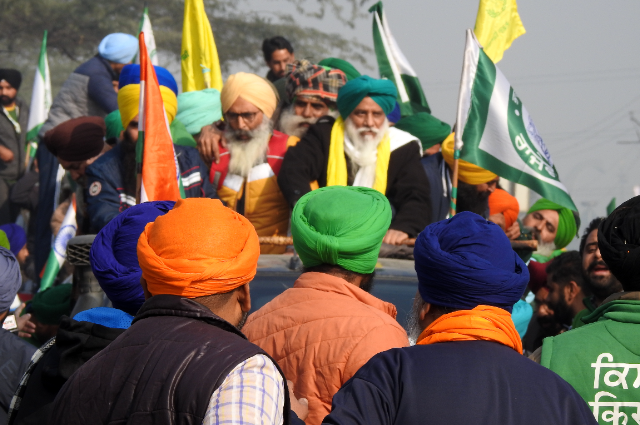
Imagine yourself as a wheat farmer in Sangrur. You have been farming for thirty years now. Input costs keep increasing but the value of your product keeps falling. All of a sudden you are told by the government that cheap, heavily subsidised products from American farms are soon going to come here – and that’s a good thing! Would you agree? Of course not!
But those who own agricultural land in Punjab, Haryana, Rajasthan and Himachal Pradesh did just that. Thousands of them got on buses, tractors and mini-vans to head towards Delhi once again this week, all in protest against the proposed India-US Trade deal which they claim will devastate their crops and incomes.
In the past few weeks, we have seen protests erupt across the country over rising oil prices and inflation rates. But this week’s demonstrations were nothing short of explosive. Organised under the banner of ‘Desh Bachao Morcha’, farmer unions held an event called ‘Kisan Mahapanchayat’ where they demanded the outright cancellation of the India-US trade deal proposal.
Farmer leader Sarwan Singh Pandher (who heads the Kisan Mazoor Sangharsh Committee) led the protest march from Gurudwara Sri Fatehgarh Sahib right up to the Shambhu border. Addressing the rally, Pandher said, “We came out today with our one and only non-negotiable demand: Scrapping this entire agreement… It is possible that these Negotiators won’t say anything [about the agreement], so we request the MPs from Punjab, from every state to bring this matter forward during the Monsoon Session of the Parliament.”
But Haryana didn’t allow the farmers to explain themselves – they just blocked the roadways. When we tried to travel along the roads leading to our capital city, police personnel detained us immediately at the border between Shambhu & Khanauri. Similarly, BKU workers were stopped in front of the toll plaza of a highway connecting Shahabad. Then, right before the protests started, farmer leader Gurnam Singh Charuni was arrested by the Haryana Police while trying to attend a programme in Kurukshetra. What kind of message does this send?
Instead of taking time to address questions posed by leaders of farmers’ organisations about the contents of this agreement, the Indian government has opted to simply detain them. In many ways, it’s simpler to block access to information than provide it. But then again, who needs freedom of speech anyway if you already know your government’s position on any issue?
As for why this trade deal should matter to ordinary citizens across the nation: nobody outside of those negotiating it actually knows yet. Which brings me back to the protests – a coalition representing agricultural stakeholders (the Samyukta Kisan Morcha) recently sent a letter to India’s president asking her to make the documents around these negotiations publicly available for discussion within the parliamentary assembly instead of revealing them suddenly during the course of protest marches. According to farm union representatives, reducing import tariffs on items including things like agriculture, dairy, machinery, electrical equipment, chemicals, steel, pharmaceuticals and motor vehicles would spell disaster for both local industries and small-scale enterprises (“MSMEs”), ultimately threatening job security for millions of Indians. And according to recent reports, this isn’t limited to anything related to farming alone – the deal potentially opens doors for e-commerce, digital trade, government procurement processes and more into India.
Samyukta Kisan Morcha took the same attitude toward the term’s emergence as many others. In fact, they declared it “total surrender” of Indian agriculture to the dictates of American corporations and demanded that the President sack Commerce Minister Piyush Goyal for having opened up our agricultural and dairy sector to multinationals at the expense of the nation’s self-reliance. To call such a development a “surrender” may be hyperbolic (and I’d love to debate with these guys about that), but I’m curious how those very same farmers would feel knowing that their own government is negotiating on their behalf — only to leave them scrambling for clues when it comes time to draw the final borders?
In fairness, the Union government insists that agriculture continues to be one of India’s “red lines” in these discussions — and we won’t sign anything that puts us against our own interests. Yet once again, farmers find themselves hearing lots of pretty talk from elected officials while the devil lies in the details. Why, for instance, does an agreement that supposedly keeps agriculture out of foreign hands also seemingly make an “intention” of purchasing $500 Billion worth of American goods? And why don’t folks want to tell me which sectors account for that figure? I mean, maybe there are just too many sectors involved to mention, but come on… this isn’t even a real treaty yet. We’re talking preliminary agreements here.
The Samyukta Kisan Morcha didn’t cause this problem alone, either. Just a few days prior, over ten thousand demonstrators marched from Jantar Mantar to Parliament in protest of Education Minister Dharmendra Pradhan’s recent paper leaks and other policy missteps. Known as the Sansad Chalo March, organised by the Cockroach Janta Party (CJP), the march came to an end after the police used tear gas and lathis to disperse the protestors. Close to 180 were reported injured during the event, and 70 protesters arrested, according to police reports. Worst of all, one nineteen-year-old demonstrator appears to be suffering permanent vision loss in one of their eyes due to pellet fire. (He was apparently hit by pellets fired by security forces). While CJP founder Abhijeet Dipke said that his organisation would never stage marches through the city streets again, he explained that this wasn’t out of fear of arrest but rather his refusal to expose his young members to physical danger anymore.
It’s worth sitting with these images for a moment. Two days ago students demanded accountability for the exams that will determine their future. Yesterday farmers demanded transparency for a trade deal that will decide their livelihoods. Today they’re being treated by our government in much the same way: barricades, detentions – but no explanations, no apologies, just more soldiers and more slabs of concrete. In particular, there hasn’t been a single press conference explaining the content of the trade deal (or even announcing its signing), or a single statement apologising for what happened to the teenager’s eye. They’ve simply put more troops on the streets.
Who stands to benefit from this? Well, clearly everyone involved in making decisions behind closed doors does because they don’t have to worry about scrutiny or criticism. But for every citizen that gets upset when his rights are trampled on, or his voice isn’t heard, there’s another citizen whose mind is already made up: I know what’s best for me and I’d rather stick to my own point of view. It means citizens get less interested in politics and governments continue to ignore democracy as a principle.
A country that truly believed in its negotiating position would make all relevant information public domain and invite discussion between farmers, economists and parliamentarians. Instead, we watch footage of armed forces blocking highways with concrete blocks, assuming that somehow the threat posed to the nation is greater than a convoy of tractors. In reality, though, we’re endangering the very thing that defines us as a society – the ability for free debate based on informed decision-making.
What strikes me most strongly now is how often media coverage highlights certain stories while ignoring others entirely. A farmer detained overnight in Kurukshetra doesn’t get beyond the agricultural news pages. When a demonstration goes violent at Jantar Mantar, the papers only cover it until the latest batch of tear gas canisters has emptied out. As for the actual beneficiaries of the trade deal – the students who face a hollowed-out education system and the farmers who’ll be confronted with subsidised imports – they’ll keep marching and writing letters to the President’s office, hoping that eventually he’ll read some of them.
That’s my question for all of us.
If we’re talking about trade agreements that are in the national interest, then why should we be surprised by a lack of communication with the country they affect?
Or perhaps more importantly – if protecting our farmers is truly a red-line issue, how can it be that protecting them will invariably result in their protection from themselves?
References:
- Down To Earth. "Farmers protest against India-US trade talks as convoys stopped near Delhi." downtoearth.org.in
- The News Mill. "Farmers protest India-US trade deal with march to Delhi." thenewsmill.com
- The Week. "Another farmer protest: Why are Punjab farmers opposing the US-India trade deal?" theweek.in
- Outlook India. "Delhi Protests: Farmers Head To The Capital For Mahapanchayat, India-US Trade Deal Under Scanner." outlookindia.com
- ANI. "March to Delhi against India-US trade deal: Farmers depart from Gurudwara Fatehgarh Sahib; to stage sit-in at 'Kisan Ghat'." aninews.in
- The News Minute. "Explained: Why are farmers protesting against the proposed India-US trade deal?" thenewsminute.com
- The Researchers. "Farmers' Protest Against India-US Trade Deal: Punjab Farmers March to Delhi." theresearchers.us
- Sourcing Journal (via Yahoo News). "US-India Trade Deal Sparks Farmer Fury, Political Backlash." yahoo.com
- The Tribune. "US trying to influence India's agriculture policy, says Kisan Mazdoor Morcha." tribuneindia.com
- Deccan Chronicle. "Kisan Mahapanchayat: Delhi Police Detain 4 Haryana Farmers at Singhu Border." deccanchronicle.com
- NewsX. "Showdown at Shambhu: Farmers' 'Delhi Chalo' March Halted Amid Police Barricading on Punjab-Haryana Border." newsx.com
- The Tribune. "Strong barricades, heavy deployment thwart farmers' march towards Delhi." tribuneindia.com
- Rural Voice. "Farmers March Towards Delhi to Protest Proposed India-US Trade Deal; Police Stop Protesters at Borders, Detain Leaders." eng. ruralvoice.in
- Wikipedia. "Sansad Chalo March." en.wikipedia.org
- Wikipedia. "2026 Delhi Jantar Mantar protests." en.wikipedia.org
- Al Jazeera. "India's 'cockroach' protest movement halts marches after police violence." aljazeera.com
- Wikipedia. "Cockroach Janta Party." en.wikipedia.org