
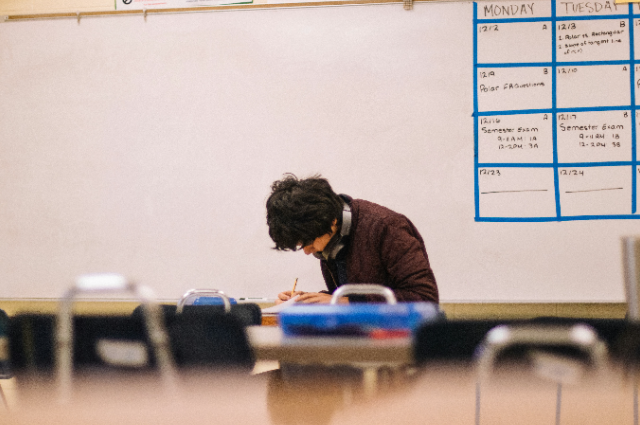
Somewhere in this country right now, there is a seventeen-year-old refreshing a results portal, heart in their throat, because a number on a screen is about to decide which door in their life stays open and which one shuts. That is what a board exam is. Not a formality. Not a bureaucratic checkbox. Someone's entire future, reduced to marks typed in by a stranger. And this year, CBSE handed that responsibility to a system so broken that it took three teenagers, not regulators, not auditors, not a single adult paid to protect them, to catch it.
Let that sink in. The people meant to safeguard millions of futures did nothing. The people whose futures were on the line had to do it themselves.
In May, a Class 12 student named Vedant Shrivastava opened the photocopy of his physics answer sheet. He had paid for it. He had waited weeks for it. And when it finally arrived, it wasn't his. Someone else's handwriting stared back at him. Someone else's mistakes, someone else's half-finished answers, someone else's failures, all about to become his. Think about what that does to a person. Not a data error on a spreadsheet somewhere. A child's future, quietly swapped with a stranger's, and nobody would have known if he hadn't looked.
CBSE's response? Call it a one-off. Fix his result quietly. Move on, the way institutions always hope students will. Except Vedant didn't move on, and the moment he refused to stay quiet, something broke open that CBSE could no longer contain.
Because Sarthak Sidhant, also seventeen, wasn't willing to accept "one-off" either. He went digging into who had actually built the system now deciding the fate of 1.7 million students, and what he found should sicken every parent reading this. The contract for CBSE's On-Screen Marking system went to a company called Coempt EduTeck. Under its older name, Globarena Technologies, this same company had already run an evaluation system into the ground once before, in Telangana, in 2019, an implosion so catastrophic that lakhs of students were wrongly failed and more than twenty of them took their own lives. Twenty children. Gone. And CBSE looked at that history, rebranded and repackaged in front of them, and handed it the marking of an entire national exam anyway.
How do you make that decision? Who sat in that room and decided a body count wasn't disqualifying?
Sarthak didn't just post his anger online and let it die in a comment section. He built a case. He took it, in person, in front of a parliamentary standing committee, and made grown men in suits answer for a decision they clearly hoped no one would ever trace back to them.
And then there's Nisarga Adhikary, nineteen, who did everything right and was ignored anyway. Back in February, months before a single result was declared, he found gaping holes in CBSE's marking portal and reported them, quietly, responsibly, to India's own cybersecurity emergency team. Nobody acted. Three months of silence, while an entire nation's board results sat on infrastructure he already knew was compromised. So in May, he stopped waiting for permission and showed the country exactly what he meant. A hardcoded master password, sitting inside the portal's own code, that let anyone skip past OTP verification entirely and log in pretending to be an examiner. From there? Anyone could view a student's marks. Anyone could edit them. Anyone could delete them. Not in a hypothetical. He proved it, live, on the real system. Millions of scanned answer sheets, sitting on a misconfigured server, wide open to anyone who knew where to look.
Read that again. A stranger, with nothing more than a laptop, could have rewritten your child's future and nobody at CBSE would have known until a teenager showed them how.
And what did CBSE do, once it could no longer hide behind the word "glitch"?
It transferred its chairman. Transferred its controller of examinations. Not suspended. Not held accountable. Quietly moved, the way you rearrange furniture instead of fixing the wall it was hiding. No one has explained who decided to relax technical requirements just to secure a bidder after two rounds of failed bidding. No one has explained why, post-result verification, the one safeguard that might have caught Vedant's mismatched sheet before it ever reached him was scrapped that same year, because digital marking was supposedly too accurate to need a safety net. And the Union Education Minister, the man whose ministry exists to answer for exactly this? He stayed exactly where he was, telling the board to "fix the glitches," as if a stranger holding the power to rewrite a child's future were a slow-loading app and not a warning siren.
We love to say this generation doesn't care about anything beyond their phones. That they lack the seriousness, the grit, the sense of duty the generations before them supposedly had. And then three of them, still minors, still writing their own board exams while all this unfolded, did more real accountability work in a single month than the entire regulatory machinery managed in a year of rollout. Not because anyone gave them a badge or a mandate. Because they simply refused to let a wrong answer sheet be the end of the story.
And this rot didn't stay contained to one board's marking portal. A month later, it spilt onto the streets of Delhi, and it is still there, right now, at Jantar Mantar, as I write this. The Cockroach Janta Party's protest, demanding Education Minister Dharmendra Pradhan's resignation over exam paper leaks and grading failures that have devastated students across the country, has been camped out for over eighteen days. Climate activist Sonam Wangchuk sat down among them and stopped eating. Ten days in, he had lost more than seven kilograms. His blood pressure was down to 102 over 61. His blood sugar had dropped to 68. Doctors check him every morning like clockwork, the way you'd monitor someone who might not make it through the week, because that is genuinely the risk. A fasting AISA student was hospitalised after her condition turned critical. These are not statistics on a protest flyer. These are people, visibly weakening in front of cameras, day after day, because talking hasn't worked and neither has waiting.
And where was the coverage that should have come with that? Turn on primetime television during those same eighteen days, and you were far more likely to find anchors dissecting the personal identity and politics of a YouTube educator named Faisal Khan than a single serious segment on a man starving himself outside Parliament to be heard. Opposition leaders themselves called it out as a distraction, and they weren't wrong. A man has done more for students by simply teaching them for free on the internet than an entire government machinery has managed with its budgets, its ministries, and its press conferences. And somehow, the loudest national conversation was about his name, not about why students are collapsing in a park demanding basic accountability.
Ask yourself who has actually shown up at Jantar Mantar. It is ordinary people. Farmers' unions walking over in solidarity. Students building a makeshift library out of their own pocket money, only to allegedly have those books, on Ambedkar, on Shivaji, on Bhagat Singh, thrown into the mud by police. Strangers turning up with food and water for people they have never met, because someone has to feed a protest that has now gone on for over two weeks. And where, in all of this, are the people with the actual reach to make a government uncomfortable? A couple of names have visited and spoken, and that matters, but where is the wave of support that this kind of number, in this kind of danger, should be pulling in? Where are the celebrities with tens of millions of followers, who share a birthday post in under a minute, but haven't found sixty seconds to ask why children are being hospitalised over exams that decide their futures?
The Cockroach Janta Party wrote directly to the Prime Minister and asked him, plainly, how long his silence would continue. Weeks later, that silence is still the answer. Everyone who actually has the power to end this- the Prime Minister, the education minister, the institutions built specifically to prevent exactly this kind of collapse- has chosen to say nothing and wait it out, the way powerful people usually do when the people protesting have no power to make waiting costly for them.
And here is the hypocrisy that makes all of this so much harder to swallow. Modi has stood at the Red Fort and said, in his own words, that he does not want the youth of this country "forced" to study abroad, that he wants an Indian education system good enough that no one has to leave. Fine words. Except look at who is actually sending their own children overseas while that speech is being written. Reports show that ministers and senior leaders from the BJP, Congress, and AAP, regardless of party differences, send their children to Oxford, Harvard, and LSE, rather than the IITs or IIMs that their own government spends millions promoting. If the system is truly strong, trustworthy, and safe for everyone else, why does it become inadequate when it comes to their own child's future? You cannot ask an entire generation to trust a system you are not willing to risk for your own family.
I need you, the reader, to think about this. Don't just pass it off as another scandal in a country that seems to produce them weekly. A national board handed the futures of over a million children to a company with a troubling history. A security flaw was left open for months while those who could have fixed it ignored it. When the issue was exposed, the responsible individuals were reassigned instead of removed, while the students who noticed the problem were left wondering if anyone in authority would act first, rather than react.
An inquiry panel has been set up. Its findings are still "pending," as they always are, until the news cycle moves on and the affected students have accepted whatever result they received, with or without an appeal. Maybe this time will be different. I want to believe that. But honestly, how many times has a system in this country punished itself before it was forced to?
If a seventeen-year-old with just a laptop and a sense of injustice can uncover what an entire national board either missed or chose to ignore, what are we really trusting our institutions to do? Protect the futures of the children in their care, or protect themselves and hope the children find the mistakes before it's too late?
Next year, another student like Vedant will open a photocopy that isn't theirs. Another student like Nisarga will discover another flaw that nobody closed. When that happens, I want a clear answer to this: will it once again be up to a child to protect a system that was supposed to protect them?
References:
- Wikipedia. "2026 CBSE On-Screen Marking controversy."
en.wikipedia.org - Al Jazeera. "How India's CBSE exam scandal set off student outrage against PM Modi."
aljazeera.com - Business Standard. "How a 19-year-old student exposed flaws in CBSE's On-Screen Marking portal."
business-standard.com - matchtocollege.com. "CBSE Portal Security Breach: Ethical Hacker Exposes Flaws."
matchtocollege.com - Brut India. "How Three Gen Z Students Sparked A National Debate Over CBSE's Digital Marking System."
brut. media - Nieman Reports. "An Exposé by Students Highlights Failings of Mainstream Journalism in India."
niemanreports.org - The Probe. "How CBSE OSM Turned Board Results Into a National Scandal."
theprobe. in - Telangana Today. "CJP protest over exam irregularities enters 18th day; Sonam Wangchuk's fast continues." telanganatoday.com
- The Print. "CJP protest day 15: Fresh political support pours in, AISA student hospitalised."
theprint. in - Newslaundry. "Cockroach Janta Party: 15 days later, bigger protest or bigger hype?"
newslaundry.com - ETV Bharat. "Delhi HC Orders Restoration Of CJP's X Account; Sonam Wangchuk Loses 7.3 Kg As Hunger Strike Enters Day 10."
etvbharat.com - RT. "'This is about the dignity of youth': India's 'cockroach' movement pushes beyond satire."
rt.com - Newsgram. "Cockroach Janta Party Explained: How a Meme Became India's Youth Protest Movement."
newsgram.com - The Quint. "WebQoof Recap: Of Misinformation Surrounding the CJP, PM Modi, and 'Khan Sir'."
thequint.com - Outlook India. "'We Love You, Delhi Police': An Inside View Of CJP's Jantar Mantar Protest."
outlookindia.com - LiveMint via Dailyhunt. "Views, virality and CJP protest: How India's creator economy found a new stage at Jantar Mantar." m.dailyhunt.in
- The Week. "Inside Day 13 of the Jantar Mantar protests: Hunger strikes, mock funerals and dissent."
theweek. in - The Print. "CJP urges PM Modi to break silence over Jantar Mantar protest."
theprint. in - The Tribune. "CJP writes open letter to PM Modi; seeks response on students' protest, Wangchuk's hunger strike." tribuneindia.com
- The Print. "CJP pens open letter to PM Modi, urges him to break 'resounding silence' over its protest."
theprint. in - SabrangIndia. "May-June 2026: Youth Congress nationwide protests challenge education system collapse under Modi government, media gives cold shoulder?"
sabrangindia. in - Wikipedia. "Khan Sir."
en.wikipedia.org - Telangana Today. "Khan Sir controversy intensifies in Bihar; BJP says administration will work as per law."
telanganatoday.com - The Print. "The cult of Khan Sir and Patna's coaching war." The Print. in
- The Print. "Khan Sir: Teacher, reformer or a figure of controversy?"
theprint. in - Vygr News. "Study in India? Politicians' Kids Choose Abroad."
vygrnews.com - The PIE News. "Modi vows to act amid increase in Indian students abroad."
thepienews.com - Times Higher Education. "Indian youth shouldn't be 'forced' to study abroad, says Modi."
timeshighereducation.com. . .