
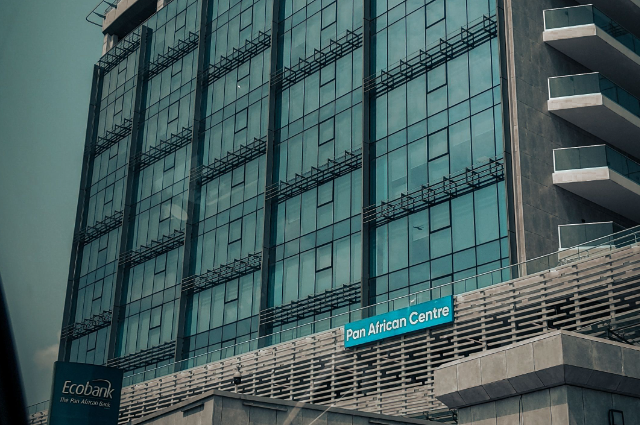
Picture a nine-storey office and shopping complex in the middle of Harare, Zimbabwe. No central air conditioning. No mechanical heating. And yet, on the hottest days, it holds steady, comfortable, breathing on its own. If you told most engineers in 1991 that this was possible at the scale of the country's largest commercial building, they would have laughed you out of the room.
Mick Pearce did not laugh. He built it.
The Eastgate Centre opened its doors in 1996, seven years and one economic gamble in the making. Old Mutual, the investment group financing the project, gave Pearce a blunt brief: build Zimbabwe's largest retail and office complex, and do not saddle us with the cost of air conditioning 55,000 square metres of floor space. That is not a design challenge. That is closer to an ultimatum.
So Pearce went looking for an answer somewhere other than a mechanical engineer's textbook. He found it on the savanna, in the termite mounds that rise out of the ground across Zimbabwe like miniature cathedrals, some taller than a person, others housing millions of termites along with the fungus gardens they farm to survive. Back then, the prevailing scientific theory regarding the nature of these mounds, formulated in the 1950s by Martin Lüscher, a Swiss entomologist, suggested that they served as air conditioners. The hot air would rise from the bottom of the colony, while the cooler air would flow from the top of the mound and thus create an entire cycle of breathing, whereby the colony would always maintain its temperature regardless of the outside climate.
It was elegant. It was intuitive. And it gave Pearce exactly the blueprint he needed. He and the engineering firm Arup designed a building laced with forty-eight brick chimneys and a network of ducts running through the floors, all built around a central atrium. Warm air generated by people, lights and machinery during the day would rise and get pulled up through the chimneys and out of the building. Cool night air would be drawn in at the base, pushed through the structure, and stored in the building's massive concrete floor slabs, which absorbed heat during the day and released it slowly overnight. Two fans at the bottom of each tower did the only mechanical work, moving air, not cooling it. Everything else ran on the physics of hot air rising and thermal mass holding steady.
It worked. It really worked. Eastgate uses roughly 35 per cent less total energy than comparable buildings running full HVAC systems in Harare, and it shaved around 10 per cent off the total construction cost simply by not needing a conventional cooling system at all. During Zimbabwe's frequent power cuts, when neighbouring buildings with proper air conditioning went dark and stifling, Eastgate kept humming along on convection alone. It became one of the most cited case studies in sustainable architecture on the planet, a symbol that biomimicry, copying nature's engineering instead of fighting it, could outperform brute-force mechanical solutions.
Here is where the story should end, with nature as the quiet genius and human ingenuity simply smart enough to listen. Except that is not quite what happened.
Around the same time Eastgate opened, an American biologist named Scott Turner was out in the field with propane pumps and gas sensors, running the most detailed measurements ever taken on nearly fifty termite mounds in South Africa. What he found upended the very theory Pearce had built his entire design around. Termite mounds were definitely not air conditioners. As shown by Turner, termite mounds operate very differently; they act much more like lungs than thermostats. These are porous constructions designed to draw oxygen in and expel carbon dioxide from the huge living mass of organisms underneath them. Contrary to what Lüscher believed, this flow of air does not happen because of the rising heat from the colony. It was powered by wind moving across the mound's surface. Termites were not building thermostats. They were building respiratory systems, and temperature regulation was closer to a side effect than the point.
So the science that inspired one of the most celebrated buildings of the twentieth century turned out to be wrong. Sit with that for a second. An idea that had been published in Scientific American, repeated in architecture journals for decades, and used to justify a $36 million construction decision, was based on a model of termite biology that the termites themselves were not actually following.
And yet Eastgate still worked exactly as intended. How does a building succeed when the science underneath it fails?
As Turner puts it, the straightforward answer, based on Pearce's own words, is that Pearce was just an excellent architect, and not some crude imitator of nature. In trying to mimic what he thought were the processes of the termite mounds, Pearce inadvertently hit upon the real solution – the way of maintaining termite mound constant temperatures – a porous outer layer and a large thermal mass, which absorbs the heat during the day and radiates it at night. He had mistaken the metaphor, but had gotten the physics right by coincidence, because good biology and good architecture were solving the same underlying problem in their respective ways.
This is the aspect of the story that rarely gets mentioned in the highlights of it. We love hearing how nature is a textbook full of ready-to-go solutions that can be applied by copying the example of a termite mound or a shark's skin or a bird's beak. This is a comfortable story. And yet, more often than not, this is a simplified one. Nature is not offering blueprints. We are those who are looking closely at the complex systems of the biology world and twisting them into something familiar.
So what do we actually owe Eastgate, and what do we owe the termites?
We owe the termites an apology for thirty years of being called crude air conditioners when they were running something closer to a lung. We owe Pearce credit not for perfectly translating biology into architecture, but for asking a genuinely difficult question, chasing an imperfect analogy with rigour, and ending up somewhere useful anyway. And we owe it to ourselves to take a hard look at each of the “nature-inspired” claims made to market some product, structure, or idea, for sometimes the inspiration is based in real engineering and sometimes it’s just a nice story in a white coat.
Eastgate still stands in Harare, still mostly operating thanks to convection and concrete, still mentioned in virtually any discussion of passive cooling and sustainable design. Eastgate should be remembered in this light. But when the next person tells you how a certain building is working “exactly like a termite mound,” you might want to ask which one. The 1961 magazine termite mound? Or the termite mound that Scott Turner actually studied? They are very different creatures indeed.
What would our buildings, our cities, our environmental solutions look like if we took as much time trying to correct our metaphors as repeating them?
References:
- RTF | Rethinking The Future. “Eastgate Centre, Zimbabwe: A Marvel of Sustainable Architecture.” https://www.rethinkingthefuture.com
- AskNature. “Passively Cooled Building Inspired by Termite Mounds.” https://asknature.org
- Nautilus. “The Termite and the Architect,” by Lee Billings. https://nautil.us/the-termite-and-the-architect-234706
- Wikipedia. “Eastgate Centre, Harare.” https://en.wikipedia.org/wiki/Eastgate_Centre,_Harare
- Mick Pearce Architect. “Eastgate Building Harare.” https://www.mickpearce.com/Eastgate.html
- Arup. “Eastgate.” https://www.arup.com/en-us/projects/eastgate/
- Grist. “These self-cooled buildings were inspired by termites and frogs,” by Jane C. Hu. https://grist.org
- Earthbound Report. “Building of the week: Eastgate, Zimbabwe.” https://earthbound.report
- Engineering For Change. “Eastgate Centre, Harare, Zimbabwe.” https://www.engineeringforchange.org
- Amusement Logic. “Efficient and eco-friendly design: Eastgate Centre, Harare, Zimbabwe.” https://amusementlogic.com