
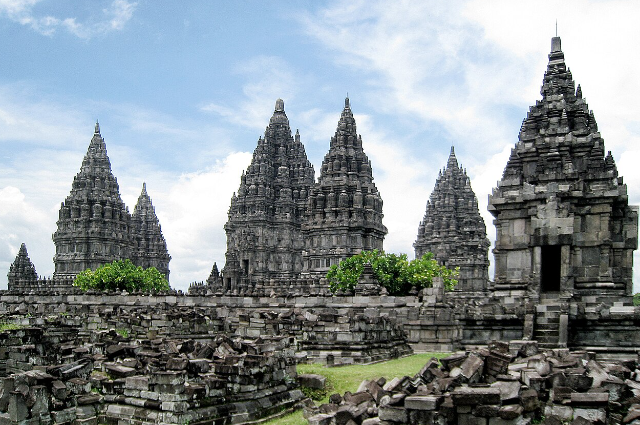
We love a good binary. Secular versus religious. East versus West. The country that erases its past versus the one that enshrines it. So when a nation that is nearly 90% Muslim spends its own money restoring a thousand-year-old Hindu temple, it doesn't fit anywhere we've already filed it, and that's exactly why it deserves a second look.
On July 8th, Prime Minister Narendra Modi and Indonesian President Prabowo Subianto stood together at Prambanan, in Yogyakarta, and inaugurated a joint restoration project for the largest Hindu temple complex in Indonesia. Crowds had lined the streets the day before, waving both nations' flags, and the visit came a day after India and Indonesia formally exchanged a Letter of Intent to begin the conservation work. Built in the 9th century and dedicated to the Trimurti, Brahma, Vishnu, and Shiva, Prambanan has survived earthquakes, volcanic ash, and roughly a thousand years of monsoons. What it had not survived, until this month, was the slow erosion that comes from simply being old in a country that has had other things to worry about.
Modi didn't just cut a ribbon. He said he was deeply moved hearing chants of the Mahamrityunjay Mantra and "Om Namah Shivaya" echo through the complex, a scene that made global headlines mostly because of how unlikely it looked: a Hindu prayer, sung with feeling, inside a Muslim nation's borders, with that nation's own president standing beside him.
Indonesia is the largest Muslim-majority country on Earth. It is also a country where the state ideology, Pancasila, does not name a state religion at all; it names five principles, the first of which is belief in one God, deliberately vague enough to hold Islam, Christianity, Hinduism, Buddhism, and Confucianism under the same roof. Prambanan and Borobudur, its Buddhist counterpart down the road, are not treated as relics of a faith the country left behind. They are treated as Indonesia's own history, full stop, pre-Islamic, yes, but not therefore un-Indonesian.
Ask yourself how many countries can say the same about their own inconvenient monuments.
India's involvement is not new, even if this particular temple is. Since 2014, the Archaeological Survey of India has quietly restored Ta Prohm since 2004 and worked on conservation around Angkor Wat and Preah Vihear in Cambodia, rebuilt pagodas at Bagan in Myanmar after the 2016 earthquake, worked on the My Son Sanctuary in Vietnam since 2017, and spent two phases restoring the Vat Phou temple in Laos since 2009. The broader programme now stretches to Bangladesh, Bahrain, and Sri Lanka as well. Prambanan is simply the newest name on a growing list, and Modi has said the restoration is targeted for completion before 2029, with a promise to return once it's done.
It's worth noticing that India runs the same playbook at home. Kedarnath was rebuilt after the 2013 floods into a gleaming pilgrimage complex; Mahakal in Ujjain got a sprawling corridor makeover inaugurated in October 2022, both flagged off by Modi himself, both filmed for maximum reach. None of that makes the Prambanan project insincere. It just means restoring a Hindu temple, whether it sits in Uttarakhand or Java, has become something this government is unusually good at turning into a moment, a photograph, a chant, a headline that travels.
This is what New Delhi calls its "Act East" policy, using shared heritage, not just shared interests, as the currency of diplomacy. At Prambanan, Modi spoke of feeling the fragrance of cultural heritage, invoked the shared roots of the Ramayana and Mahabharata across both countries, and thanked Indonesia warmly for preserving what could easily have been left to crumble.
It's a nice line. It's also, unavoidably, a political one.
Here is where the story stops being simple. Heritage conservation is expensive, slow, and largely invisible to voters back home; nobody wins an election because a stupa in Bagan has a new roof. So when a government invests in it anyway, across a decade and half a dozen countries, the honest question isn't whether the temples deserve saving. Of course they do. The honest question is what the saving is for.
Is this civilizational solidarity, or is it soft power wearing a civilizational costume? Can it be both at once, and does that combination cheapen it? India gets goodwill and tourism numbers it can point to — Indian arrivals to Indonesia are already projected to cross 750,000 this year, along with a diplomatic story that plays well with a domestic audience that likes hearing about Ram and Krishna showing up thousands of miles from home. Indonesia gets funding, expertise, and a bigger tourist economy around Yogyakarta. Everybody wins. That should be reassuring. Somehow it isn't quite.
Maybe the discomfort is this: we want to believe a country protects its own history because history matters, not because history is useful. Indonesia has protected Prambanan since long before any Letter of Intent was signed with India, through Suharto's decades, through the reformasi years, through a rise in hardline Islamist sentiment that could easily have turned a Hindu temple into a target instead of a landmark. That part of the story isn't about India at all. It's about a Muslim-majority country choosing, repeatedly and without much fanfare, not to erase what came before it.
So which is the real headline here? Is it "India funds temple in Muslim country," a story about generosity and diplomacy? Or is it "Muslim-majority nation refuses to erase a Hindu past," a story about a kind of restraint most nations don't manage? It's worth sitting with the second version a little longer, because it doesn't flatter the country doing the funding; it flatters the country that never asked to be funded in the first place, and chose to keep its inconvenient history standing anyway, long before anyone offered to pay for the scaffolding.
I'd rather ask you than answer it for you. When a country spends money protecting a religion it doesn't practice, is that pluralism working the way it's supposed to, or proof that pluralism only survives when it's also convenient? And when we praise Indonesia for keeping Prambanan standing, are we praising the temple, or are we just relieved to find one example, anywhere, of a country getting this right?
References:
- https://www.opindia.com
- https://en.antaranews.com
- https://www.business-standard.com
- https://aninews.in
- https://ddnews.gov.in
- https://organiser.org
- https://csep.org
- https://www.weareonehumanity.org
- https://www.outlookindia.com