
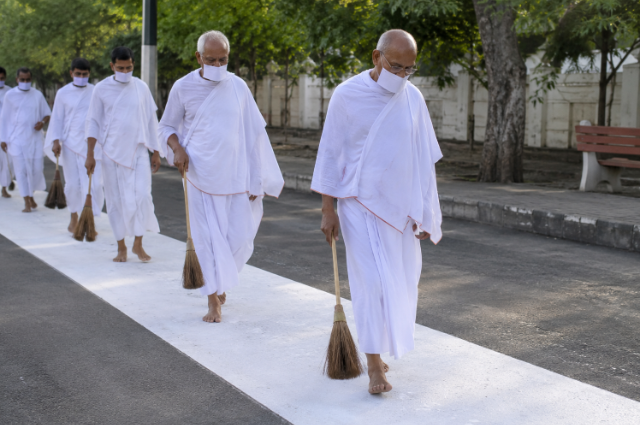
Who would have imagined that a strip of white paint on a road could become the centre of a national debate? But that's exactly what happened in Mumbai in June 2026. What was meant to be a temporary arrangement for visiting Jain monks soon found itself all over social media and news channels. Some people questioned why a common space was being used for a religious purpose, while others saw it as nothing more than a small gesture of respect towards an age-old tradition. As the debate grew louder, the real reason behind the white pathway slowly faded into the background.
To understand the controversy, it's important to first understand the community it was meant for.
Jainism is one of the oldest religions in the world and is built around the idea of living with as little harm to others as possible. The principle of Ahimsa, or non-violence, isn't limited to human beings—it extends to animals, birds, insects, and even the tiniest living organisms. For Jain monks, this isn't just something they believe in; it's something they practise every single day.
Choosing to become a Jain monk means giving up almost everything that most people consider essential. They leave behind their families, careers, money, and personal belongings to lead a life focused entirely on spirituality. They depend on others for food, own very little, and spend much of their lives travelling from one place to another on foot.
One thing that immediately stands out is that Jain monks never wear footwear. Walking barefoot is a conscious choice that reflects simplicity, humility, and detachment from material comforts. But there's another reason behind it too. Walking without shoes makes them more aware of every step they take. They walk slowly and carefully because even accidentally stepping on a tiny insect goes against the principle of Ahimsa that they have dedicated their lives to following.
For the same reason, Jain monks avoid travelling after sunset. Once it gets dark, it becomes difficult to see the ground clearly, increasing the possibility of unknowingly stepping on insects or other tiny living beings. During Chaturmas, the four-month monsoon period, they stop travelling altogether and stay in one place. The rains bring countless insects, worms, and microscopic organisms onto roads and pathways, making it much harder to walk without causing harm. Staying in one place during these months is another way they honour their commitment to non-violence.
Walking barefoot, however, isn't always easy. Anyone who has stepped onto a road during peak summer knows how hot it can get. Asphalt roads absorb heat throughout the day, and by afternoon the surface becomes almost impossible to walk on without shoes. Since wearing footwear isn't an option for Jain monks, members of the Jain community sometimes paint a temporary white strip on the route the monks are expected to take. White reflects sunlight better than black asphalt, which helps keep the surface a little cooler. It's a simple and practical solution to a real problem.
Many people assume that painting roads white is a religious ritual, but that's not actually the case. Jain scriptures do not instruct followers to paint roads for monks. It is simply a voluntary gesture by devotees who want to make the monks' journey a little less difficult while respecting their religious vows. The white strip is temporary and is usually removed or allowed to fade once the monks have completed their visit.
For years, this practice went largely unnoticed. That changed when a housing society in Mumbai's Ghatkopar area painted a white pathway for visiting Jain monks. A resident and social media influencer questioned the decision and posted videos online, arguing that common residential spaces should not be altered for religious purposes without the consent of everyone living there. His concern sparked a discussion about the use of shared spaces, but the controversy became much bigger after he referred to the practice as "Jain Jihad." The phrase upset many members of the Jain community, who felt it unfairly portrayed one of the world's most peaceful religions in a negative light.
Within a short time, the videos spread across Instagram, X, YouTube, and other platforms. As often happens on social media, opinions formed quickly. Many people criticised the practice without knowing why the pathway had been painted. Others defended it, saying it was only a temporary arrangement meant to help barefoot monks walk safely during extreme heat. For them, it was less about religion and more about showing kindness to people who had chosen a life of discipline and sacrifice.
The issue soon went beyond social media. Complaints were reportedly filed against the influencer for allegedly hurting religious sentiments, and police visited him as part of the complaint process. He later claimed that he had also received threats online. Political leaders joined the discussion as well. Some argued that common spaces should remain neutral and not be used for religious purposes, while others felt that accommodating such a temporary practice reflected India's tradition of respecting different faiths. Eventually, after discussions between the housing society and community representatives, the white strip was repainted and the matter was peacefully resolved.
Although the controversy lasted only a few days, it raised questions that don't have simple answers. Should religious practices be accommodated in shared spaces? How should housing societies balance the interests of one community with those of everyone else? These are genuine concerns, and they deserve thoughtful discussion rather than heated arguments.
The incident also showed how powerful social media has become. A local issue that could easily have been settled within one neighbourhood turned into a national debate within hours. Incomplete information, short video clips, and emotionally charged language encouraged people to take sides before understanding the full story. It is a reminder that in the age of instant information, taking a little time to understand the facts is more important than ever.
There is also a scientific side to this story. White surfaces reflect more sunlight than dark ones, which is why they remain cooler. The same idea is used in many cities around the world where light-coloured roofs and pavements are introduced to reduce heat. In that sense, the white pathway wasn't just connected to faith—it was also based on a simple scientific principle.
More than anything else, this incident reminds us that traditions often make sense once we understand the reasons behind them. We don't all have to agree with every religious practice, but we should try to understand it before forming an opinion. At the same time, conversations about public spaces and shared responsibilities are equally important and should be approached with fairness and respect.
References:
- Public discussions and news updates on Instagram and YouTube related to the Mumbai Jain white pathway controversy.
- OpenAI. (2026). ChatGPT. Used for language assistance, drafting, editing, and organizing the article.