
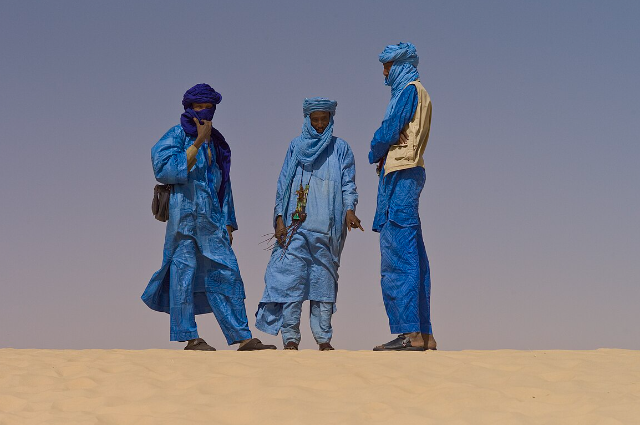
He is eighteen years old, standing in the Sahara, and something is about to change about him forever.
Not a scar. Not a ceremony with drums and fire, though there is ceremony to this too. What changes is what his face means to the world and what the world has to earn to see it.
He takes the tagelmust, a strip of indigo cloth that can runfour totenmetres long, and wraps it around his head, across his face, leaving only his eyes. And from that moment forward, he is a man by the only definition that matters in Tuareg culture: a veiled one. The cloth will stay there for the rest of his life. He will sleep in it, adjust it, rewrap it. He will lower it fractionally in the presence of close family. In front of his father-in-law, it will stay firmly in place. Before elders and strangers, it will never drop.
His wife, if he has one, does not wear a veil. She never has and never will. She sits unveiled in her tent, her tent, because it belongs to her, and composes poetry, tends her livestock, manages the inheritance that passes through her line and not his. If they divorce, which is no source of shame among the Tuareg and is sometimes even celebrated with a party, he is the one who leaves. He returns to his mother's home. With his camel. She keeps everything else.
This is life among the Tuareg, the semi-nomadic Berber people spread across Niger, Mali, Algeria, Libya, and Burkina Faso, and almost nothing about it resembles what the outside world assumes a desert Islamic culture must look like.
The Veil That Belongs to Men
The tagelmust is so central to Tuareg male identity that oneof thecommunity's self-given names translates directly as "people of the veil", Kel Tagelmust. Not people of the sword, or people of the desert. People of the cloth that covers the face. The veil is the man.
The origins of this tradition are layered. Practically, the Sahara demands it: in an environment of blowing sand and brutal sun, a cloth thatprotects thee nose and lungs is survival technology. But the tradition long outlasted its purely practical function, accumulating meaning that no desert wind alone can explain.
The veil wards off evil spirits, in the older belief. It signals maturity; the initial wrapping ceremony sits alongside circumcision as a marker of passage into manhood. And it communicates something subtler: the degree of trust a man extends to those in his presence. The face, in Tuareg understanding, is not a surface to be displayed freely. It is something private, offered selectively. To see a Tuareg man's face is to have been permitted to see it. That permission is not given lightly.
Anthropologist Susan Rasmussen, who spent years living with and studying Tuareg communities, documented how the veil functions as a marker of masculine honour and reserve, not the modesty of concealment as it appears in other traditions, but the dignity of controlled revelation. The man with the highest status wraps most completely. The newlyveiledeighteen-year-old is asserting not submission but arrival.
The Women Who Need No Veil
In virtually every other culture across the Saharan and Sahelian belt, the expectation runs the other way. Women cover. Men do not. Among the Tuareg, none of that applies.
Tuareg women move through their world with faces uncovered and social power intact. The tent is theirs. In a divorce, the man is the one who leaves with nothing but his camel, returning to his mother's household—because his mother's household is where his lineage belongs. Inheritance flows through the female line. Property belongs to women. The camel herds, the silver jewellery, the tent itself, all hers.
The women compose poetry. In a culture where oral tradition carries everything- history, values, social critique- the poets carry real power. Tuareg women have historically written and recited verse that praised courage and called out cowardice, that celebrated love and shamed men who failed to live up to it. The poet does not need a veil because the poet has nothing to hide behind and no reason to.
Pre-marital relationships are not taboo. Divorce carries no shame. Remarriage is welcomed. The social architecture of Tuareg life arrived at an arrangement that continues to confound the assumptions of outsiders: that in the desert, behind the indigo veil, it was the woman who was free.
What the Indigo Stains
The tagelmust is almost always dyed indigo. Over time, over years of wearing, the dye rubs off. Onto the skin. Into the cheeks, the forehead, the lines around the eyes. The Tuareg are called the BluPeople of the Sahara,raa not as metaphor but because the desert and their tradition have literally coloured them with it. A man who has worn his veil for decades carries the indigo in his skin the way other people carry work scars. It is not a mark of one occasion. It is the accumulated evidence of a life lived inside a commitment.
That commitment is now being tested by the same forces that test every traditional culture: urbanisation, migration, the slow erosionof nomadiclife by drawn borders and sedentary economies. The Sahel droughts of the 1970s and 1980s devastated Tuareg herds and drove many families into cities like Niamey and Bamako, where the tagelmust became complicated, too conspicuous for certain streets, too meaningful to abandon, worn now for festivals and weddings and moments when the old identity reasserts itself against the pressure of the new.
Young Tuareg men in cities make their own calculations about when to wrap and when not to. The cloth is still there. The meaning is still there. But the world it was built for, the caravan routes, the seasonal migrations, the tent that belongs to the wife, exists more in memory than in daily life for many families.
What the Desert Teaches About Assumption
The Tuareg do not think of themselves as progressive, or as a counterexample to anything. They are not trying to prove a point about gender. They built a culture that worked in a specific place under specific conditions, and the gender arrangement that emerged from it worked, for a society where women needed to be the stable centre because men were frequently absent on trade routes, where matrilineal inheritance kept property from fragmenting, where the veil offered men a way to navigate a world in which honour was the primary currency.
The things we assume are universal, that women cover and men don't, that property passes through men, that the man stays when a marriage ends, are not universal at all. They are local. They are contingent. They are choices that cultures made, forgotten so thoroughly that they came to look like nature.
In the Sahara, a boy turns eighteen and wraps his face in indigo cloth. His sister sits unveiled across from him, owner of the tent, heir to the property ty composer of the poems that will outlast them both. Neither of them thinks this is unusual. They are home.
References:
- Wikipedia. Tuareg people. https://en.wikipedia.org/wiki/Tuareg_people
- Wikipedia. Litham (Tagelmust). https://en.wikipedia.org/wiki/Litham
- Africa Unfiltered / Substack (November 2025). The Blue People of the Sahara. https://africaunfiltered.substack.com
- New World Encyclopedia. Tuareg. https://www.newworldencyclopedia.org/entry/Tuareg
- Encyclopedia.com. Tuareg (citing Rasmussen, The Tuareg, 1996). https://www.encyclopedia.com
- https://dunzofsand.com
- Splash Travels (June 2025). The Tuareg's Battle To Become Lords Of The Sahara. https://www.splashtravels.com
- Ancient Origins. The Ancient Tuareg: Free Men of the Sahara Desert. https://www.ancient- origins.net/history/tuareg-002900
- Young Pioneer Tours (March 2026). Who Are the Tuareg?https://www.youngpioneertours.com/who-are-the-tuareg/
- Homegrown (2022). In the Sahara Desert's Tuareg Tribe, Islamic Women Rule The Roost. https://homegrown.co.in