
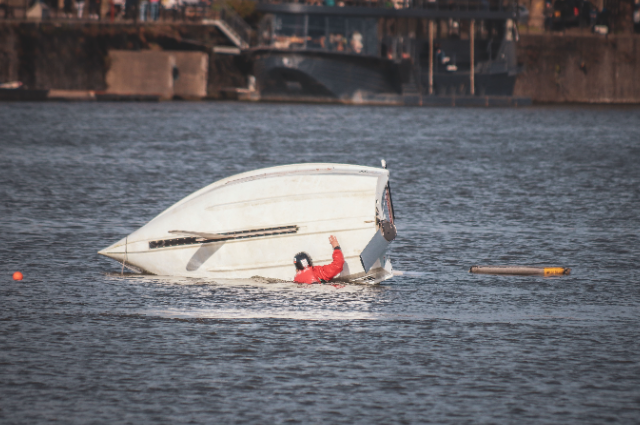
The boat had not even gone half a kilometre.
Ashish Kumar was watching from the shore when it happened. Heis48years old, a distributor for the Indian electronics company Lava International from the city of Guntur, and he had come to Vietnam on a company trip, the kind of trip that gets organised as a reward, as a celebration, as the thing you tell people at home about. The party had divided into three boats for the island excursion. His boat had already departed. The second was loading. The third, the one that would not make it back, was just leaving.
"The boat had not even gone half a kilometre when it just tipped over he told the Associated Press. "We screamed, 'Help! Help!'
"What happened next took seconds. The speedboat, carrying 32Indiantourists and four Vietnamese crew members, returning from Hon May Rut Ngoaioai Island to An Thoi International Port near Phu Quoc, overturned in rough seas on the afternoon of Saturday, July 11, 2026. Fifteen people died. All of them were Indian nationals. All of them had come on the same company trip, employees and distributors and retail partners of Lava International, to one of Vietnam's most popular island destinations, in rough seas, but the boat had departed anyway.
Some of them were trapped inside.
The Last Moments
State media quoted sailors involved in the rescue effort as saying there were high waves but no rain at the time of the capsizing. Several other tourist boats were operating in the same waters.
The boat went over fast, survivors say, within seconds of the waves hitting it. Some passengers were thrown into the water. Others were not thrown out at all. Witnesses told VN Express that some people were trapped inside the overturned hull. From the shore, from other boats, from jet skis that moved toward the accident while coast guard vessels were still arriving, rescuers could see people in the water and could hear them.
Footage on Vietnamese television showed rough seas, life buoys being thrown, jet skis ferrying people to shore, beachgoers wading into help. Ambulances lined up on the pier. By the time the Vietnamese border guards, navy, and coast guard arrived, the initial rescue effort had already been underway, carried out by people who happened to be nearby, who saw what happened, and ran.
Survivors allege that not everyone on the boat had been properly wearing life jackets. They allege that emergency treatment for the injured was delayed by nearly an hour after the capsizing. They allege the crew knew the conditions were dangerous and departed anyway. These are witness accounts, and the investigation is ongoing. But the eyewitnesses who made it to shore said the same things to multiple reporters: that something could have been done differently before the boat ever left the dock, and that it wasn't.
The captain, Nguyen Hong Hai, 57, was arrested the following day on charges of violating waterway transport safety regulations.
Who They Were
All 15 people who died were on a company trip. Lava International —a smartphone and consumer electronics manufacturer based in India- had organised the Vietnam excursion for its employees, distributors, and retail partners. This was the kind of trip that companies organise as recognition. You meet targets. You earn the trip. You board the flight to a place you might not have gone on your own, with colleagues who have become something closer than colleagues, and you go somewhere beautiful because the year was good,d and you worked hard, rd and this is what that looks like.
Vietnam welcomed approximately 750,000 Indian tourists in20up nearlyrly 50% from the previous year. The growth is driven by expanding networks of direct flights and Vietnam's relatively liberal e-visapolicy. India is one of Vietnam's fastest-growing tourism markets. The people on that boat were part of a relationship between two countries still building their routes and the habits and the trust that makes tourism feel ordinary.
They were not extraordinary in the way that disaster coverage sometimes makes victims. They were ordinary in the most important sense: people who had earned something and were using it, people who were somewhere beautiful on a Saturday afternoon, for whom the return journey was not a thought at all because return journeys never are until they aren't.
What Followed
Twenty-one people survived. Sixteen were discharged fromhospital bySunday and were returning to India. One remained in critical condition in a Vietnamese hospital. The Indian Embassy in Hanoi established emergency response centres in Ho Chi Minh City and Hanoi, and described the incident as "tragic." Identification and repatriation of the deadwas ongoingas of Sunday, coordinated between the Indian Embassy and Vietnamese authorities.
Vietnam's Prime Minister ordered a review of waterway safety standardsinPhu Quoc, an acknowledgement that this was not being treated as an isolated accident. This was not Vietnam's first recent waterway disaster. In July 2025, just a year earlier, the Wonder Sea boat capsized in Ha Long Bay during a sudden thunderstorm, killing 34 people, most of them Vietnamese families from Hanoi, including around 20children.In February 2022, 13 people died when a tourist boat capsized off Ho An in bad weather. The pattern is not hidden. It is documented, repeated, and reviewed after each event with the same language about safety standards and accountability that follows every tragedy, and then, the next boat departs into rough water.
The Distance Between Safety and Disaster
Less than half a kilometre. That is the distance that separates where the boat left from where it went over. That is the distance between a Saturday afternoon company trip and fifteen families in India receiving phone calls that no one should ever have to make.
The sea does not negotiate. It does not adjust for the occasion or the itinerary or the fact that the people on board came a long way and deserved the afternoon they were promised. What it does is create conditions, and what humans do with those conditions is a choice. The choice to depart or to wait. The choice to ensure every life jacket is fastened or to accept that most of them are close enough. The choice to read the waves as manageable or to acknowledge that they are not.
Somewhere in the sequence of small decisions that preceded the capsizing, the distance between safety and disaster collapsed to the width of a wave. The investigation will find where that happened and name the person responsible. The captain is already named. The charges are already filed.
But the fifteen people who didn't come back from that boat trip weren't thinking about maritime safety regulations on a Saturday afternoon in a place they came to because it was beautiful. They were thinking about getting back to shore. They were thinking, perhaps, about dinner, or about the photographs on their phones, or about the flight home, or aboutthe peoplee waiting for them.
The boat had not even gone half a kilometre.
References:
- ABC News (July 11, 2026). 15 Indian tourists killed after speedboat capsizes in southern Vietnam. https://abcnews.com
- CBS News (July 12, 2026). Speedboat capsizes off Vietnam, killing 15 tourists; police detain captain. https://www.cbsnews.com
- Al Jazeera (July 11, 2026). Speedboat accident in southern Vietnam kills 15 Indian tourists. https://www.aljazeera.com
- CNN (July 11, 2026). Boat carrying tourists capsizes off Vietnam's Phu Quoc island, killing 15. https://www.cnn.com
- HNGN (July 13, 2026). 15 Indian Tourists Killed As Speedboat Capsizes Near Vietnam Phu Quoc Island https://www.hngn.com
- NPR (July 2025). Tourist boat capsizes during a thunderstorm in Vietnam, 34 dead. https://www.npr.org