
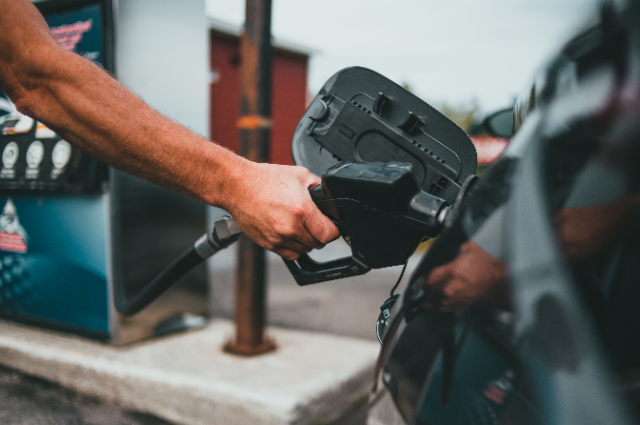
Source: Erik Mclean on Pexels.com
India's Fuel Dream vs. India's Fuel Reality
There is a sugarcane farmer in Maharashtra who doesn't know what E100 is. He just knows the price of his crop, whether the mill paid on time, and whether this year's yield will cover the loan he took last monsoon. He doesn't attend policy conferences or read regulatory gazette notifications. But if India'sE100dream is going to work — truly work, not just exist on paper — it has to work for him. And ri, it barely works for the person filling up a car in Delhi.
That tension is the whole story of India's leap from E20 to E100. And it is a story worth telling honestly, because the ambition is real, the science is complicated, and the gap between t enormous.
What India Just Did
On June 12, 2026, Union Minister Nitin Gadkari formally approved regulations for E100 fuel —a blend of roughly 95% bio-ethanol and 5% petrol — making India one of the few countries in the world to create a legal framework for near-pure ethanol as a vehicle fuel. It came just weeks after India hit its E20blendingtarget ahead of schedule in April 2026, a milestone that had already saved over ₹1 lakh crore and sent ₹80,000 crore directly into the hands of farmers growing the sugarcane, maize, and broken grains that feed the distilleries.
This matters. India imports more than 85% of its petroleum. Every litre of domestic ethanol that replaces imported crude is a rupee that stays in the country, a farmer paid, a current account deficit slightly less ugly. The programme reportedly generated more than ₹1.58 lakh crore in direct income for the farming community since its acceleration. E100, if it scales, could do for the Indian rural economy what no recent energy policy has even attempted — turn the paddy field into the petrol pump.
But scale is the word doing enormous, unacknowledged work in that sentence.
What E100 Actually Asks of You
Here is what the brochure doesn't say loudly enough. Ethanol is corrosive. It is a solvent. It eats the zinc on standard fuel tanks, degrades conventional rubber fuel lines, and wears down regular engine valves faster than petrol ever would. Running E100 through a standard vehicle is not just inefficient —it is actively destructive. To run properly on E100, a vehicle needs an HDPE or stainless-steel fuel tank, hardened cobalt-alloy valves, and sensor systems recalibrated for a different combustion chemistry. None of that comes free, and none of it can be retrofitted cheaply.
This is why, as of April 2026, not a single automaker had commercially launched even an E85-compatible flex-fuel vehicle in India. Maruti Suzuki showed a prototype in June 2026. Field trials are expected around December 2026. The government has asked Toyota, Suzuki, and Hyundai to accelerate —but asking and delivering are different conversations. The regulation exists. The vehicles do not.
And the fuel has the same problem from the other direction. The government has outlined a plan to establish 500 ethanol dispensing stations by December 2026 — beginning with 50 to 100 outlets across Delhi-NCR, Mumbai, Pune, and Nagpur — scaling to 5,000 outlets across major cities by the end of 2027. That sounds like
progress until you remember that India has over 80,000 petrol stations, and that ethanol requires different storage tanks, moisture-controlled handling, and dedicated dispensing systems because it absorbs water readily, degrading fuel quality across the entire distribution chain. Building 5,000 ethanol pumps by 2027 is genuinely ambitious. Whether it happens is a different matter.
The Math Nobody Is Talking About: Let's talk about the 70% rule, because this is where the dream meets the daily commute.
Ethanol has roughly 30% lower energy density than petrol. A litre of E100 simply contains less energy than a litre of petrol. This means your fuel economy drops — call it 20 to 25% fewer kilometres per litre in real-world driving conditions. If E85 is priced at ₹82 per litre while petrol sits at ₹104, the pump. But if you're getting 25% fewer kilometres from every litre, you're spending more per k you think. For E100 to genuinely save the consumer money, it needs to be priced at least 30%belowpetrol at every pump, every day, across the country. That pricing discipline —sustained, regulated, and inflation-proof — has to be built into policy from the beginning. Otherwise, E100 becomes a green-labelled trap: cleaner for the planet, quietly worse for the household budget.
The Farmer in the Middle
The hardest part of this whole story isn't the chemistry or the infrastructure. It's the human cost of getting this sequencing wrong.
The government's own projections say that if 50% of new two-wheelers and four-wheelers shift to flex-fuel technology, it would create demand for an additional 311 crore litres of ethanol and generate ₹12,403crorein additional farmer income. That is a life-changing number for the rural communities that grow sugarcane in Maharashtra and UP, maize in Karnataka and Bihar, and damaged grain across the country's agricultural belt.
But that income only arrives if the vehicles arrive, if the pumps arrive, if the pricing holds. The farmer doesn't benefit from a policy gazette. He benefits from demand. And demand follows infrastructure, which follows vehicles, which follows consumer trust, which follows pricing, which follows policy discipline. Every link in that chain has to hold at once. If one breaks — if vehicles launch but pumps don't materialise, or pumps appear, but pricing makes E100 uneconomical for ordinary drivers —the farmer is left growing feedstock for a market that never fully came.
What Has to Happen
India's E20 success was real and should not be undersold. Hitting that target early, saving ₹ 1 lakh crore, building the ethanol supply chain from near-nothing to 500 crore litres annually—that took a decade of policy persistence and deserves credit.
But E100 is a different class of problem. E20 required tweaking existing vehicles and existing pumps. E100requires building a parallel fuel ecosystem — new vehicles, new stations, new storage, new consumer habits— essentially from scratch, while keeping the existing petrol system running for the hundreds of millions of vehicles that will never be flex-fuel compatible. The government is effectively asking for two fuel networks to coexist and for one to grow fast enough to matter, without the other shrinking so fast it breaks.
That is not impossible. Brazil did something close to it over thirty years ago. But Brazil has a price guarantee and a national commitment that predate most of its current political institutions. India is starting with a regulatory gazette, fifty petrol stations, and a prototype on a stage.
The ambition is right. The direction is right. The gap between the gazette and the garage is the only question that matters now — and the answer to it will be written not in policy documents, but in the by ordinary people, in the bills they pay at ordinary pumps, in the income that reaches or doesn't reach the farmer who still doesn't know what E100 is.
References
- TopNews (June 2026). 100% Ethanol Fuel Regulations Approved by Indian Government for E85andE100.https://topnews.in
- AutoPunditz (June 2026). India Clears E100 Fuel Regulations: What the Move Means for Cars, Consumers, and the Ethanol Economy. https://www.autopunditz.com
- Business Standard (May 2026). How the government's E85, E100 push tests India's ethanol supply and storage limits.https://www.business-standard.com
- PSU Watch (June 2026). India to set up 50–100 ethanol fuel stations, targets 5,000 by end-2027.https://psuwatch.com
- HMSA Consultancy (June 2026). Beyond E20: Can E85 and E100 Become the Next Growth Trigger for India's Ethanol Manufacturers? https://hmsaconsultancy.com
- Energetica India (April 2026). Energy Independence Starts at the Pump: Why India Must Back Ethanol Mobility.https://www.energetica-india.net
- Drishti IAS (April 2026). India's Ethanol Blending Programme and the Path to E100. https://www.drishtiias.com
- Deccan Herald. Ethanol leap: Progress or pitfall? https://www.deccanherald.com