
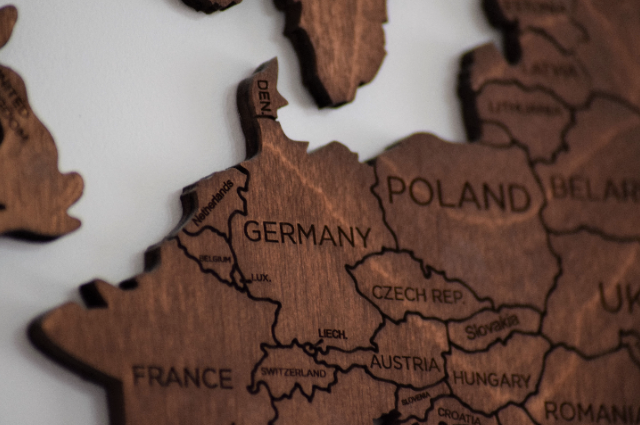
Imagine walking. Not flying, not driving, walking. Setting out from a village in northern Portugal and heading east, talking to people as you go. In Portugal, they speak Portuguese. Cross into Spain, and they speak Spanish. Except that's not quite what happens if you walk slowly enough and pay close enough attention.
Because the woman in the last Portuguese village and the man in the first Spanish village don't experience a wall between their languages. They lean against fences and understand each other, mostly. Their grandparents probably did too. The difference between their speech is real, a word here, a vowel there, a grammatical turn that sounds slightly off to the other ear, but it is not a cliff. It is a slope. Gentle, gradual, almost imperceptible from one village to the next.
Keep walking east, though, and by the time you reach Catalonia, and then France, and then eventually Italy, something extraordinary has happened without you ever crossing a sharp line. The person speaking beside you, and the woman back in Portugal would understand almost nothing of each other's conversation. Not because a border changed things. Because distance changed things. Because language, left to its own devices and given enough geography, drifts.
What a Dialect Actually is
Linguists have a term for what happens along that walk: a dialect continuum. It describes a geographical series of related speech varieties where neighbouring communities sound slightly different but mutually intelligible, and where the differences accumulate across distance until at the opposite ends, speakers might as well be speaking different languages, because for all practical purposes, they are.
The concept tears apart one of the most comfortable assumptions people have about language: that languages are things, discrete and bound with clear edges where one ends and another begins. They are not. We call ecall"a language" is almost always a political decision as much as a linguistic one. The German dialects are the canonical example; the regional varieties from the Dutch border in the north to the Austrian Alps in the south form a continuum where each village understands its neighbours, but a speaker from Cologne and a speaker from rural Bavaria, meeting without their shared written standard, might genuinely struggle to communicate.
The same story runs through Scandinavia. Norwegian, Danish, and Swedish are officially three separate languages with three separate national identities. But spoken Norwegian and spoken Swedish are mutually intelligible to most speakers most of the time, and Swedes neartheÖresund strait understand Danish considerably better than Swedes in the north, simply because they grew up hearing it across the water. The border between Sweden and Denmark is a political line. The linguistic reality on either side is considerably blurrier.
Where Language Lives and How It Moves
Language doesn't change because someone decided it should. It changes the way water finds its way downhill, following the path of least resistance through everyday human contact. A new word, a shift in pronunciation, a grammatical innovation- these spread out from wherever they originate, through conversation, through trade, through marriage, through the ordinary friction of people living near each other. Each innovation radiates outward like a ripple, weakening with distance, stopped or redirected by physical barriers.
In a study of 27 Dutch towns and villages, researchers found that geography alone accounted for between 65 and 81 per cent of the linguistic variation measured between communities. Not history, not politics, not religion, simply distance and the physical terrain between places. The closer two villages were, the more their speech resembled each other. The further apart, the more it diverged. The land itself was shaping the language.
Rivers have always worked as dialect boundaries. The Rhine in Germany.The Loire in France, which historically divided the langue d'oïl dialects of the north from the langue d'oc dialects of the south, the divide that gave Occitan its name. Mountains work even more decisively. Alpine ranges have preserved dialect features in Swiss German villages that vanished from the plains around them, simply because crossing a mountain range meant that innovations from one valley never reached the next.
The Politics of Naming What We Speak
Here is the line that linguists quote most often, attributed to the Yiddish scholar Max Weinreich: "A language is a dialect with an army and a navy."
It is a joke with a steel spine. Hindi and Urdu are, in their spoken everyday forms, almost entirely mutually intelligible, two registers of the same Hindustani, separated by their written scripts and by the political border that made one the national language of India and the other the national language of Pakistan. The partition of 1947 did not create a linguistic divide. It imposed a political identity on a continuum that was already there, and named the two ends differently.
Serbian and Croatian are another version of the same story. Linguistically, they sit so close together that most linguists classify themas varietiesof thesame language. Politically, they have been separate languages since the dissolution of Yugoslavia, a decision made with pens, not tongueArabic spreadsads from Morocco to Iraq acroscontinuum soumso wide that the spoken Arabic of Rabat and the spoken Arabic of Baghdad are mutually unintelligible to many of their speakers. They are held together as "Arabic" by a shared written standard that neither group speaks natively, and that both learn in school as a formal register distinct from what they grew up saying at home.
What Mass Media Did to the Drift
For most of human history, the dialect continuum developed in relative freedom. Villages talked to their neighbours. Innovations spread slowly. Distances preserved difference. Then came standardised national education, mass print media, radio, television, and eventually the internet, and the pressure on local dialects reversed.
Standard languages, the prestige forms taught in schools, broadcast on national radio, written in newspapers, exert a gravitational pull on the dialects within their range. Speakers shift toward the standard, consciously or not, because the standard carries social and economic capital that the local dialect doesn't. Over generations, the smooth chain of variation that once linked communities starts to simplify. Local features flatten. The gradient compresses. The long walk from Portugal to Italy gets harder to take one village at a time.
But something goes with the old continua, the chain of villages where each understood the next, all the way across a continent, the long human conversation that crossed every political border because it preceded every political border. The invisible lines where dialects quietly shifted were not borders.
They were the places where two people, leaning on either side of a fence, found they could still mostly understand each other. Geography drew those lines.
People crossed them every day without noticing. And in the crossing, across thousands of years and thousands of fences, the whole extraordinary spectrum of human speech was built.
References:
- Wikipedia. Dialect continuum. https://en.wikipedia.org/wiki/Dialect_continuum2.
- Wikipedia. Mutual intelligibility. https://en.wikipedia.org/wiki/Mutual_intelligibility
- Cambridge University Press. Dialect areas and dialect continua. Language Variation and Change. https://www.cambridge.org
- Grokipedia. Dialect continuum. https://grokipedia.com/page/Dialect_continuum5.
- Wiley Online Library (September 2025). Linguistic Diversification and Rates of Change. https://compass.onlinelibrary.wiley.com/doi/10.1111/lnc3.70022
- ResearchGate. Language, Dialect, and Variety — A Continuum. https://www.researchgate.net
- Citizendium. Dialect continuum. https://en.citizendium.org/wiki/Dialect_continuum8.
- SiteTran (December 2024). Mutually Intelligible Languages. https://www.sitetran.com
- FluentU (January 2025). 16 Similar Language Pairs for Bonus Learning. https://www.fluentu.com
- arXiv (2024). Exploring Diachronic and Diatopic Changes in Dialect Continua. https://arxiv.org/pdf/2407.04010