
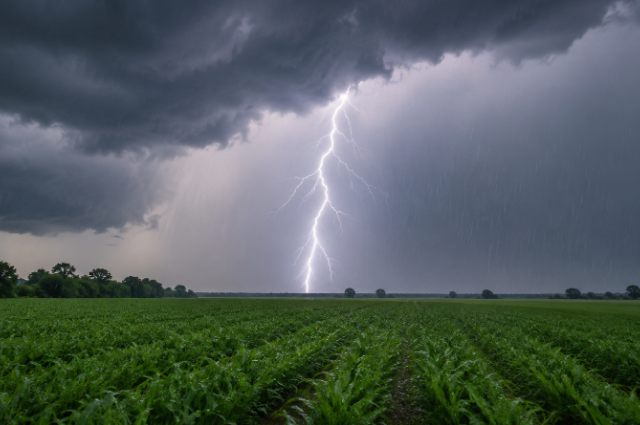
There is a sound you have heard your whole life and never once thought to question. The crack of thunder rolling across a darkened sky, the sudden white flash that splits the horizon, the smell that follows — sharp, metallic, almost electric on your tongue. You have called it dangerous. You have called it beautiful. You have probably never called it what it actually is: the oldest act of feeding the earth has ever known.
Every bolt of lightning that strikes during a storm is, quite literally, fertilising the ground beneath it. Not metaphorically. Not poetically. Chemically, precisely, and at a scale that predates agriculture, predates humanity, predates almost every living thing that has ever depended on soil to survive.
The Bond That Nothing Can Break — Except This. Nearly 80% of the air around you is nitrogen. It is everywhere, in every breath, surrounding every plant, every field, every forest on Earth. And almost none of it is usable by anything alive.
Nitrogen in the atmosphere exists as N2 — two nitrogen atoms locked together by one of the strongest chemical bonds in nature, a triple bond so stable that it barely reacts with anything under ordinary conditions. Plants cannot absorb it in this form. Animals cannot use it. It simply drifts past every living cell on the planet, abundant and entirely out of reach, like food sealed behind glass nobody can break.
Then lightning strikes. And for a fraction of a second, something extraordinary happens.
A single bolt of lightning heats the surrounding air to roughly 30,000°C—five times hotter than the surface of the sun. At that temperature, even the most stubborn bond in nature gives way. The nitrogen triple bond, untouched by wind and rain and centuries of chemistry, simply cannot withstand it. It breaks. The nitrogen atoms, suddenly free and searching for something to bond with, collide with oxygen atoms in the surrounding air.
And form nitrogen oxides — compounds that did not exist a moment before the strike, and that plants, for the first time, can actually use.
What Happens After the Flash
The nitrogen oxides created in that instant don't stay nitrogen oxides for long. They react with water vapour in the atmosphere, transforming into nitric acid. As the storm continues — as the rain begins to fall — that nitric acid dissolves into the raindrops themselves, converting into nitrate, the exact molecular form that plant roots are built to absorb.
So the rain that falls during a thunderstorm is not just rain. It is rain carrying dissolved nitrogen, freshly created moments earlier by the very lightning that lit up the sky above it. By the time that water reaches the soil, it has already completed a transformation that would otherwise require enormous industrial machinery, immense heat, and immense pressure to replicate. The storm did it in microseconds, using nothing but its own violence.
This is why farmers for centuries — long before anyone understood the chemistry—noticed that fields seemed to grow more vigorously after a thunderstorm than after an ordinary rain. They didn't have the word "nitrate." They just knew that thunder brought green.
A Number Too Large to Picture
Globally, lightning fixes an estimated 5 teragrams of nitrogen every single year—millions of tons of usable fertiliser, manufactured entirely by the sky, delivered for free to every continent on Earth. No factory. No fuel. No invoice. Just atmosphere, electricity, and rain doing what they have always done.
It is humbling to set this beside what humanity eventually had to build to replicate it. The Haber-Bosch process — the industrial method that now produces the synthetic fertiliser feeding most of the planet's 8 billion people — requires immense heat, crushing pressure, and enormous quantities of fossil fuel to force nitrogen and hydrogen
together into ammonia. It is one of the most energy-intensive chemical processes humans have ever industrialised, responsible for as much as 3%of global emissions. Lightning does the same fundamental job using nothing but the energy already contained in a single storm.
We built an entire branch of modern industry to imitate, imperfectly and at enormous environmental cost, something the sky has been doing quietly since before there was soil worth fertilising.
The Spark That May Have Started Everything: Here is where the story stops being about agriculture and starts being about existence itself.
In 1952, a young graduate student named Stanley Miller, working under Nobel laureateHarold Urey at the University of Chicago, built a sealed glass apparatus designed to recreate the atmosphere of early Earth — a mixture of methane, ammonia, hydrogen, and water vapour, the gases scientists at the time believed surrounded the planet billions of years before anything lived on it. Then he did something deceptively simple. He ran an electric spark through the gas, again and again, simulating lightning striking a world with no life in it at all.
Within a week, the bottom of that flask was tinted faintly pink. When Miller analysed the residue, he found amino acids — the literal building blocks of every protein in every living organism that has ever existed, including you.
The Miller-Urey experiment did not prove exactly how life began. Scientists have considerably revised their understanding of early Earth's atmosphere. But what it proved, irrefutably, is that lightning is not just compatible with the chemistry of life—it may be one of the forces that made that chemistry possible in the first place. More recent research, using reactors designed to mimic plausible early-Earth atmospheres more precisely, has continued to find the same result: lightning discharges synthesising the prebiotic molecules— amino acids, nucleobases, the literal vocabulary of biology—out of nothing but gas and electricity. Some studies have even found that lightning-driven chemistry can concentrate these molecules into protocells, primitive membrane-bound structures that look uncannily like the first rough draft of a living cell.
If that's even partly true, then the storm above your head right now is doing something it has been doing for roughly four billion years. It split the bonds that built the first proteins. It is, today, still splitting the bonds that feed the crops in your fields. The same mechanism, the same violence, the same act — across an almost unimaginable span of time.
What the Storm Is Actually Doing
Next time the sky splits open, and the thunder rolls and you instinctively flinch, consider what is actually happening above you. A bolt of electricity, hotter than the surface of a star, briefly tearing apart one of the most stable bonds in the universe —andinthat actof destruction, creating exactly the compound that every blade of grass, every tree, every crop on Earth has been waiting for.
It is not a coincidence that life and lightning have always been entangled. Long before there was a first farmer, a first field, a first harvest — there was a storm, breaking nitrogen apart over an empty, lifeless Earth, scattering the raw material of biology into a world that had nothing alive in it yet to use it.
Every storm since has, in its own small way, been doing the same thing. Feeding something. Building something. Continuing a chemical relationship between sky and soil that started before there was anyone here to notice it, and that continues, invisibly, every single time the clouds go dark and the air starts to crackle.
The thunder isn't just noise. It's the sound of the world being fed.
References
- OCI Global. Where does nitrogen come from? https://oci-global.com
- Sierra Club (2024). Lightning-on-Demand Could Create the Green Fertiliser We've Been Waiting For. https://www.sierraclub.org
- 13News Now (2025). How lightning fertilises soil with atmospheric nitrogen fixation. https://www.13newsnow.com
- Wikipedia. Nitrogen fixation. https://en.wikipedia.org
- Northern Woodlands (2022). Splitting the Air: The Unexpected Chemistry of Lightning. https://northernwoodlands.org
- Britannica. Nitrogen fixation. https://www.britannica.com
- Wikipedia. Miller–Urey experiment. https://en.wikipedia.org
- University of Chicago News (2025). The origin of life on Earth, explained. https://news.uchicago.edu
- PNAS (2024). Concomitant formation of protocells and prebiotic compounds. https://www.pnas.org
- Barth, P., et al. Isotopic constraints on lightning as a source of fixed nitrogen in Earth's early biosphere. https://arxiv.org