
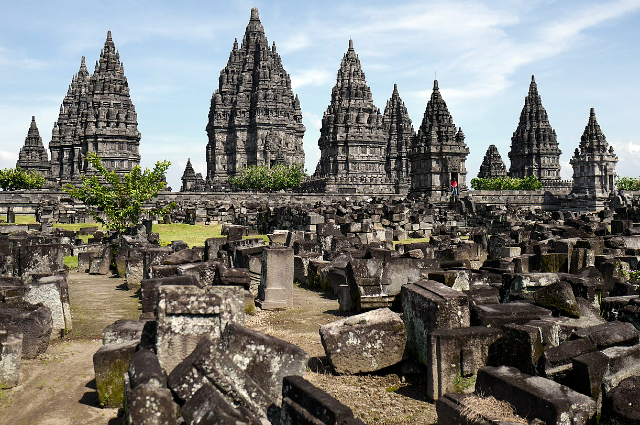
On the morning of July 8, 2026, two heads of state arrived by helicopter at a 9th-century Hindu temple complex in Yogyakarta, offered prayersat theshrine of Lord Shiva, and together unveiled a plaque launching a restoration project that will, brick by brick, return one of the world'sgreatreligious monuments to something closer to what it once was.
One of those men was the Prime Minister of India. The other was the President of Indonesia, the largest Muslim-majority nation on earth.
The photograph of them standing together at Prambanan, withthe47-metre Shiva tower rising behind them, is not a contradiction. It is a sentence written in stone and diplomacy that says something the modern world has mostly forgotten how to say: that civilisations are longer than religions, that what connects people can outlast what divides them, and that the past sometimes survives its own present.
What Is Standing in Yogyakarta
Prambanan was built in the 9th century during the Hindu Mataram Kingdom, at a time when the islands of Java and Bali were cultural satellites of the Indian subcontinent, absorbing its texts, its epics, its gods, its architecture through centuries of trade and scholarship that left no political record but enormous physical evidence.
The complex originally consisted of around 240 temples spread across nearly 40 hectares of Java's interior, centred on three towering shrines dedicated to the Hindu Trimurti, Brahma, Vishnu, and Shiva. The Shiva temple stands 47 metres tall. Its inner walls are carved with reliefs from the Ramayana, the same epic whose heroes and morals have been part of Indonesian culture for longer than Islam has been present on the archipelago. UNESCO inscribed Prambanan as a World HeritageSitein1991. Indonesia designated it as National Cultural Property in1998. A Muslim-majority democracy protecting a Hindu temple complex with its highest heritage designation is not a paradox that requires explanation to Indonesians; it is simply what Indonesia is.
During the full moon months from May to October, the Ramayana Ballet is performed in an open-air theatre beside the temple. Under the night sky, with the ancient spires lit behind them, Indonesian dancers perform stories from a Hindu epic for Indonesian audiences who have never thought of themselves as Hindu. The stories belong to them. They always have.
What India Came to Do
The restoration project places the Archaeological Survey of India, the same body that conserved Kedarnath and the Mahakal Temple corridor, at the centre of a complex, multi-year effort to restore and conserve several smaller temples within the Prambanan compound. Earthquakes, including the devastating 2006 Java earthquake, volcanic eruptions, and political upheavals following the decline of the Hindu Mataram Kingdom a thousand years ago, had collapsed much of what was originally built.
This is not India's first time doing this kind of work beyond its borders. Since 2014, the ASI has led conservation work on the UNESCO-listedMySon Sanctuary in Vietnam. It has restored 12 historic pagodas and the iconic Ananda Temple in Myanmar's Bagan Archaeological Zone. It restored 28 cultural heritage sites in Nepal after the 2015 earthquake, provided LKR 326 million to Sri Lanka in 2015 for the ThiruketheeswaramTemple, and helped restore temples in Bangladesh.
What India is building, temple by temple and country by country, is a geography of cultural memory, a visible map of where Indian civilisation once extended, and where it left traces that still carry meaning for people who may never have been to India and may never have identified as Hindu.
Modi called Prambanan "a timeless symbol of our cultural and spiritual links." He said the winds at the site carried "a scent of culture, that scent which we feel every moment on the soil of India." It was political language, but it pointed at something real: that the Ramayana carvings on the walls of a Javanese temple built twelve centuries ago were not importedas foreignart. They were local. They were what the people of that place understood and loved and built to honour.
What Indonesia Chose to Keep
Indonesia became a Muslim-majority nation through a conversion process that took several centuries, accelerating between the 13thand17thcenturies as maritime trade brought faith along the same sea routes that had once brought Hinduism and Buddhism. The conversion was remarkably gentle by the standards of religious history, less conquest than conversation, less erasure than layering. Islam arrived alongside the Hindu-Buddhist heritage, not on top of its rubble.
The result is a national identity that carries both without contradiction. Indonesia's state philosophy, Pancasila, the five principles adopted at independence in 1945, does not name Islam as the state religion. It names belief in one God, in a form broad enough to encompass the country'sChristians, Hindus, Buddhists, and Confucianists alongside its Muslim majority. The Garuda, the vehicle of Vishnu in Hindu mythology, isIndonesia's national emblem. The national airline is Garuda Indonesia.
Indonesia did not preserve Prambanan despite being Muslim. I preserved it because being Indonesian means something larger than asingle faithith. President Prabowo Subianto standing at Prambanan to welcome the restoration project is not a Muslim president at a Hindu temple making a diplomatic concession. It is an Indonesian president at an Indonesian monument doing what Indonesians do, treating the pre-Islamic past as their own, because it is.
What the Stones Remember
The year 2026 was declared the "Tagore-Dewantara Year of Cultural and Educational Diplomacy", named after RabindranathTagore and Ki Hadjarr Dewantara, the Indonesian education reformer who visited Tagore at Santiniketan and whose ideas shaped the Indonesian national curriculum. That friendship between the two men in the early 20thcenturyis a thread in the same cloth as the Ramayana Ballet and the ASI conservators arriving now to work on the smaller temples.
The connection between India and what became Indonesia is not a claim being made for diplomatic convenience. It is recorded in the stones. In the language, Bahasa Indonesia contains thousands of Sanskrit loanwords, including words for government, law, society, and philosophy. In the epics, the Ramayana and Mahabharata- they are not Indian stories performed in Indonesia; they are Indonesian stories with Indian origins, which is a different thing. In the calendar systems, the architecture, the shadow puppet traditions, the royal court music, the cosmology that still underlies Javanese and Balinese spiritual life even where Islam is the practised faith.
A thousand years after Prambanan was built, twelve centuries after the Sanskrit texts arrived in Java by sea, two leaders stood at the baseof theShiva tower and spoke about shared heritage. The stones behind them were older than either of their nations. They had survived the fall of the Hindu Mataram Kingdom, survived centuries of Islamic conversion, survived colonial cartography redrawing every border, survived two world wars, survived an earthquake in 2006.
They are still there. And now, carefully, slowly, with the tools and expertise of another country that shares their origin story, they are beingput backtogether.
References:
- WION (July 8, 2026). PM Modi visits historic Prambanan Temple, strengthens India-Indonesiacultural diplomacy. https://www.wionews.com
- DD News (July 8, 2026). Restoring shared heritage: PM Modi's visit to historic PrambananTemple. https://ddnews.gov.in
- Business Upturn (July 8, 2026). PM Modi, Prabowo Inaugurate ASI-Led Prambanan Temple Restoration Project. https://www.businessupturn.com
- Open Magazine (July 8, 2026). As PM Modi Visits Indonesia's Prambanan Temple, India'sCultural Diplomacy in Focus. https://openthemagazine.com
- Daily Pioneer (July 8, 2026). India to help restore Prambanan Temple. https://dailypioneer.com
- New Kerala (July 8, 2026). PM Modi at Prambanan: India's Heritage Revival in Southeast Asia. https://www.newkerala.com
- UNESCO World Heritage. Prambanan Temple Compounds. https://whc.unesco.org/en/list/642/