
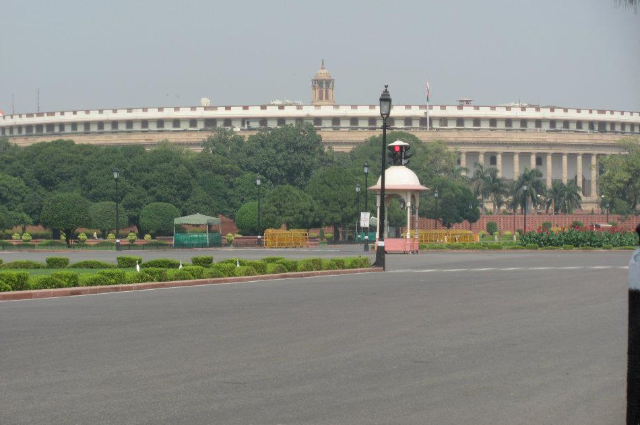
On the morning of 13 December 2001, Parliament House in New Delhi was preparing for what seemed like another ordinary day. The Members of Parliament, Ministers, Officials, Journalists, and security personnel were carrying out their routine responsibilities inside one of the country’s most heavily protected buildings. Few could have imagined that within minutes, the Parliament would become the target of one of the most audacious terrorist attacks in India’s history.
Standing at Iron Gate No.1 that morning was Constable Kamlesh Kumari Yadhav of the Central Reserve Police Force CRPF). Her duty was simple but crucial– to monitor vehicles entering one of the most sensitive gates of Parliament, used by Union Ministers, Members of Parliament, and other senior officials. Like every other day, she was expected to verify vehicles, maintain security, and ensure that only authorised persons enter the complex.
What happened next transformed her from a security guard performing her duty into one of India’s most celebrated gallantry award recipients.
Kamlesh Kumari joined the CRPF in 1994 and began her career with the 104 Rapid Action Force in Allahabad. Seven years later, in July 2001, she was transferred to the 88 Mahila Battalion, one of the country's premier all-women CRPF units. She was assigned to Bravo Company, the team responsible for Parliament security. It was a prestigious but demanding posting, requiring constant vigilance at one of the nation's most important institutions.
On the morning of the attack, a white Ambassador car approached Iron Gate No. 1. At first glance, the vehicle appeared legitimate. It carried a red beacon and displayed “Parliament” and “Home Ministry” markings– features that are commonly associated with government vehicles transporting senior officials. Such vehicles entered the Parliament regularly, making them a familiar sight for security personnel.
However, Kamlesh Kumari noticed that something was not right.
Although the exact reason for her suspicion was never officially established, she immediately acted on her instincts, and instead of allowing the vehicle to proceed, she rushed back to her position, raised the alarm over her walkie-talkie, and shut the gate before the car could enter the Parliament complex.
That single decision changed the course of the attack.
Realising that they had been detected, the terrorists abandoned any attempt to enter quietly and immediately opened fire. Kamlesh Kumari came under heavy gunfire. She was carrying only a walkie-talkie and had no firearm with which to defend herself. Despite this, she had already managed to alert fellow security personnel before being hit.
Reports state that she was struck by eleven bullets, making her the first security personnel to lose her life during the Parliament attack.
Her warning, however, gave other members of the security forces the time they needed to respond. Constable Sukhwinder Singh intercepted and shot a terrorist wearing a suicide vest before he could advance further into the complex. Constable Santosh Kumar engaged the attackers and killed three of the five terrorists. Along with personnel from the Delhi Police and other security agencies, the attackers were neutralised before they could enter Parliament.
The significance of those few moments cannot be overstated. At the time of the attack, Parliament was in session, and hundreds of elected representatives, ministers, parliamentary staff, journalists, and security personnel were present inside or around the building. Had the terrorists breached the main complex, the loss of life could have been catastrophic, and India's democratic institutions would have faced one of their darkest moments.
Kamlesh Kumari's actions ensured that the terrorists lost the advantage of surprise. By raising the alarm before they entered the building, she gave the security forces valuable time to organise their response. Many security experts have since acknowledged that these few minutes played a crucial role in preventing a much larger tragedy.
For her extraordinary courage and devotion to duty, Constable Kamlesh Kumari Yadav was posthumously awarded the Ashoka Chakra, India's highest peacetime gallantry award, on Republic Day 2002. She is widely recognised as the first woman to receive the Ashoka Chakra for combat gallantry. Prime Minister Atal Bihari Vajpayee and several national leaders paid tribute to her sacrifice, describing her actions as an example of exceptional bravery under the most difficult circumstances.
While the nation honoured her as a hero, her sacrifice was deeply personal for her family. She was survived by her husband, Avdhesh Yadav, and their two daughters, Jyoti and Shweta. Originally from Sikanderpur in Kannauj, Uttar Pradesh, Kamlesh Kumari came from an ordinary family, making her achievement even more inspiring. Like many members of the armed and paramilitary forces, she left home each day simply to perform her duty, never expecting that one day she would become part of India's history.
More than two decades have passed since the Parliament attack, but Kamlesh Kumari's story continues to be remembered within the CRPF and across India's security forces. Her actions remain an important example in discussions on vigilance, quick decision-making, and professional commitment. She demonstrated that security is not only about weapons or technology but also about awareness, judgement, and the willingness to act decisively when every second matters.
The Parliament attack of 2001 is remembered for many reasons, but among the stories of courage that emerged that day, Kamlesh Kumari's stands out. She had only a walkie-talkie, her training, and her instinct. She trusted that instinct, raised the alarm, and ensured that others had the time to stop the attackers before they could enter Parliament.
In doing so, she gave India something invaluable—those extra minutes that helped protect the country's highest democratic institution. Her courage serves as a lasting reminder that history is often changed not only by those who make decisions inside Parliament, but also by those who stand outside its gates, quietly ensuring that democracy remains protected.
sources