
Patriarchy has held its grip on societies worldwide for centuries, largely because it keeps adapting to whatever economic and cultural moment it finds itself in. It started as something crude and physical, a system built on brute distinction. And has since settled into something quieter. It’s evolved into a structural bias that researchers and activists are still working to untangle.
None of this makes patriarchy natural or inevitable. It's a phenomenon that grew over time, propped up by social systems designed—deliberately or not- to keep women's autonomy in check.
On paper, things look better. Legal barriers have come down in plenty of places, and women now hold seats in boardrooms, courtrooms, and parliaments that used to be closed off entirely. But dig past the surface and patriarchy hasn't really disappeared. It's just gotten better at hiding—swapping blatant discrimination for the kind of imbalance that's hard to point to and even easier to shrug off.
That's really where modern patriarchy lives now—not in loud declarations, but in the quiet stuff. In the extra hours women feel they need to put in just to be taken seriously at work. In the assumption that whoever keeps emotion out of a decision must be the one making it correctly. It shows up in pay gaps, in dating norms that still tilt in one direction, in inheritance customs that quietly favour sons.
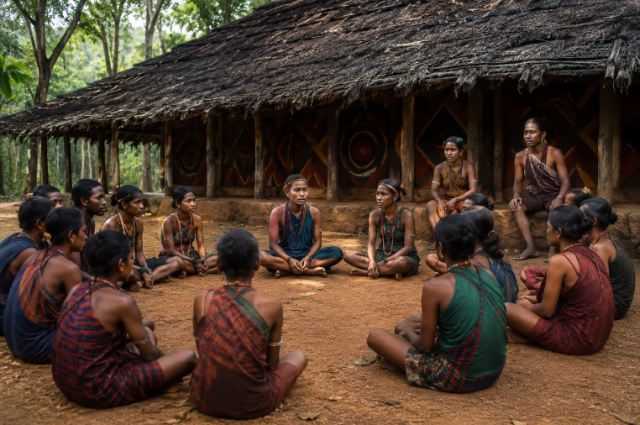
But head to the more remote parts of India, and you'll find communities that seem to have sidestepped much of this generations ago. Two in particular stand out among India's Adivasi populations. The Muria of Chhattisgarh and the Khasi of Meghalaya. Neither community built its social structure around male authority to begin with, long before "patriarchy" was even a word anyone outside these regions was using.
That's not to say these are flawless societies free of complication. They aren't. But when it comes to gender equality and basic dignity, they've built working models that much of urban India—and the wider world—is still trying to figure out.
The Muria and the Ghotul
In the Bastar region, Muria teenagers grow up spending time in the Ghotul, a co-ed dormitory where they're free to socialise, date, and figure things out with each other, largely left alone by the adults around them. The place runs itself. Boys and girls are expected to treat each other well and with respect, and relationships start or end based on what the two people involved actually want. Compare that to arranged marriages elsewhere in the country, where women often get little to no input on who they marry. Among the Muria, a young man makes his interest known by handing a woman a flower. What she does with it is up to her.
Inside the Ghotul, young people pick up real responsibilities along the way too, learning tribal folklore, weighing in on communal decisions, building the kind of social skills that carry into adulthood.
The Khasi and Matrilineal Inheritance
The Khasi of Meghalaya run family life on a completely different logic—descent, lineage, and surname all travel through the mother, not the father. In much of India, a daughter's birth can still be met with quiet disappointment over the financial burden she's assumed to represent. Among the Khasi, it's the reverse. Daughters are the ones who keep the family going.
The family's ancestral property goes to the youngest daughter, known as the Ka Khadduh. She's expected to stay in the family home, look after her ageing parents, and hold the household together for everyone else. And instead of the woman leaving home at marriage, as is standard practice across much of India, it's the husband who moves in with her family.
That doesn't mean men are sidelined. The mother's brother, called the U Kni, takes on an advisory and managerial role, particularly around property and big family decisions. It's less a mirror image of patriarchy and more a genuine split of responsibility between men and women.
A Model Worth Studying
What stands out about the Muria and Khasi systems isn't that either gender gets pushed out of the picture. It's that authority, responsibility, and inheritance get spread around instead of defaulting to men. Women hold real institutional power here. Over property, over lineage and over how the household runs. Men keep meaningful roles too, like the U Kni's advisory function among the Khasi.
These communities rarely come up in mainstream conversations about gender equality and are treated more like anthropological footnotes than actual models worth learning from. That's worth reconsidering. A lot of what modern society is still arguing about, like inheritance, autonomy, family structure, these tribes have already worked it out here for generations.
However, none of this means the Muria or the Khasi have it all figured out, or that their systems would translate neatly elsewhere. Every community carries its own tensions, and these two are no exception. But there's something worth sitting with; they never had to dismantle patriarchy the way the rest of the world is now attempting to. They simply never built their societies around it in the first place.
That's a different starting point, and maybe a useful one. The debates modern society keeps circling back to, like who inherits what, who has a say in their own relationships, whose name a family carries forward, aren't hypothetical questions for the Muria and the Khasi. They're just how things have worked for generations. It might be worth asking less "how do we fix patriarchy" and more "what does it look like when a society never leaned on it to begin with?"
References: