
India has been pushing towards higher green-fuel integration in the forthcoming years. It has successfully made E20 the national baseline standard for petrol and is actively pushing forward the legal and regulatory framework required for E85 and E100 flex-fuel options.
E100 is a clean, h green initiative which includes ethanol that acts as a corrosive solvent.
E100 fuel, quite contrary to its name, isn’t completely composed of ethanol. It is an automotive fuel specification that contains roughly 93% to 95% anhydrous ethanol and the remaining 5% composed of petrol and other additives that are crucial for improving cold-start performance and ensuring that the flame is visible in case of fire.
One of the most important causes for choosing E100 over other fuels is its high-octane rating. Pure ethanol has a very high-octane rating, around 113, that allows for cleaner combustion and potentially higher performance in optimised engines.
Countries are pushing for E100 because they want to reduce their dependence on crude oil imported from other countries and because it lowers greenhouse gas emissions.
However, E100 cannot be used to run standard petrol vehicles.
Using ethanol blends in standard non-flex-fuel cars will rapidly damage the fuel injectors, fuel pumps, and engine gaskets. For E100 to be used, Flex-Fuel Vehicles (FFVs) engineered with corrosion-resistant materials, modified fuel injectors, and specialised engine calibration units that automatically adjust to the varying ratios of ethanol to petrol are required.
Ethanol is chemically a polar solvent and is highly hygroscopic. Therefore, it aggressively absorbs any water moisture from the surrounding air. It also has a significantly lower energy density as compared to petrol.
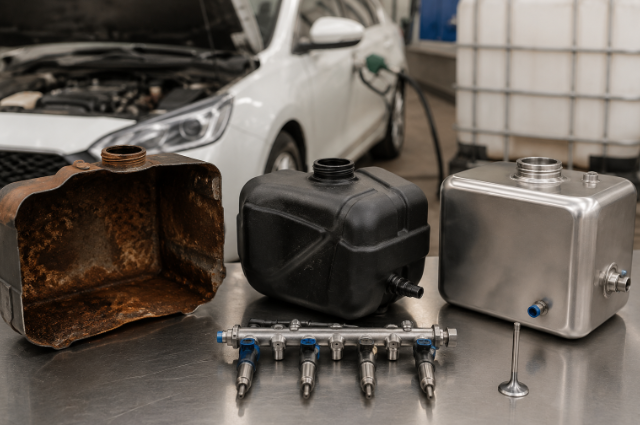
Traditional automotive fuel tanks are made from steel and galvanised using zinc to protect against rusting. However, in the case of E100, the moisture is absorbed by the substance and therefore a phenomenon known as phase separation takes place.
While low blends like E10 can only hold a fraction of a percent of water before they fail, higher blends like E100 have a higher tolerance for water. Yet, when a sudden temperature drop occurs, such as overnight cooling, the fuel’s ability to hold water plummets sharply.
Phase Occurrence refers to the water being separated from the fuel matrix to form an acidic and highly corrosive ethanol-water layer at the bottom of the tank as soon as the threshold saturation is crossed. The heavy aqueous alcohol-water phase drops to the bottom.
This bottom layer is not pure water. It acts as a magnetic solvent for organic weak acids, dissolved salts, and tank impurities. This results in the puddle transforming into a highly conductive, low pH electrolyte solution.
Due to the creation of this mixture and its corrosive nature, the zinc coating is stripped away. The zinc shield works perfectly against gasoline; however, it undergoes rapid chemical destruction when exposed to hydrated alcohol mixtures.
Furthermore, the zinc dissolved into the liquid matrix harms the fuel itself by accelerating the chemical breakdown and deterioration of the fuel. This leads to structural micro-perforations, fuel leaks, and zinc flakes clogging fuel injectors.
This forces the manufacturers to switch entirely to non-reactive HDPE plastic tanks or heavy-duty SUS303/SUS316L stainless steel tanks that natively resist alcohol induced oxidation.
HDPE is a robust, petroleum-based thermoplastic polymer having a higher strength-to-density ratio and is completely immune to the corrosive phase separation triggered by alcohol water blends.
Using these substances instead of zinc coating prevents the fuel tanks from corroding because of the unique constitution of E100.
Ethanol also completely lacks the lubricity that conventional petrol fuel provides to the intake and exhaust valves as it vaporises. It acts as a dry solvent and therefore strips away oil films from valve components.
This causes severe friction, mechanical scaling, and premature valve recessions when E100 is run. To solve this, the automakers have to integrate hardened cobalt chromium base alloys into the engine valves and valve seat inserts.
These alloys allow the structural hot hardness to maintain up to 800 degrees Celsius. This ensures that the engine parts don’t deform under the intense dynamic loads of dry ethanol combustion.
However, the major reason why this issue is so severe is that it is very difficult to detect this rust problem as it is overlooked during the standard detection methods. Hence, catching the motorists and fleet operators off guard.
Standard gas station storage tanks and vehicle fuel management systems often use floating sensors. These sensors are responsible for the detection of water infiltration. These floats are calibrated to a specific density that matches that of pure water.
However, an ethanol-water phase-separated layer has a lower density than that of pure water. This implies that these sensors fail to sense the alcohol-water mixture that is created when using E100 or similar fuels.
Therefore, bypassing the standard detection, this results in the failure of traditional sensors and accumulation of undetected corrosive material to sit within the tank for months going unnoticed.
Another possible failure happens due to the high density of ethanol-water. This mixture is fundamentally heavier than petrol. This allows it to sink to the bottom of the tank and therefore successfully avoid the eyes of the motorist checking their tanks with a naked eye.
Therefore, to switch to green fuels, motorists and automakers will have to change their ways by completely abandoning zinc and galvanised steel and replacing them with anti-corrosive materials that are immune to the assaults of phase occurrence.
References:
- https://www.veeder.com
- https://mobilemarina.co
- https://petroclear.com
- https://milexglobal.com
- https://www.researchgate.net
- https://ipt.br