
For decades, humanity has celebrated the eradication of deadly diseases and pests as some of its greatest scientific achievements. Smallpox was eliminated, rinderpest disappeared from livestock, and the New World screwworm, a flesh-eating parasite that devastated cattle and wildlife, was successfully wiped out from North America. Yet history repeatedly shows that eradication is not always the end of the story. Diseases and parasites can return when surveillance weakens, borders become more interconnected, or climate conditions become more favourable. The recent resurgence of the New World screwworm serves as a powerful reminder that victory over infectious threats requires constant vigilance rather than permanent celebration.
This article talks about a topic that goes beyond a gruesome parasite. It explores why disease eradication is rarely permanent, how global health depends on constant surveillance, and how environmental changes can allow old diseases to return.
How a Flesh-eating Parasite Attacks
As someone who is astonished by the vastness of this universe and the different wonders nature has produced, people often disregard the harm caused by many beautiful species on Earth. Biologists have worked for decades to learn about different species and to identify and classify them into different classes. Entomologists, for that matter, have worked with different types of insects. Insects are small, yet they possess the capacity to bring a great deal of pain and suffering to one. Throughout history, it has been evident that these small insects can be responsible for many infectious and gruesome diseases that can lead to widespread outbreaks and significant loss of life. Scientists have studied these small yet dangerous species to learn about the causes and to find cures for diseases. Nature is mysterious, and many such species are yet to be discovered and studied.
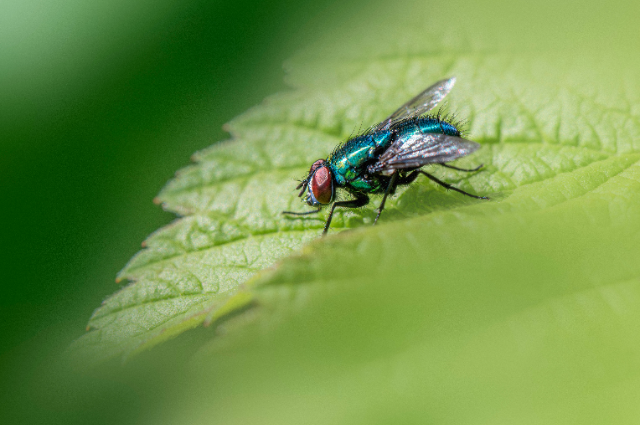
One such small and beautiful species is called the Cochliomyia hominivorax, or in simpler terms, the New World Screwworm. It is not categorised as a worm, but rather it is the larval stage of a metallic blue-green blowfly. Unlike ordinary maggots, which feed on dead tissue, screwworm larvae attack the living tissue of animals and humans. Female flies lay hundreds of eggs on open wounds, surgical cuts, tick bites or even the navels of newborn animals. Within hours, the eggs hatch into larvae that burrow into healthy tissue using hook-like mouthparts. As they feed, they enlarge the wound, causing severe pain, infections, tissue destruction and often death if left untreated.
When Treatment Costs More Than Survival: The Devastating Impact of Screwworm on Farmers
The new world screwworm is a parasite. Parasites are those organisms that feed on other organisms – the hosts – to fulfil their own needs and nutrition. This parasite in particular affects cattle, sheep, goats, horses, wildlife, dogs and occasionally humans as well.
Before the efforts for eradication of this parasite, the screwworm caused enormous economic losses across North America. Each year it infected millions of livestock, leading to great economic losses. It reduced meat production, lowered milk yields, caused infertility in animals and eventually higher mortality rates. All of these issues created debates among producers and consumers regarding food safety. Many authorities questioned the livestock businesses about the quality of livestock produced. As a result of these factors, many livestock traders saw their businesses come to a standstill, leaving their livelihoods severely affected. In despair, they sought help from veterinary treatments. The treatments cost a fortune, which the traders were unable to maintain. Eventually, the expenses incurred in treating infected livestock often surpassed the income generated from livestock sales. Farmers often spent more on treating their infected livestock than they earned, making it difficult to sustain their livelihoods.
Humans were also at risk. People with untreated wounds, poor hygiene or limited access to healthcare could become infected – a condition known as myiasis. Due to all the disastrous effects caused by the screwworm, proper treatments became an urgency to the scientists. This would not only help in restoring the declining economic value of the country but would also help in preventing such an epidemic in the following decades.
Climate Change and The Return of Old Threats
The New World Screwworm became one of history’s greatest examples of biological pest control. In response to the poor quality of livestock and declining economic values, scientists developed the Sterile Insect Technique (SIT) during the 1950s. The process involved mass–producing millions of male screwworm flies, followed by sterilising them using radiation and eventually releasing them into the wild. Since female screwworm flies mate only once in their lifetime, mating with a sterile male fly removed the possibility of producing any offspring. Over time, the wild population of screwworm collapsed. Through decades of international cooperation, the parasite was eliminated from the United States, Mexico, Canada and most parts of Central America. This program saved the livestock industry billions of dollars annually, eventually restoring the economic losses.
Despite its earlier eradication, the screwworm has begun spreading northward again from regions where it still survives. Several factors contribute to its resurgence. Some natural factors include climate change and animal movement. Other factors include reduced surveillance and global travel, which are largely caused by human society's negligence.
Once a disease appears eliminated, governments often reduce monitoring and funding. This simply creates opportunities for outbreaks to go unnoticed until they become widespread.
Although rare, humans can tend to transport screwworm larvae after travelling from epidemic regions. Recent travel-associated human cases demonstrate that international movement continues to pose risks.
Why Disease Eradication is Never Truly Permanent
The resurgence of the New World screwworm is more than the return of a horrifying parasite; it is a warning about the fragility of public health achievements. Decades after science seemingly defeated this flesh-eating pest, shifting climates, global travel, and reduced surveillance have created conditions for its comeback. The lesson is clear: disease eradication is not a one-time victory but an ongoing commitment. In an increasingly interconnected and warming world, maintaining that commitment may prove just as important as achieving eradication in the first place.
An Insignificant Creature Taking Down Economies
The story of the New World screwworm is more than a tale of a gruesome parasite; it is a lesson in humility. It reminds us that even the smallest and seemingly insignificant creatures can shake the foundations of entire economies. A tiny fly, weighing less than a gram, once brought the livestock industry of nations to its knees, causing billions of dollars in losses and threatening food security. It is a sobering reminder that humanity's technological advances and economic power do not place us above nature. Our victories over disease are never final; they are sustained only through constant vigilance, scientific cooperation, and respect for the delicate balance of the natural world. In the end, the screwworm teaches us that true strength lies not in believing we have conquered nature, but in recognising how profoundly interconnected and vulnerable we all remain.
References: