
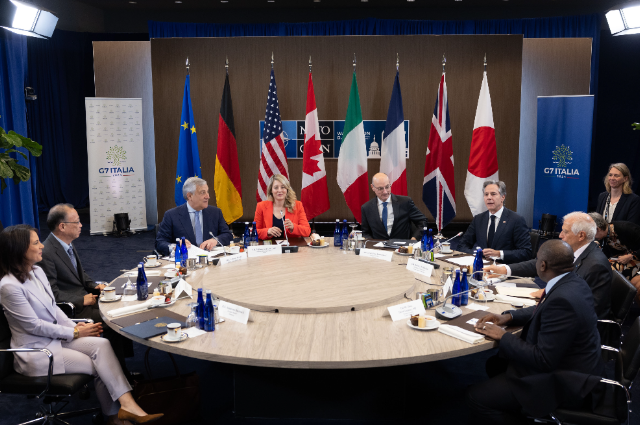
The Group of Seven was never meant to be an institution. It started in 1973 as a phone call between finance ministers trying to understand the oil shock that had just disrupted the global economy. By 1975, this informal channel had turned into an annual leaders' summit, bringing together the United States, the United Kingdom, France, West Germany, Italy, and Japan. Canada joined a year later. The European Union followed soon after as a non-enumerated member. There has never been a secretariat, a charter, or a binding vote. The G7 has always relied on consensus and statements rather than treaties and tribunals, which is why it has been able to adapt over time without falling apart. The G7’s agenda has expanded from traditional economic issues like trade disputes and financial crises to new global challenges such as artificial intelligence. At the recent G7 summit, AI safety became a major focus, with members discussing cooperation, responsible AI development, and sharing advanced technologies with trusted partners. China, which is not a G7 member, promoted its own vision of global AI cooperation and argued that AI should be developed safely and benefit humanity. The divide shows how AI has become a new area of competition and diplomacy between major powers, especially the US and China.
For a while in the 1990s, it looked like the format might grow permanently. Russia was added as a political partner in 1998, changing the G7 into the G8 — an attempt to include Moscow in the post-Cold War liberal order. That effort ended in 2014, when Russia's annexation of Crimea led to its suspension, and the group returned to seven members. China, despite being the world's second-largest economy for over a decade, has never had a seat at the table. Its absence is arguably the most significant structural fact about today's G7: a group aimed at coordinating the advanced industrial democracies while intentionally excluding the nation most likely to challenge that coordination.
The early G7 focused almost entirely on macroeconomics — exchange rates, inflation, oil dependency, and how to maintain the post-Bretton Woods system. Over the decades, the agenda expanded to include debt relief for developing nations, responses to financial crises, climate finance, and coordination during pandemics. The consistent theme is that the G7 tends to address whatever problems existing international structures are too slow or too stuck to manage. Recent years have seen trade disputes, sanctions coordination, and supply-chain security take centre stage; now, discussions about AI governance, safety standards, and technology export controls are increasingly pushing into the agenda, showing how quickly cutting-edge technology has turned into a major geopolitical and economic issue rather than a minor policy concern.
One of the lesser-known aspects of the G7 is that the presidency rotates each year. The country holding the presidency largely sets the agenda and decides who gets invited to the meetings. This rotation highlights the group's flexibility; hosts often invite non-member nations to broaden the discussion without diluting core membership. France's presidency in 2026 will follow this trend, inviting India, Brazil, Egypt, Kenya, and South Korea as guest countries. None of these nations gets a vote or a permanent seat, and the actual membership remains unchanged, but their presence is important. It indicates which regional powers and emerging economies the host wants involved in discussions about AI governance, trade, or climate, and it allows for informal meetings that often prove to be more significant than the official summit sessions.
It's easy to see the G7's informality as a weakness. There is no enforcement mechanism, no legal status, and no way to stop a member from ignoring a joint statement the day after it is signed. However, that same informality has helped the group last for over fifty years, while many more formal institutions have stalled. Because no binding unanimous agreement is necessary, the G7 can quickly address emerging issues — with AI safety being the latest example — without first going through a treaty ratification process. The real value lies not in the text of the communiqué but in the access it provides. Having a seat near the table, even as a guest, ensures hours of direct, informal contact with leaders of the world's most powerful democracies. This is a valuable opportunity that the G7 has offered since 1975, which is why countries continue to participate even though there's nothing on the table except conversation.
References: