
On July 3, 2025, a 48-year-old Dalit man who had spent twelve years in hiding walked into a police station in Karnataka and said he could no longer carry what he knew. He asked to go on record. He said he wanted to be free of what he called an insurmountable sense of guilt. Eight days later, veiled entirely in black with only a narrow strip of mesh visible over his eyes, he appeared before a magistrate in Belthangady and recorded a formal statement. What he alleged, if true, would represent one of the most sustained and systematic crimes in the history of modern India.
He said he had been forced, under threat of death, to bury hundreds of bodies of women and young girls between 1995 and 2014 while working as a sanitation worker at the Dharmasthala temple in Dakshina Kannada district, Karnataka. He said many of the bodies bore signs of strangulation and sexual assault. He described having found the bodies in and around the Nethravathi River that runs alongside the temple. He said he had been told that if he did not do as instructed, he would be buried alongside them. He left Dharmasthala in 2014, he said, after one of his own family members was sexually harassed by someone associated with the temple administration. He had said nothing, publicly, for eleven more years.
The Town and Its Power
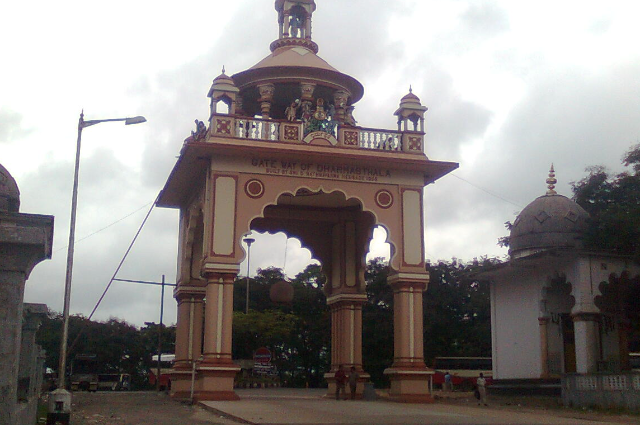
Dharmasthala is not a place that welcomes ambiguity. It is an 800-year-old pilgrimage village on the lower slopes of the Western Ghats, drawing close to two thousand devotees every day who come to seek the blessings of Lord Manjunatha. It is a place associated, in the minds of most who visit it, with divine justice, virtue, and the reward of the righteous. It is also a town that, until 2016, did not have its own police station.
The administration of the Dharmasthala temple has been controlled by the Heggade family for centuries. Veerendra Heggade, who has served as the 21st hereditary Dharmadhikari since 1968, is a recipient of the Padma Vibhushan, India's second-highest civilian honour, and a sitting member of the Rajya Sabha, nominated by the BJP. His family oversees a network of schools, colleges, hospitals, and charitable institutions across Karnataka. It is, in the most literal sense of the phrase, an empire of influence. The lawyer S. Balan, who represented the whistleblower's interests in early hearings, described it plainly: the temple trust is not merely a religious body. It is a social institution whose reach extends into every arm of public life in the region, and that reach, he said, may explain the decades of silence.
The History That Came Before
The 2025 complaint did not arrive in a vacuum. Dharmasthala has been the site of protests over violence and cover-ups since at least the 1980s. In 1987, a 17-year-old named Padmalatha was raped and murdered. Protests followed. The officer initially investigating the case was abruptly transferred, and his successor filed a closure report. In 2003, a medical student named Ananya Bhat vanished after a college trip to Dharmasthala. Her case generated years of advocacy and appeals, and no resolution. In October 2012, a 17-year-old student named Sowjanya was raped and murdered within a kilometre of the Dharmasthala temple. The case produced the Justice for Sowjanya movement, a grassroots campaign that brought protesters to the streets of Karnataka for years, and a single accused, who was acquitted by the trial court in 2023 for lack of evidence, with the Karnataka High Court upholding the acquittal in August 2024. The High Court noted, with troubling implications, that the physical evidence suggested more than one perpetrator may have been involved.
A report published ahead of the 2025 SIT formation cited roughly 462 unnatural deaths in Dharmasthala across the years ending in 2013. The number, even if it encompasses accidental deaths at a major pilgrim site with significant footfall, is notable. Activists noted, pointedly, that the number of unnatural deaths in Dharmasthala dropped significantly after the Sowjanya protests brought sustained public attention to the town.
The SIT, the Gag Order, and the Judge Who Recused Himself
Under sustained pressure from lawyers, rights activists, and public outrage, the Karnataka government, led by the Congress party, constituted a Special Investigation Team on July 19, 2025, headed by DGP Pronab Mohanty. The complainant identified thirteen burial sites. By August 4, eleven of those thirteen had been excavated by the SIT. The results were inconclusive: no human remains were found at nine of the sites. A partial skeleton was found at one site, and a human skull and bones at another.
While the excavations were underway, a separate development drew significant attention. On July 18, Judge Vijaya Kumar Rai B, sitting in the court handling aspects of the case, issued a gag order removing over 800 online links related to the Dharmasthala case. Journalists and activists promptly pointed out that the judge had been educated at institutions run by the Dharmasthala temple, and had previously worked as a lawyer at a firm that represented the Heggade family. On August 4, the judge recused himself. His successor questioned the basis for the original gag order, which was subsequently lifted.
The Arrest of the Whistleblower
On August 23, 2025, the SIT arrested the chief complainant, later identified as C.N. Chinnaiah, on charges of perjury and furnishing false evidence. The specific allegation was that he had produced a skull and bones before the Belthangady magistrate on July 11, claiming they belonged to a woman he had buried, and that forensic examination had since confirmed the skeletal remains were those of a male. He was remanded to ten days' police custody.
Veerendra Heggade, who had throughout the investigation described the allegations as baseless and deeply hurtful, welcomed the arrest. He said the truth was beginning to come out. Both the BJP and the Congress, in a rare moment of political convergence, publicly expressed solidarity with the Dharmasthala temple administration. The BJP called for the probe to be transferred to the National Investigation Agency to expose what it described as a conspiracy with foreign funding. The Congress Deputy Chief Minister DK Shivakumar accused the BJP of being behind the campaign in the first place. The investigation, meanwhile, had become a Rorschach test onto which every political actor projected their preferred narrative.
Karnataka's Home Minister G. Parameshwara said clearly that no conclusions could be drawn until the SIT completed its probe, and confirmed that the investigation would continue regardless of the complainant's arrest. The SIT expanded its scope to examine missing person FIRs filed in Karnataka and neighbouring states related to the disappearance of pilgrims visiting Dharmasthala.
What We Know and What We Don't
As of writing, the SIT investigation is ongoing. The chief complainant is in custody for perjury. The physical evidence recovered from the thirteen excavation sites is partial and, so far, forensically ambiguous. Several other witnesses have come forward, including activist Jayanth T., who told a court he witnessed a body being buried in 2005, and said he was related to someone who had been murdered in Dharmasthala. Sujatha Bhat, who initially came forward claiming to be the mother of missing student Ananya Bhat and filed a new complaint in the wake of Chinnaiah's testimony, later gave contradictory statements to the media and withdrew key elements of her account.
The case is a labyrinth of competing claims, compromised evidence, institutional pressures, and political interference, and it would be wrong to present it as anything simpler than that. What is not ambiguous is the pattern: protests in 1987, in 2012, and now in 2025, each time involving allegations of violence against women and girls, each time followed by investigations that stalled, accused individuals who were acquitted or transferred away, and victims' families who say they were discouraged from pursuing justice. Whether Chinnaiah's specific claims are true, false, or a mixture of both, the pattern they forced into public view is not his invention. It is four decades old.
A sanitation worker, the most disposable person in any institutional hierarchy, carried that pattern into a courtroom in the summer of 2025. His credibility is now under serious legal question. But the question he asked is still open. And the SIT, whatever the complainant's fate, has said it will keep looking.
References:
- Wikipedia – Dharmasthala Mass Burial Case: https://en.wikipedia.org/wiki/Dharmasthala_mass_burial_case
- Al Jazeera – How an Indian Temple Town Is at the Centre of Hundreds of Alleged Murders: https://www.aljazeera.com
- TRT World – How a Whistleblower Exposed Rape, Murder, Mass Graves in Indian Temple Town: https://www.trtworld.com/article/46c63845be96
- The Print – Dharmasthala: SIT Arrests Complainant Who Alleged Multiple Murders, Rapes, Burials: https://theprint.in/india
- The News Minute – Dharmasthala Whistleblower Arrested by SIT for Perjury, Fake Evidence: https://www.thenewsminute.com
- Feminism in India – Unravelling the Dharmasthala Case: The Hurdles on the Road to Justice: https://feminisminindia.com
- Deshabhimani – Mass Graves, Missing Women, and a Whistleblower: The Dharmasthala Horror Unfolds: https://www.deshabhimani.com
- The Womb – The Shadow of Dharmasthala: Unravelling the Soujanya Case: https://www.thewomb.in
- The Week – Dharmasthala Case: Dharmadhikari Veerendra Heggade Welcomes Arrest of Complainant: https://www.theweek.in
- Wikipedia – Veerendra Heggade: https://en.wikipedia.org/wiki/Veerendra_Heggade
Note: This article discusses allegations of murder, sexual violence, and the deaths of women and minors. All allegations attributed to the complainant and other witnesses are unproven in court. The chief complainant was arrested for perjury in August 2025; the SIT investigation remains ongoing. No individual named in this article has been convicted of any crime.