
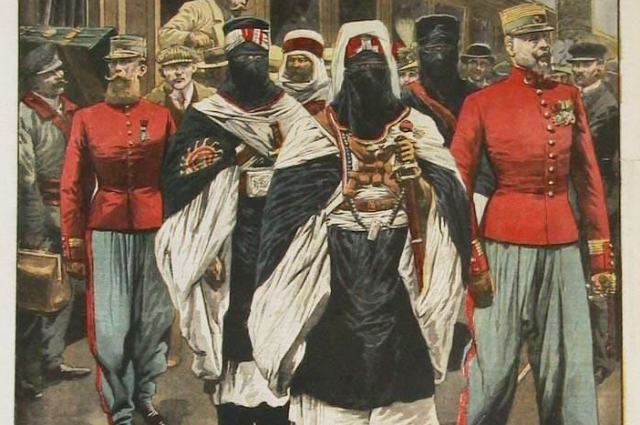
Somewhere in the central Sahara, a man adjusts the indigo cloth wound around his face until only his eyes are visible. He has worn it this way since puberty. He will wear it this way for the rest of his life, loosening it only in the company of people he trusts completely: close male relatives, intimate friends, his wife. The wider the circle of people before whom he uncovers his face, the more he is, in the logic of his culture, diminishing himself. To go unveiled in public is not freedom. It is exposure in a sense that carries no comfort at all.
This is not a woman. This is a Tuareg man in the Sahara, practising one of the most striking gender inversions that any culture on earth has produced. While most of the world has spent centuries associating the female veil with modesty, subordination, and the erasure of public identity, the Tuareg arrived at the opposite arrangement entirely: among their people, it is men who cover their faces and women who do not. And the reasons behind that arrangement, once you understand them, reveal something genuinely surprising about how gender, power, and status can be organised in ways that most of us have never considered.
Who the Tuareg Are
The Tuareg are a Berber people whose traditional territory stretches across the central and western Sahara, covering parts of what are now Mali, Niger, Algeria, Libya, and Burkina Faso. They call themselves Imuhar, meaning the free people. The name Tuareg is of outside, likely Arabic origin and was never theirs to begin with, which is perhaps fitting for a people whose entire culture is built around resisting the kind of fixed definition that borders and names impose.
They are nomadic pastoralists, historically moving with herds of camels, goats, and cattle across vast seasonal circuits determined by grazing and water. For centuries they controlled the trans-Saharan trade routes, moving gold, salt, and goods between sub-Saharan Africa and the Mediterranean world, accumulating both wealth and a fierce reputation for independence. Colonial powers spent considerable effort trying to pacify them. They were not easily pacified. Today, with modern national borders slicing through their ancestral range, the Tuareg remain a people without a country of their own, united not by a state but by a shared language, a shared culture, and a shared understanding of what it means to belong to the desert rather than to any government within it.
They are also known, visually, by a single striking detail: the indigo. The Tuareg dye their robes and veils with deep blue indigo, and the pigment is so rich that it rubs off on the skin, leaving their faces and hands tinted blue. This is where their most widely used nickname originates: the Blue People of the Sahara. One of their own self-designations, Kel Tagelmust, translates directly as the people of the veil. The veil is not an accessory. It is identity, worn into the skin.
The Tagelmust and What It Actually Means
The tagelmust is a single length of cloth, sometimes exceeding ten metres, wound around the head and face in a style whose precise folds and arrangement communicate specific information about the wearer's clan, regional origin, and social status. It protects against the desert sun, the blowing sand, and the desiccating heat. But these practical functions, real as they are, exist alongside a deeper symbolic architecture that has nothing to do with weather.
The men's facial covering in Tuareg tradition originates from the belief that it wards off evil spirits. The mouth and nose, in Tuareg cosmology, are understood to be vulnerable entry points for malevolent forces. Covering them is a form of spiritual protection, not merely physical shelter. Beyond the spiritual dimension, the tagelmust is a code of social reserve: the degree to which a man covers his face in a given situation signals how much trust he extends to those present. Before his mother-in-law, a Tuareg man covers his face completely. Before a chief or elder of high status, he covers it fully as a mark of respect. Before close male companions, he may relax it. The veil is not a wall. It is a calibrated signal of intimacy and distance.
The initiation into wearing the tagelmust happens at puberty, around the age of 18, and marks a boy's formal passage into adulthood. Some sources suggest the transition begins even earlier, around 25 in certain communities, but in all cases the taking on of the veil is a rite of manhood, a public declaration that the boy is now a man who carries himself with the restraint, dignity, and social awareness that Tuareg masculinity demands. To refuse the veil after puberty, or to go unveiled casually in public, would not be an expression of freedom. It would be a failure of character.
The Women Who Do Not Veil
Tuareg women do not cover their faces. This alone would be notable in any Muslim-majority context in the Saharan region, but the Tuareg female position goes considerably further than the absence of a veil. Tuareg society is matrilineal: descent, inheritance, and lineage pass through the mother's line rather than the father's. The tent belongs to the woman. If a marriage ends, the husband leaves. Children stay with their mother. The founding figure of Tuareg legend is not a warrior king but a woman, Queen Tin Hinan, who led her people southward into the Hoggar Mountains of Algeria sometime in the 4th or 5th century. Her tomb, over fifteen centuries old, still stands at Abalessa in southern Algeria.
Tuareg women have historically had far greater freedom of movement, ownership, and social participation than women in most neighbouring cultures. They compose and perform poetry, including poetry that critiques male behaviour with considerable directness. Divorce is socially acceptable and relatively common, and women frequently initiate it. Even the inheritance of the chief's title, the amghar, is traditionally passed not to the chief's own son but to his sister's son, keeping leadership within the female line of descent. This is not a matriarchy in the sense that women hold formal political authority over men, but it is a social order in which female lineage is the carrier of identity, property, and continuity in a way that most patrilineal cultures have spent millennia suppressing.
The combination of unveiled women with significant social and economic power, alongside veiled men performing an elaborate code of reserve and restraint, is not a coincidence. It reflects a coherent cultural logic in which status is not expressed through exposure but through control, and in which the person who covers their face is not hiding but demonstrating, through the very act of covering, that they have something worth protecting.
What the Blue Skin Means
The indigo that stains the Tuareg's skin was not always just a cultural preference. For much of Tuareg history, indigo-dyed cloth was a marker of wealth. The richer the blue, the more expensive the dye, the higher the wearer's status. To be blue-skinned was to be visibly prosperous, marked by the accumulation that trade across the Sahara could produce. The dye wore off, and then you dyed again, which meant that sustained blueness was itself a kind of ongoing demonstration of means. The Blue People of the Sahara were not named accidentally. They were named for what the blue announced.
Today, synthetic dyes have made indigo cloth widely accessible, and its function as a pure status marker has diminished. But the tradition of wearing it continues, and the skin-staining remains, because some habits outlast the economic logic that created them and become, over time, simply what it means to be who you are.
A Mirror the World Did Not Expect
The Tuareg are Muslim, officially, having converted centuries ago. But their Islam sits lightly on a pre-Islamic substrate that kept its own rules: matrilineal inheritance, female autonomy, male veiling. Islamic orthodoxy, in most of its historical expressions, moved in the opposite direction on all three of these axes. The Tuareg kept their own axes anyway.
What their culture offers, to anyone paying attention, is not an argument that one gender arrangement is superior to another. It is the demonstration that the arrangements we tend to treat as natural or universal- that women veil and men do not, that inheritance flows through fathers, that female visibility is a social problem to be managed- are in fact choices. Specific, historical, contingent choices that other peoples, in other deserts, made differently. The Tuareg man wrapping ten metres of indigo cloth around his face each morning is doing what his culture taught him dignity looks like. He is no less dignified for it. He may, by his own culture's reckoning, be considerably more so.
References:
- Young Pioneer Tours, Who Are the Tuareg?: https://www.youngpioneertours.com/who-are-the-tuareg/
- GetUnruly, The Free People: Inside the Ancient Culture of the Tuareg: https://getunruly.com
- New World Encyclopedia, Tuareg: https://www.newworldencyclopedia.org
- Splash Travels, The Tuareg's Battle To Become Lords of the Sahara: https://www.splashtravels.com/cultures/tuareg-people
- Encyclopedia.com, Tuareg: https://www.encyclopedia.com
- Africa Unfiltered, The Blue People of the Sahara: The Untamed Spirit of the Tuareg Berbers: https://africaunfiltered.substack.com
- Cultural Plus, Tuareg Nomadic Life: Traditions and Survival in the Sahara: https://culturalplus.com/tuareg-nomadic-life/
- Ranch de Diabat, The Tuareg: Between Ancestral Traditions and Women's Emancipation: https://ranchdediabat.com