
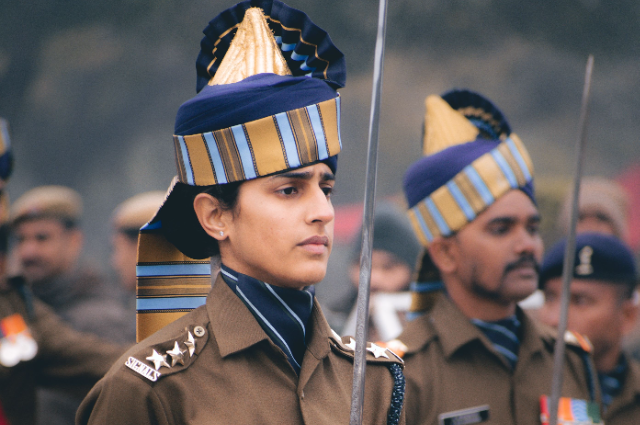
She had no gun. No bulletproof vest. No backup at arm's reach. What Constable Kamlesh Kumari Yadav had, on the morning of December 13, 2001, was a walkie-talkie, a pair of sharp eyes, and a gut feeling that something was very, very wrong. That feeling, acted upon in a matter of seconds, may have saved India's Parliament. It certainly cost Kamlesh her life.
In a country that has produced countless heroes, Kamlesh Kumari remains one of the most quietly remarkable. She was not a general. She was not a decorated officer. She was a constable, a woman from Sikanderpur, Kannauj in Uttar Pradesh, who had joined the Central Reserve Police Force seven years before that December morning, raised a family, and reported to work every day to do her job. On the last day she ever did that job, she did it in a way that the nation still honours over two decades later.
From Kannauj to Parliament House
Kamlesh Kumari joined the CRPF in 1994, beginning her career with the elite 104 Rapid Action Force in Allahabad. In July 2001, just five months before the attack, she was reassigned to the 88 Mahila Battalion, one of India's premier all-women paramilitary units, and placed in Bravo Company: the group specifically tasked with securing the Parliament complex when it was in session.
Her posting was Iron Gate No. 1, directly adjacent to Building Gate No. 11, the entrance used by Union Ministers, Members of Parliament, and other VVIPs. This was not a quiet corner of the complex. It was the heart of Indian political power, and Kamlesh was one of the people responsible for keeping it safe. There was, however, a significant limitation that would become tragically relevant that morning: female constables deployed at Parliament were not issued weapons. Kamlesh was on duty carrying only her walkie-talkie.
December 13, 2001: The Morning Everything Changed
At approximately 11:40 AM, a white Ambassador car bearing a red beacon light and labels reading 'Parliament' and 'Home Ministry' entered the complex from the Parliament Street gate and began moving toward the building. On any ordinary day, such markings would have been enough assurance; VVIPs used similar cars, and the tags were designed precisely to communicate authority and legitimacy. This was no ordinary day.
Kamlesh noticed immediately that the car was not slowing down as protocol demanded. Something about the vehicle's behaviour did not match the routine she had observed every working day. In those few seconds, the kind of seconds that feel longer in memory than they do in reality, she made her decision. She ran back to her post, slammed Iron Gate No. 1 shut, and raised the alarm over her wireless set, alerting CRPF personnel across the complex that something was wrong.
The terrorists, five in total, all members of Jaish-e-Mohammed, realised their cover was blown. They opened fire immediately and indiscriminately. With no weapon, no cover, and nowhere to run, Kamlesh Kumari was struck by eleven bullets. She became the first person to fall in what would go down in history as the 2001 Indian Parliament attack.
Eleven Bullets, One Outcome
It would be easy, and wrong, to remember Kamlesh only as a victim. She was not. She was the reason the attack failed to become a massacre. Her alarm, transmitted in those final seconds, triggered an immediate lockdown. Parliament's heavy gates were sealed. Internal security personnel were alerted. L.K. Advani and Jaswant Singh, among other senior Cabinet ministers who were still inside the building forty minutes after the session had adjourned, escaped unharmed.
Constable Sukhwinder Singh, alerted by Kamlesh's warning, pursued the attackers and shot the terrorist wearing a suicide vest, preventing what could have been a catastrophic explosion inside the Parliament complex. Constable Santosh Kumar went on to neutralise three of the five terrorists. All five attackers were eventually killed. Nine security personnel lost their lives in the attack. Without Kamlesh's alarm, that number, and the scale of the destruction, could have been unimaginably higher.
She had no weapon. She used the one thing she had. And it was enough.
The Award That Almost Got Returned
On Republic Day 2002, President K.R. Narayanan posthumously awarded Kamlesh Kumari the Ashoka Chakra, India's highest peacetime gallantry honour. Prime Minister A.B. Vajpayee paid personal tribute to her courage. She became the second woman in Indian history to receive the Ashoka Chakra, and the first from India's central armed police forces.
But the story of the medal did not end with the ceremony. Mohammad Afzal Guru, later found by the Supreme Court to be a key conspirator in the attack, was sentenced to death, yet his execution was indefinitely delayed as his family petitioned for clemency. Kamlesh's surviving family publicly declared that they would return the Ashoka Chakra if the President accepted the mercy petition. In December 2006, on the fifth anniversary of the attack, the families of eight security officials who had been honoured for their bravery, including Kamlesh's, returned their gallantry medals to the government in protest. They reclaimed the medals only after the matter reached its conclusion. Afzal Guru was eventually executed in February 2013.
The Family She Left Behind
Kamlesh Kumari is survived by her husband, Avdhesh Yadav, and their two daughters, Jyoti and Shweta. They had lived together in Vikaspuri, Delhi, with family roots in Sikanderpur, Kannauj, Uttar Pradesh. Her daughters grew up knowing that their mother did not merely wear a uniform; she lived its values completely, until the very last moment.
There is a particular kind of grief that comes with losing someone to a cause larger than themselves, pride and sorrow so completely intertwined that they can never quite be separated. Jyoti and Shweta have carried that grief for over two decades. In interviews over the years, the family has spoken not of bitterness but of quiet, fierce pride, the kind that does not shout, but does not fade either.
What Her Story Means
India has no shortage of stories about soldiers who died bravely. What makes Kamlesh Kumari's story different is the specific, almost unbearable clarity of her situation. She was unarmed in a moment that demanded everything. She had less than a minute. She had only herself and a radio. And she chose, without hesitation, to run toward the danger rather than away from it.
There is a tendency, when we speak of martyrs, to make them larger than life, to transform them into symbols so complete that the human being inside the symbol disappears. Kamlesh Kumari was a wife. She was a mother of two daughters. She was a woman from a small town in Uttar Pradesh who made her way into one of the country's most demanding paramilitary forces and showed up every day to do her job. On December 13, 2001, she did her job for the last time, and in doing so, she did something that generals plan for and rarely achieve: she held the line.
The Ashoka Chakra sits in her daughters' home. Parliament still stands. And every December 13th, her name is called, one more time, so that India does not forget the woman who, with nothing but a walkie-talkie and a refusal to look the other way, kept the doors of democracy shut.
References:
- Wikipedia – Kamlesh Kumari Yadav: https://en.wikipedia.org/wiki/Kamlesh_Kumari_Yadav
- Wikipedia – 2001 Indian Parliament Attack: https://en.wikipedia.org/wiki/2001_Indian_Parliament_attack
- Wikipedia – Ashoka Chakra (Military Decoration): https://en.wikipedia.org
- The Better India – The Story of Kamlesh Kumari: https://thebetterindia.com
- India TV News – With No Weapons, Just a Walkie-Talkie in Hand: https://www.indiatvnews.com
- TFI Post – Parliament Attack Anniversary: Remembering CRPF Braveheart Kamlesh Kumari: https://tfipost.com
- Medium / Incredible India – Ashoka Chakra Awardee: Kamlesh Kumari: https://medium.com
- Wikipedia – Neerja Bhanot: https://en.wikipedia.org/wiki/Neerja_Bhanot