
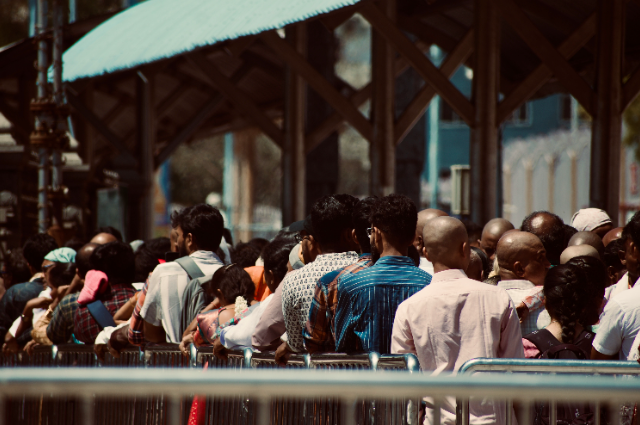
The queue at Omkareshwar on a busy morning can stretch for three to four hours. This is not an exaggeration. The Jyotirlinga at Omkareshwar is one of the twelve most sacred Shiva shrines in the country, and on peak pilgrimage days the crowd is the kind that does not move so much as press forward, slowly, in the hope that the people ahead of it will eventually thin out. If you have ever waited in a queue like that, you know the specific exhaustion of it. You also know that the people who skip it, who walk past the entire line and go straight in through the VIP gate, carry with them a particular quality of smugness that is difficult to describe politely.
For most of India's major temples, a VIP pass is exactly what the name implies. You pay for it. The going rate at Omkareshwar was Rs 300 per person. Not a fortune, but not nothing either, and enough to ensure that the line-skipping privilege sat primarily with those who could afford it. Nobody seemed to find this especially troubling. That is just how temple queues work.
Then Khandwa's District Magistrate, Rishav Gupta, changed the currency.
Give Blood, Skip the Queue
The scheme launched by the Khandwa district administration is, in its mechanics, extremely simple. A five-bed blood collection facility has been set up near the Omkareshwar temple complex. Devotees who are healthy, aged between 18 and 60, and weigh at least 45 kilograms can donate blood on site. The process takes roughly 20 minutes. In exchange, they receive refreshments, a certificate, prasad from the temple, and a photograph of Lord Omkareshwar. That certificate gets them and their family members straight into the VIP darshan lane, bypassing the three- to four-hour general queue entirely.
Gupta, speaking to PTI in July 2026, described the logic plainly. Demand for blood in hospitals was rising. What was available from camps was not enough, particularly for patients in emergency wards. So the administration linked the two things together. The devotee gets something they want. The blood bank gets something it desperately needs. Nobody is compelled to participate. Nobody is turned away from darshan for refusing. It is entirely voluntary, which is, practically speaking, the only kind of blood donation that actually works.
The results have been, by any reasonable measure, remarkable. When the scheme began in February 2026, the district hospital at Khandwa was collecting between 15 and 20 units of blood per day. By July, daily collection had climbed to 200 units. That is not a modest improvement. That is roughly a tenfold increase in voluntary blood supply from one district, generated not by a government awareness campaign or a celebrity endorsement, but by a five-bed tent near a temple and a queue-jumping certificate.
India's Blood Problem Is Bigger Than Most People Realise
To understand why this matters beyond Khandwa, you have to sit with some numbers that the health ministry does not publicise loudly. India requires approximately 14.6 million units of blood annually. Of the blood collected across Madhya Pradesh in 2025 to 2026, about 8.36 lakh units were gathered in total, with only 57 per cent coming from voluntary donors. The rest came from replacement donors, which the WHO actively discourages because it is reactive, unreliable, and tends to collapse precisely when demand is highest, during emergencies, surgeries, and disasters.
The problem is not just volume. It is geography. A 2024 study mapping blood access across eight Indian states found that only around 26 per cent of residents in areas like Madhya Pradesh live within 30 minutes of a functioning blood bank. The surplus that exists in large cities does nothing for a woman haemorrhaging after childbirth in a district hospital in Khandwa or Betul or Harda. Since the Omkareshwar scheme generated a surplus, the Khandwa blood bank has been distributing units to exactly these kinds of neighbouring districts, including Betul, Dhar, Burhanpur, Barwani, and Harda. Blood collected at a temple is arriving in hospitals that had none.
The Part That Makes It Actually Smart
Standard blood donation drives work in certain places with certain people. Urban colleges. Corporate parks. Localities where young, educated residents are already primed to respond to civic appeals framed around abstract future benefit. They do not work particularly well in semi-urban and rural India, which is, unfortunately, also where the blood shortage tends to be most acute.
Pilgrimage sites are different infrastructure. They are not places that people occasionally pass through. They are destinations that people travel to deliberately, in large numbers, on a predictable schedule, already in a frame of mind that leans toward devotion, charity, and sacrifice. The Omkareshwar temple draws enormous footfall year-round, and during religiously significant periods like Adhik Maas, the numbers and the motivation spike together. The administration essentially looked at that footfall and asked: what do these people already want, and what does the health system need, and is there a way to connect the two honestly?
The answer was a certificate. Not cash. Not a voucher for a discount on the next visit. A certificate that grants you faster access to the very thing you came here for. That distinction matters more than it might seem. Paid VIP darshan is a transaction. It carries, if you are thinking about it at all, a faint sense of trading money for spiritual privilege. Blood donation for darshan is an exchange. It carries the sense of having earned something through an act of giving, and then receiving something in return that is genuinely meaningful in the context of why you made the journey. The spiritual logic is coherent. The health logic is sound. And it costs the administration almost nothing to run.
Tirupati Was Already Doing This
One thing worth noting, because it tends to get buried in the coverage of the Omkareshwar scheme: this is not entirely a new idea in India. The Tirumala Tirupati Devasthanams in Andhra Pradesh has for some years offered a free Special Entry Darshan ticket, ordinarily priced at Rs 300, to devotees who donate blood at the Ashwini Hospital in Tirumala. The darshan is typically available within one to two hours of donation. It is a comparable scheme in a comparable context, and it has operated without much controversy.
The Omkareshwar initiative has attracted more attention, partly because the blood collection results have been more dramatic and more publicly documented, and partly because the MP government is now actively examining whether to expand the model to other major temples across the state. A standalone blood bank at the medical college in Khandwa is already being planned in response to the surplus the scheme has generated. That is infrastructure created by a queue-jumping pass. It is difficult to think of a more efficient use of religious footfall in the service of public health.
The Obvious Question
Does paying someone, even in non-cash terms, for blood donation undermine the ethics of voluntary giving? It is a fair question, and one that public health officials have been wrestling with globally for decades. The WHO's position is that non-monetary incentives that do not compromise donor safety or blood quality are permissible. The bar is the screening process and the rigour of the collection setup, not the existence of a reward.
At Omkareshwar, the collection facility has medical staff on site. Eligibility criteria are enforced. The process is supervised. Donors who do not meet the criteria are turned away. None of this is markedly different from any other organised blood collection camp in India. What is different is that the queue outside the temple is moving faster, the blood bank is full for the first time in memory, and districts that were sending emergency requests to larger cities are now receiving supply from Khandwa instead.
An idea this simple solving a problem this persistent is the kind of thing that tends to make people in large offices with large mandates feel slightly embarrassed. They had the budget. They had the campaigns. They had the celebrity posters and the awareness drives. What they did not have was a five-bed tent next to a temple and the specific audacity to ask pilgrims to roll up their sleeves before walking through the VIP gate. Rishav Gupta had that. And Madhya Pradesh, apparently, is paying attention.
References:
- Siasat Daily, Donate blood and get free VIP darshan pass at Omkareshwar temple (PTI, July 2026):
https://www.siasat.com - Deccan Chronicle, MP Mulls Offering VIP Darshan to Devotees for Voluntary Blood Donation (June 2026):
https://www.deccanchronicle.com - India.com, Is Omkareshwar Temple Providing VIP Darshan in Exchange for Blood Donation?:
https://www.india.com - Tirtha Yatra, Donate Blood, Save Lives, and Enjoy VIP Darshan at Omkareshwar Jyotirlinga:
https://www.tirthayatra.org - ORF Online, Securing India's Lifeblood for a Reliable National Blood Supply:
https://www.orfonline.org - IndiaSpend, Govt Claims It Is Blood-Sufficient. But Is It?:
https://www.indiaspend.com - Wikipedia, Blood Donation in India:
https://en.wikipedia.org. . .