
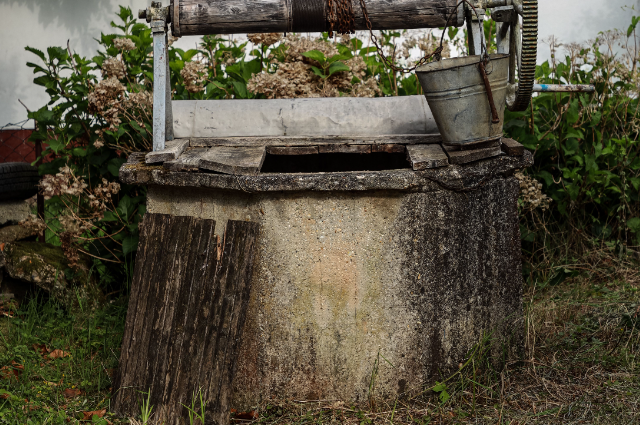
It is reported that in a farmland situated in Virparda village of Morbi district of Gujarat, a new well started showing characteristics of not being a well but behaving more like a miniature, restless sea. Water in the well kept rising and falling as if creating waves, restless and sometimes overflowing. It caught people’s attention very soon, and videos were made about it, while different speculations about the earthquake, underground passages, and other forces were going around.
However, there could be another, more scientific explanation for it.
The well,l which was built recently in the farmland of farmer Pranjivanbhai Sadariya, is about 18 feet deep and was built about three months ago. Sadariya found that something strange was happening on the 2nd of August 2026 because he noticed water overflowing from the well. It was moving for some days, ys but after a period of calm returned to motion. Other nearby wells supposedly stayed silent at the same time.
With the videos getting viral on the internet, the well started becoming a popular attraction site. People would stop at the side of the nearby highway and watch the water, while people from nearby villages would visit just to witness the phenomenon. It was more interesting due to the fact that the water movement was not just a result of somebody drawing water or wind blowing on it. Instead, the surface of the water was oscillating again and again, as if waves were moving inside the well.
Of course, the first thing that comes to mind, as I find when one witnesses such a phenomenon, is that of an earthquake.
The local authorities were aware of that too. Officials from the district said that some preliminary studies done by them showed that there was no occurrence of any earthquake or seismic activity in the area.
This discovery led from earthquakes to the processes of seismic activity under the ground.
There had been abundant rainfall in Morbi, and it is assumed that the unusually moist weather had a significant influence on the event. The process through which the groundwater is replenished due to the water moving from the upper levels of soil and rocks into the underground levels is called groundwater recharge. The United States Geological Survey explains groundwater recharge as the movement of water into the saturated part of the hydrological cycle underground.
On the other hand, with regard to the Virparda well, the increase in the rate of groundwater recharge is believed by the district geologists to have resulted from the heavy rainfall leading to a change in the underground pressure. The underground pressure could have forced the trapped air in the void spaces in the rock strata to be expelled, hence affecting the water in the well. According to Indian sources, the trapped air pressure and groundwater recharge were believed to be the causes of the incident.
This is where we encounter the phenomenon of “seiche.”
A seiche is, in essence, a standing wave where the water oscillates in an enclosed or semi-enclosed area. One may consider filling up a tub with water and pushing the water to one end. Once the effort ceases, the water will not stop moving but will rather move to the opposite end, and so on, until it eventually loses energy. This movement back and forth is the principle of a seiche. According to NOAA, seiches can take place in enclosed or semi-enclosed areas and represent the sloshing of water in a bathtub.
Seiches are most famously known to occur in big lakes and bays. Seiches may form due to various factors, including high-speed winds, changes in air pressure, and sometimes earthquakes.
Of course, it is evident that a small well differs greatly from the Great Lakes. This is precisely the reason why the case of Gujarat must be discussed in detail. Calling it a “well seiche” may be good for illustrating the process of oscillation, but it does not mean that the seiche phenomenon has been proven to explain all the aspects of the incident in Virparda.
On the contrary, according to reports, the mechanism remains to be investigated. A group from Gandhinagar made an inspection of the site, while the groundwater experts had to examine the situation with regard to the underground water and soil. As it seemed at first glance, the phenomenon was caused by the recharging of underground waters and air pressure, yet the geological process itself had to be examined.
The fact that neighbouring wells did not react to the rainfall was the most intriguing aspect of the incident. It would seem logical to expect that if the rainfall caused such a reaction in one well, then all the others should follow its example too. However, the groundwater does not necessarily travel along identical channels under the ground; groundwater wells face different geological structures.
This explains why the relative newness of the well is important. The well was about three months old at the time the strange occurrence took place. There were chances that the depth of the well, its shape, and its relationship with the underground formation would affect the way water behaved in the well. As such, any scientific investigation would have to take into account the geology of both the well and the environment surrounding it.
The unusual event was linked with the same old divide that exists between science and folklore. The town of Morbi is situated in the Saurashtra region of the state of Gujarat, which is also quite near the Arabian Sea. Therefore, some people considered that the unusual phenomenon of the water in the well was due to the belief in folklore that there are underground tunnels which link the well to the sea and tidal movements. Some people were also sceptical about whether the unusual water phenomena was due to an earthquake.
At the presensceptical about, there is no proof of those phenomena due to interpretations.
The sea-tide explanation is especially attractive since the water seems to behave like waves. However, similarity does not mean physical connection. The reason for oceanic tides is mostly the effect of gravity, which comes from the Moon and the Sun, while the phenomenon of a seiche represents an oscillating standing wave. As NOAA reports, a seiche may be confused with tidal activity due to the fact that they behave quite similarly.
So, in this case, it would be more interesting to understand what lies behind the "mysterious wells" other than the mystery itself. This is because the process reflects how a usual groundwater system acts under certain changes that cannot be noticed on the surface. Raindrops fall down, then go through layers of the ground and alter the pressure there.
In addition, the unusual natural phenomena should be scientifically explored prior to being turned into legends. The local authorities of the Morbi district asked citizens not to trust any gossip about the phenomenon, while scientists were suggested to explore it scientifically; as far as the most rational explanation of the event is concerned, it is hardly possible to consider that the well is somehow connected with the Arabian Sea or that it predicts an earthquake. It is rather possible that the heavy rain and the recharge of groundwater could affect the underground pressures, resulting in some process resembling a seiche. Nevertheless, the latter geological explanation will require scientific investigation.
What is remarkable about the Virparda well phenomenon is thus not its defiance of the laws of nature. It is rather that nature has revealed the underground process which is normally invisible, in the form of waves inside a simple farm well.
And at times, some of the most baffling things have a way of reminding us of just how little of what lies beneath us we actually know.
References:
- https://theprint.in
- https://www.indiatoday.in
- https://deshgujarat.com
- https://timesofindia.indiatimes.com
- https://oceanservice.noaa.gov/facts/seiche.html?lv=true
- https://www.usgs.gov
- https://www.usgs.gov