
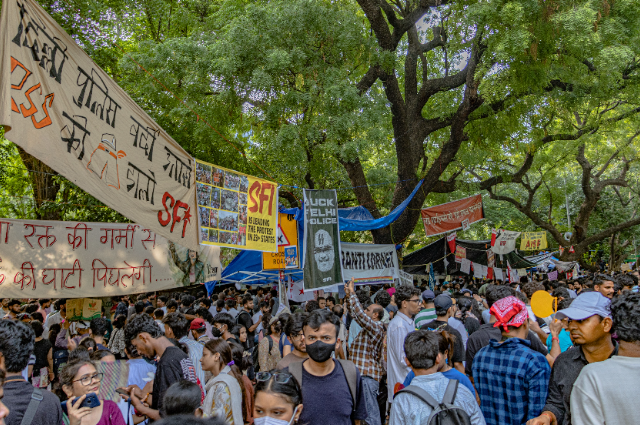
Recently, a student-led protest movement has emerged in India and has caught the attention of everyone in the country. The initial protests by the youth were against paper leakages in examinations and lack of transparency in the education system which eventually took shape of a movement demanding transparency from all public organisations. At the forefront of this movement lies the Janta Party (CJP), a student organisation whose marches have attracted huge crowds and debate regarding issues of education, governance, and civic rights.
This movement received a lot of media attention after staging a massive march towards Parliament of India in New Delhi. Although there were strict security arrangements, restrictions on public gatherings, and problems in metro transportation in some parts of the city, the march continued. They demanded reforms in the examination system and accountability from government officials. Thus what started as a student issue has now become one of the most watched civic movements in India.
Indian educational institutions have a large number of students each year vying for seats in educational institutions and government employment. The reliability of entrance examinations and recruitment exams has assumed great importance since they decide educational and career prospects.
Many examinations have faced controversy due to the leak of question papers and administrative failures in the past few decades. This has led to the cancellation of examinations and delays in the process of recruitment. These problems have left many young students disappointed since they devote many years to prepare for such challenging examinations.
These issues are preparing and mere administrative problems for many youngsters.
Emergence of the Cockroach Janta Party (CJP)
The Cockroach Janta Party (CJP) is a protest movement by youths rather than a political party. As per reports, the unusual name of the organisation resulted from an insulting statement in which people calling themselves cockroaches. It has to be mentioned that accounts of the statement have differences; however, the movement managed to use the name successfully in order to unite students from different universities and examination centers.
In contrast to traditional political movements, the organisation has been using social media to call for protests, recruit volunteers, and provide news and updates about the activities.
The main demands of the movement are related to transparency in examinations, protection from malpractices in examinations, prompt investigation of leaks, and punishment of those responsible for poor administration.
One of the major demonstrations of the movement included a march towards the Indian parliament in the city of New Delhi. According to the organizers of the event, it was organized in order to borganisersul demonstration that organisedw the problems of students to the national lawmakers.
Strict security measures were taken on the streets through which the demonstration took place; such measures included traffic management and additional police presence. Some reports have even mentioned disruptions in metro services in some parts of the capital city.
Despite all these restrictions, thousands of demonstrators came with banners, posters, and national flags, highlighting the slogans of educational reform, fair examination process, and accountability in the education system.
When the demonstrators tried to pursue their demonstration march, there was an encounter between the security forces and some of the protesters. The media reported on the deployment of crowd control measures like the use of tear gas and baton charges, although the government said that such steps were taken to implement restrictions on the demonstrations and ensure public safety.
The protesters accused the police of taking this step when they were exercising their democratic right of assembly. Human rights campaigners and civil society also raised concerns about public safety versus the constitutionally protected right of protest.
There were debates on television channels, print media, and the Internet about the legitimacy of the protesters' demands against certain aspects of the demonstrations and the way they were organised.
The Indian government responded to the worries about examination fraud and noted that there were actions taken by the authorities aimed at making the system of competitive exams more reliable. Representatives of the government underlined the current investigation into the issues of paper leaks and noted the legislative and administrative changes which should help avoid such cases in the future.
Despite this, protesters insisted that the government took further steps and demanded the resignation of Education Minister Dharmendra Pradhan because he should bear administrative responsibility along with the reforms made. But the representatives of the government did not find these demands appropriate.
It is one of the key issues of this movement.
The emergence of CJP clearly shows how young people are increasingly becoming part of the shaping of public discourse in India. Student movements have always played an important role in influencing the debate about issues such as education, employment and social justice, and contemporary protests are no exception.
Digital communication technology has provided students with an enhanced capacity for organising quickly, sharing information and mobilising supporters irrespective of geographic location. Social networking sites have allowed protesters to coordinate their protests, report events and communicate with national audiences through digital media.
The protests have shown wider concerns of the youth in India over employment prospects and access to quality education.
Although the movement has been gaining much-needed attention, there are still many problems facing CJP. First is the problem of keeping people interested, having peaceful rallies, and turning the attention of the masses into real policy changes.
On top of that, because the CJP is operating in an already highly politicised atmosphere, its organizers will have to deal with conflicting stories, organisational pressure, and limits placed on the demonstration itself.
Ultimately, the success of this movement will be defined by how well the demands turn into institutional change and not just political attention.
The emergence of the Cockroach Janta Party is indicative of the fact that local students’ concerns could eventually result in a national civil movement. While the initial focus was on the problem of examination integrity and fair education, the movement has turned into a wider discussion regarding the issues of accountability, democracy, and the interaction between young citizens and public organisations.
Regardless of the varying political views, the movement has emphasised the need for public trust in those examinations which determine the destinies of millions of students. With the ongoing negotiations between the protesters and the representatives of the government, the main contribution of the movement will be assessed not only in terms of demonstration size, but also in terms of future educational reforms.
References:
- https://www.aljazeera.com
- https://www.youtube.com/shorts/HptEHeW-o34
- https://www.instagram.com/reels/DbDbDqBj2Pq/
- https://www.aljazeera.com
- https://www.bbc.com/news/articles/cedj9j911p8o