
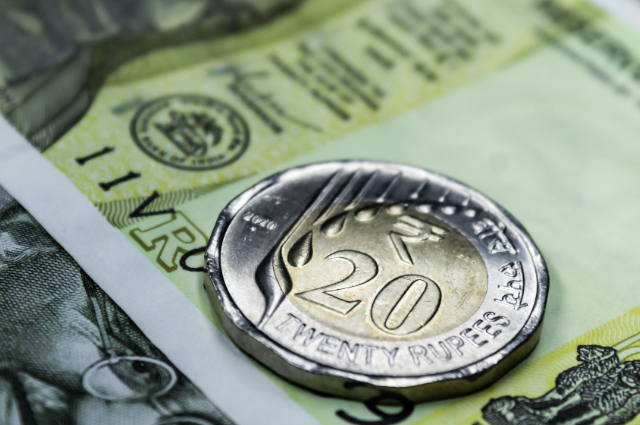
Despite this, there is no question that the Indian rupee is more valuable than the Pakistani rupee, even though the difference between the two currencies has become very small. For example, as of May 2025, one Indian rupee could be exchanged for 3.3 Pakistani rupees, while by September 2026, it had almost gone down to 2.9.
Of course, this fact means nothing because the currency of Pakistan has become stronger than the Indian currency. There are no independent exchange rates. Therefore, the currency of any country can be compared only with another currency.
As for India, 2026 was a year of challenges for this country. Indeed, compared to the American dollar, the rupee has been depreciating fast. In particular, the currency has recently been worth around ₹96 per dollar. On September 10, 2026, the rate was ₹95.44 for one dollar, but the rupee depreciated for the third successive session. As reported by Reuters, high oil prices, high demand for the dollar, and high yields on the U.S. Treasury bonds have been causing depreciation of the rupee.
What causes rupee depreciation in India?
There are several other pressures on the rupee working at the same time. The first major problem is India's need for crude oil imports. As prices of oil internationally go up, Indian importers will require more dollars to fund the purchases. This leads to higher dollar demand and causes pressure on the rupee.
As geopolitical situations in the Middle East heat up in September 2026, the price of Brent crude approaches $110 per barrel, and Reuters reports that during the week, it has increased by nearly 12%. Thus, oil becomes another serious immediate threat to the rupee.
Another pressure on the rupee originates from the United States due to higher inflation and Treasury yields in the country. As dollar-based assets get more attractive for international investments, money flows into the dollar and weakens the rupee and other emerging markets' currencies.
The third pressure is caused by foreign investments, as foreign investors have withdrawn funds from Indian equity. Thus, another source of dollar inflows disappears for India.
The trade wars are another source of uncertainty. The earlier tussle between India and the US involved tariffs as high as 50% during that particular tariff episode. Even though the structure of the tariff has since evolved, the tariff episode has exerted pressure on India's trade outlook.
The Reserve Bank of India has come to the rescue of the currency several times to avoid a disorderly decline. According to a report by Reuters, the RBI had sold at least $8 billion recently to help the rupee, while government-owned banks have been found to be selling dollars on behalf of the RBI.
Foreign exchange swaps have been another tool employed by the RBI for managing liquidity and helping the currency. However, such methods might help in slowing down depreciation but cannot stop expensive oil or a stronger dollar.
This is not the first time the rupee has weakened.
The depreciating value of the Indian Rupee is not merely a concern of 2026 but a reality that the Indian Rupee has faced for decades now with respect to U.S. Dollars.
The Indian Rupee became more market-oriented due to the liberalisation policies that were followed by India in the early 1990s. From then on, the value of the Indian Rupee has been declining vis-à-vis the U.S. Dollar, except for some individual years when there has been appreciation.
This can be seen clearly from RBI historical data, with the annual average exchange rate being ₹31.45 to the U.S. dollar in 1993 and rising to ₹78.60 in 2022.
This long-term trend of depreciation is not necessarily an indication of the poor economic performance of India, because various factors affect exchange rates. These include inflation differences across nations, productivity variations, capital flows, oil prices and global interest rates.
It is crucial to note that depreciation of the rupee has historically followed a steady pattern, with the current depreciation following the trend.
Meanwhile, the rupee in Pakistan has shown relative stability.
The rupee in Pakistan has also had its history of depreciation, especially when there have been shortages of foreign exchange, high levels of inflation, and financing issues. However, it has been relatively stable recently.
IMF programme for Pakistan has made a significant contribution in this regard. According to the IMF in May 2026, successful implementation of policies contributed to the maintenance of economic stability and improvement in the financing and external situation. IMF programme also helped Pakistan build up foreign exchange and fiscal buffers.
Gross foreign exchange reserves in Pakistan rose from approximately $14.5 billion to a projected $20.9 billion according to IMF data.
Remittances have continued to be another significant source of foreign currency for Pakistan. The improved balance of its external account and reserve position has helped to mitigate some of the stress that had been exerting downward pressure on the Pakistani rupee.
This is relevant when considering the two currencies. Although the Pakistani rupee is not appreciating significantly, it may continue to appreciate against the Indian rupee when the latter is depreciating much faster.
So, is the Pakistani rupee now stronger?
Not exactly.
This is the simplest way to put it: one Indian rupee will buy some Pakistani rupees, but fewer Pakistani rupees than a year ago.
Why is this relevant? Because we can’t just look at the INR-PKR exchange rate and conclude who has a better economy.
Because the value of currency in numbers is not indicative of the nation’s economic might. For instance, the currency of Japan is valued in dollars lower than that of many developing nations, but that doesn’t mean that Japan is less economically developed.
It is more important to consider the trend of the currency, inflation, foreign reserves, balance of trade and investments, interest rates, etc.
For India, the current weakness is due to a combination of factors external to the economy, such as high costs of energy, a strong US dollar, foreign capital flows and foreign trade uncertainties. RBI still enjoys a good reserve position and the ability to intervene in the situation to provide enough cushion against foreign exchange risks.
For Pakistan, IMF-supported policy changes and a better external financing environment have provided some stabilisation of the rupee. However, this has been conditional on further policy restraint, external funding and the capacity of Pakistan to accumulate reserves.
The gap is closing, and this is the true story.
As far as the INR-PKR exchange rate dynamic goes, the most exciting point here is not the fact that the Pakistani rupee became stronger than the Indian one. This is not true.
The main thing to be noted from all this is that the difference between the two currencies has narrowed quite a bit.
A year back, one INR would be worth approximately 3.3 PKR. Today, it is worth only 2.9 PKR. On the other hand, INR is at its lowest level with respect to USD.
This is not to say that India has entered a currency crisis or that Pakistan has solved its economic challenges. Both currencies are vulnerable to inflation, the price of oil, the interest rates in the rest of the world, and political and economic uncertainty.
Nevertheless, the exchange rate development is meaningful. It indicates how fast the positions of the two currencies can be reversed in favour of one against the other under conditions of greater pressure on one economy and stability in another economy.
Right now, the rupee of India still outperforms the rupee of Pakistan in nominal terms. However, the disparity between the two currencies is not as significant as it used to be. Under the continuing weakening of the Indian currency and stability in Pakistan's exchange rate, the gap will decrease even more.
Thus, the exchange rate conveys a much more complex picture than "which currency is stronger."
References:
- https://www.reuters.com
- https://www.reuters.com
- https://www.reuters.com
- https://www.elibrary.imf.org
- https://www.imf.org
- https://www.reuters.com
- https://www.reuters.com